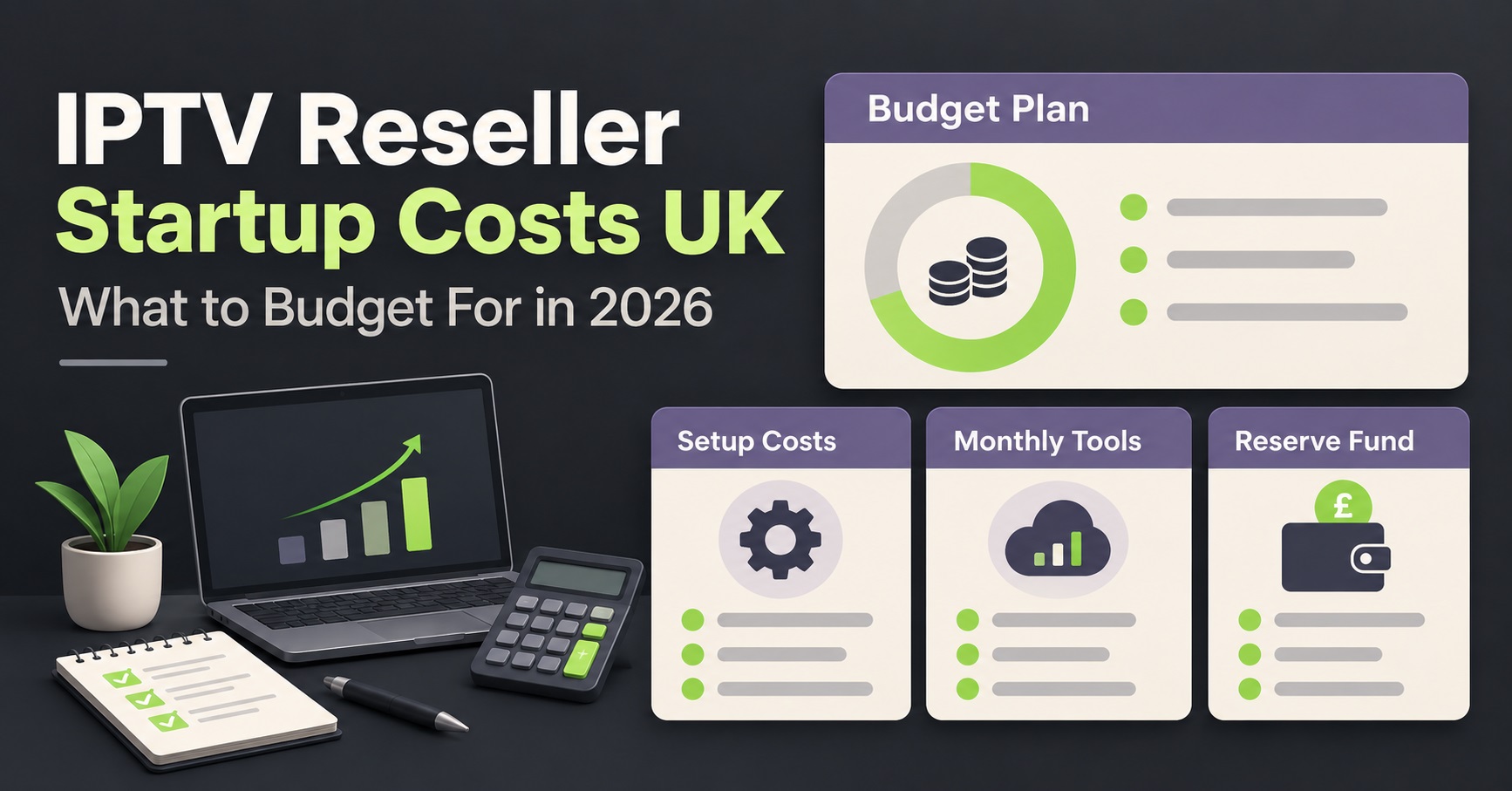
IPTV Reseller Startup Costs UK depend far less on the panel price than most beginners assume, and far more on how much time, testing and buffer money they set aside before their first customer signs up. A starter credit pack might only cost you sixty pounds, but the business around it (support, payment handling, a few weeks of trial and error) is where the real budget usually goes missing.
What Actually Goes Into IPTV Reseller Startup Costs UK
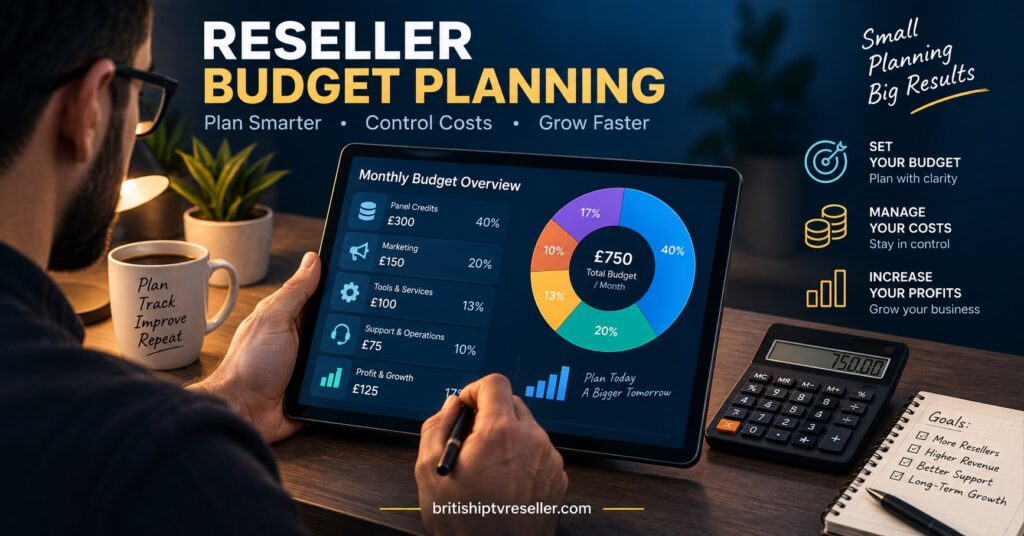
Most people search this phrase expecting a single number. There isn’t one, because the panel is only one line item on a longer list. A realistic launch budget has to account for credits, some form of branding, the hours you’ll spend answering messages before you have a rhythm, a way to collect payment that doesn’t fall over, a testing period where you’re not making money, and a cushion for whatever goes wrong in month one. Skip any of those categories and the “cheap” launch tends to get expensive fast, usually through refunds and lost customers rather than a single bad invoice.
Panel and Credit Costs: The Core Expense
Credits are the one cost most people research properly, so they’re rarely the surprise. Entry-level packs typically sit somewhere in the tens of pounds, with volume pricing improving as you commit to larger batches. The mistake isn’t underestimating this number, it’s treating it as the whole budget. Credits buy you the ability to activate subscriber lines. They don’t cover anything else on this list, and a reseller who spends their entire starting budget on the biggest possible credit pack often has nothing left when a customer needs help two weeks later.
Pro tip: Buy a smaller credit pack for your first month than you think you need. It’s cheaper to top up again once you know your actual customer acquisition rate than to sit on unused credits.
Branding and White Label Setup
You don’t need a branding budget to start, but most IPTV panel resellers who last more than a few months eventually spend something here, even if it’s modest. That might mean a simple logo, a landing page, or a WhatsApp Business profile that looks like a real operation rather than a personal number. None of this needs to be expensive. A basic logo and a one-page site can realistically be put together for very little if you do it yourself, or a bit more if you pay someone else to handle it. Where costs climb is custom domain branding on the panel itself, which some providers include and others charge extra for depending on the plan tier.
| Cost category | Typical range | What affects it |
|---|---|---|
| Starter credits | Low tens of pounds | Pack size, provider pricing tier |
| Branding basics | Free to a modest one-off fee | DIY versus hiring, domain and logo needs |
| Payment processing | Small percentage per transaction | Processor chosen, transaction volume |
| Contingency buffer | Roughly 15 to 25 percent of total budget | Risk tolerance, how tested your setup already is |
Support Time: The Cost Nobody Budgets For
This is the category new resellers consistently underestimate, and it isn’t a cash cost, it’s a time cost that eventually becomes a cash cost once you can’t keep up alone. In the first few weeks, expect setup questions, buffering complaints that turn out to be a customer’s home broadband rather than your service, and requests to switch devices. If you’re doing this solo, that’s realistically an hour or two most days early on. Once you pass a few dozen active subscribers, that time cost either grows into a second job or turns into an actual line item when you bring someone else in to help answer messages. Budgeting for support doesn’t mean paying for it from day one. It means being honest about how many hours you can personally give before quality slips, because a reseller who goes quiet on support tends to lose customers faster than one who’s slightly more expensive.
Payment Processing and Getting Paid
However you collect money from subscribers, something takes a small cut or carries a small risk. Card processors and payment links typically charge a percentage per transaction. Bank transfers avoid that fee but slow down your onboarding, since customers have to actively send money rather than tap a button. Some resellers start with informal payment methods and formalise this later, which is fine early on but becomes harder to manage once volume increases and refund requests start needing a paper trail. Whatever you choose, factor the transaction fee into your subscriber pricing rather than discovering it’s eating your margin after the fact.
Testing Before You Sell
Set aside both time and a handful of credits purely for testing, not selling. That means putting the service on your own devices, checking how it behaves on a weaker connection rather than only your best one, and confirming that your support process actually works before a paying customer tests it for you. This period isn’t wasted money even though it produces no revenue. It’s the difference between finding a problem yourself and having a customer find it for you in their first week, which is a far more expensive way to learn the same lesson.
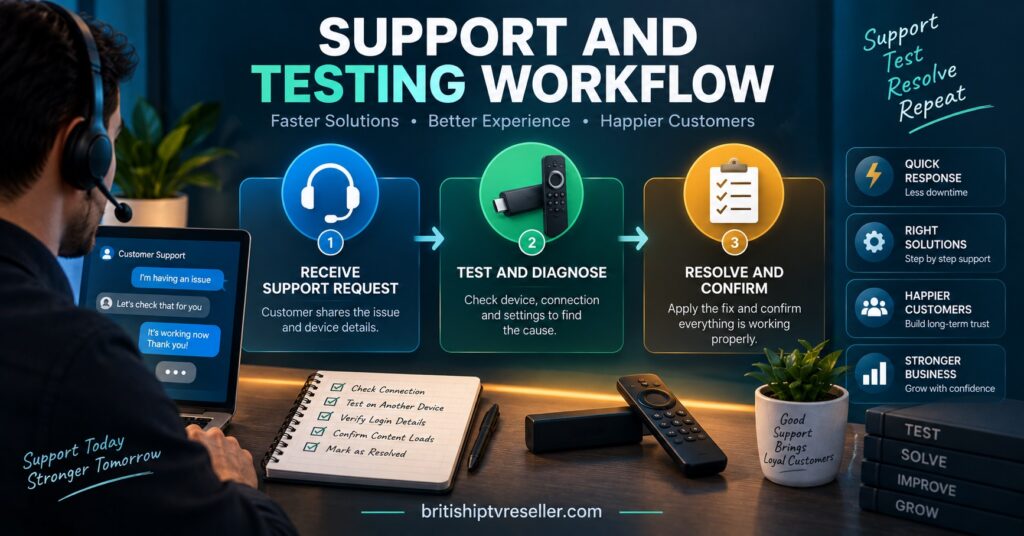
Pro tip: Test on the device your target customers are most likely to use, not the device that’s easiest for you. If most of your early interest is coming from Firestick users, test on a Firestick first.
Building In a Contingency Buffer
A contingency buffer isn’t optional padding, it’s what stops a single bad week from ending the business before it’s properly started. Refund requests happen even with a solid setup. A device turns out to be incompatible with a particular player. A customer disputes a payment. None of these are catastrophic on their own, but if your starting budget has nothing spare, one of them can wipe out your first month’s margin entirely. A buffer in the range of fifteen to twenty five percent of your total starting budget gives you room to absorb the ordinary friction of a new operation without panicking or cutting corners on support.
Three Realistic Launch Budgets
A cautious solo launch, testing the model with a handful of customers before committing further, tends to keep total spend modest by starting with a small credit pack, free or near-free branding, and a longer testing window before any paid marketing.
A steadier mid-range launch usually adds a proper landing page, a slightly larger credit pack bought at better per-credit pricing, and a small amount set aside specifically for payment processing fees and a first-month contingency buffer.
A more committed launch, aimed at scaling quickly rather than testing gradually, typically front-loads a larger credit purchase to access volume pricing, invests properly in branding from the start, and holds a larger contingency buffer because higher subscriber numbers mean higher exposure if something goes wrong in the first few weeks.
None of these figures should be treated as fixed. Your actual costs depend on the IPTV reseller panel and credit pricing you choose and how much of the setup you’re willing to do yourself versus paying for.
Reseller Checklist Before You Commit Budget
- Confirm your starter credit pack size matches your realistic first-month customer target, not your ambition
- Decide how you’ll collect payment and check the actual transaction fee before pricing your subscriptions
- Set aside dedicated testing time on the devices your early customers are most likely to use
- Work out how many support hours you can personally give before quality drops
- Hold back a contingency buffer rather than spending your entire budget on launch day
- Read through how IPTV panel reselling actually works before finalising numbers, so your budget matches the real workflow rather than assumptions
Frequently Asked Questions
Do I need a big budget to start reselling IPTV in the UK?
No. A starter credit pack is inexpensive, and much of the rest of the setup (branding, payment methods, a basic support process) can be built with time rather than money. The bigger risk is underbudgeting the ongoing costs like support and contingency, not the initial outlay.
What’s the most commonly forgotten cost when people plan an IPTV reseller launch?
Support time. New resellers usually price out credits and branding carefully but don’t account for how many hours early customer questions will take, or what happens to service quality once that time runs out.
Should I spend on branding before I have any customers?
Basic branding is worth doing early because it affects how trustworthy your service looks, but expensive branding can wait. A simple, clean setup is usually enough until you’ve proven the model works.
How much contingency should I actually hold back?
There’s no fixed figure that suits everyone, but treating roughly fifteen to twenty five percent of your total starting budget as untouchable reserve gives you room to handle refunds, device issues, or a slow first few weeks without derailing the business.
Is it worth paying more for a larger credit pack right away?
Only if you’re confident in your customer numbers. Volume pricing does improve your per-credit cost, but an oversized pack sitting unused ties up money that would be better spent on testing, support capacity, or your contingency buffer. Check current refund and credit policy details before committing to a larger purchase.
Conclusion
IPTV Reseller panel Startup Costs UK come down to six categories that matter far more together than any single price tag: credits, branding, support time, payment processing, testing, and a contingency buffer. The credit pack is the easiest part to research and the least likely to catch you out. The categories that quietly decide whether a launch survives its first month are the ones with no fixed price, support hours and the buffer you hold back for the ordinary things that go wrong. Build your budget around ranges rather than a single exact figure, keep enough spare capacity to absorb a rough first few weeks, and scale your credit purchasing once you actually know your customer numbers rather than before.