

Here’s a claim I’ll defend for the next three thousand words: the technology is no longer the hard part. Anyone can rent capacity. What separates a hobbyist from an operator is whether customers remember your name a year later, and that’s precisely the gap a white label IPTV reseller arrangement is designed to close. You get infrastructure that someone else maintains, wrapped in a brand that belongs entirely to you.
I’ve spent fifteen years watching the telecoms and streaming space churn through business models, and this one keeps surviving because the maths is honest. A white label IPTV reseller doesn’t sell a stream. They sell reliability, a recognizable storefront, and a human being who picks up when something breaks. That last part is worth more than most newcomers realize.
What a White Label IPTV Reseller Actually Sells
Let’s clear up the vocabulary first, because the industry is sloppy with it.
A plain reseller buys allocation from a supplier and passes it along under the supplier’s identity. Customers see the supplier’s panel, the supplier’s login page, sometimes even the supplier’s support email. You’re a middleman, and everyone can tell.
A white label IPTV reseller operates differently. The backend belongs to a vendor, but the front door belongs to you: your domain, your logo, your pricing page, your customer relationships. The technical infrastructure stays invisible. From where the customer stands, you built the whole thing.
That distinction sounds cosmetic. It isn’t. Brand ownership changes your renewal rate, your ability to raise prices, and whether you can ever sell the business you’re building. A white label IPTV reseller who keeps their customer list keeps an asset. A plain reseller keeps a spreadsheet.
There’s a practical side too. When you control the branding layer, you control the messaging. You can position yourself around the UK market specifically, or around families, or around technically confident users who want a clean setup and nothing else. Vendors serve everybody. You get to serve somebody.
The Night I Stopped Competing on Price
A few years back I was advising a small operator in the Midlands who’d been undercutting everyone in his region by about twenty percent. Volume was climbing. He was thrilled. Then he showed me his support inbox at eleven on a Tuesday night, and there were forty unread messages.
His customers weren’t loyal. They’d come for the cheapest number on the page and they’d leave for the next cheapest number the following month. He’d built a queue, not a client base.
We rebuilt his positioning as a white label IPTV reseller with a proper brand, a real support process, and prices about fifteen percent above the regional average. He lost roughly a third of his customer base in six weeks. He also stopped working past nine at night, and his revenue per customer nearly doubled within a quarter.
Was that comfortable? Not remotely. But it taught me something I now repeat constantly: the cheapest provider in any market is always temporary, because someone poorer and hungrier is always coming.
Nine Advantages Worth Weighing Before You Commit
I’m wary of listicles that read like sales sheets, so treat these as claims to interrogate rather than promises to accept.
- Brand equity accumulates. Every satisfied customer strengthens something you own rather than something you rent.
- Pricing freedom. You set your own tiers, bundles and promotional cycles without asking permission.
- Lower technical overhead. Server management, load balancing and uptime monitoring sit with the infrastructure vendor.
- Faster launch. A white label IPTV reseller can be trading within days rather than the months a self-hosted build demands.
- Customer data stays yours. You keep the emails, the renewal dates and the purchase history.
- Support becomes a differentiator. Responsive help is the easiest competitive moat in this sector, and almost nobody bothers.
- Scalability without capital. Growth costs credits, not hardware.
- Exit potential. Branded operations with recurring revenue can genuinely be sold. Anonymous ones rarely can.
- Room to diversify. The same brand can later carry adjacent services without confusing your audience.
Notice what’s missing from that list. I haven’t promised passive income, and I haven’t suggested this is easy. It’s a business, and businesses are work.
Where the Real Margin Hides
Most newcomers obsess over the wholesale cost per credit. It’s the wrong number to fixate on.
Your margin lives in three places that have almost nothing to do with your supplier invoice. Retention is the first, because acquiring a customer costs roughly five to seven times what keeping one does, a ratio that Harvard Business Review has been citing for decades and that holds up uncomfortably well in subscription services.
Average revenue per user is the second. A customer on a twelve month plan is worth dramatically more than twelve customers on one month plans, and not just arithmetically. They’re cheaper to support, cheaper to bill, and far less likely to churn on a whim.
Operational efficiency is the third. If it takes you twenty minutes to onboard a customer manually, you’ve capped your own growth with your own calendar. The best white label IPTV reseller operations I’ve seen automate provisioning, welcome emails and renewal reminders before they chase their hundredth customer.
Here’s a question worth sitting with: if you doubled your customer count tomorrow, would your workload double too? If the answer is yes, you haven’t built a business yet. You’ve built a job with worse hours.
Panel, Payments and Support: The Three Pillars
Everything operational rests on these three, and weakness in any one of them will quietly cap your growth.
The panel
Your reseller panel is the engine room. It handles credit allocation, line creation, expiry tracking and the day to day mechanics of running accounts. Speed matters enormously here, because a sluggish panel translates directly into slow customer onboarding.
Look for clean credit accounting, sensible sub reseller controls if you plan to build a downstream network, and an interface you can actually explain to a part time assistant. Anything that requires a tutorial every time you use it will cost you hours across a year.
A white label IPTV reseller should also confirm what happens during vendor maintenance windows. Ask directly. Vague answers tend to become outages later.
Payments
Payment processing is where a surprising number of operations stall. Traditional gateways are cautious about this sector, and a frozen account with three hundred active subscribers is a genuinely miserable experience.
Build redundancy from day one. Run at least two viable payment routes, keep your business documentation tidy, and if you’re operating a UK entity, make sure your Companies House registration and business banking are properly aligned. Cutting corners here creates problems that no amount of good streaming quality can fix.
Support
This is the pillar most people underinvest in, and it’s the one customers actually judge you on. Set explicit response windows, publish them, and then beat them. Two hours is achievable with the right tooling. Two days is how you train customers to look elsewhere.
Comparing the Three Common Reseller Routes
I find people understand the choice far better when it’s laid out plainly rather than argued.
| Factor | Basic Reseller | White Label Reseller | Fully Self Hosted |
|---|---|---|---|
| Startup cost | Very low | Low to moderate | High |
| Time to launch | Days | Days to weeks | Months |
| Brand ownership | None | Complete | Complete |
| Technical skill needed | Minimal | Moderate | Extensive |
| Control over pricing | Limited | Full | Full |
| Infrastructure burden | Vendor | Vendor | You |
| Customer data ownership | Usually vendor | You | You |
| Realistic scale ceiling | Low | High | Very high |
| Resale value of business | Negligible | Meaningful | Meaningful |
Read that table honestly and the middle column looks like an obvious winner. It usually is, but not always. If you’re genuinely technical, well capitalised and planning to operate at serious scale, self hosting gives you margins nobody else can touch. If you just want pocket money from a dozen friends, basic reselling is fine and the white label overhead would be wasted effort.
Everyone in between, which is most people, lands in that middle column. That’s not marketing. It’s just where the risk and reward curves intersect.
The Trade Offs Nobody Puts in the Sales Pitch
I promised nuance, so here it is.
Vendor dependency is real. When your infrastructure partner has a bad week, your customers hold you responsible, because your name is on the invoice. That’s the price of the branding advantage, and you can’t have one without the other. Mitigate it by choosing partners with transparent status reporting and by being honest with customers when things go wrong. People forgive outages. They don’t forgive silence.
Regulatory complexity is the second thing worth understanding properly. The streaming distribution space in Britain sits under real scrutiny, and Ofcom has been increasingly vocal about content distribution standards and consumer protection across online services. Anyone building in the iptv UK market should understand exactly what they’re distributing and under what authorisation, and should structure their operation accordingly. A white label IPTV reseller carries the brand, which means they also carry the reputational exposure.
Market saturation is the third. Search for the best iptv subscription options in any competitive region and you’ll find hundreds of nearly identical offers with nearly identical claims. Differentiation has to come from somewhere other than features, because the features are largely the same everywhere.
And then there’s the churn reality. Even well run subscription businesses in adjacent sectors report monthly churn in the mid single digits, with Digital TV Research repeatedly flagging retention as the defining challenge for over the top services worldwide. Plan for it. Budget for it. Don’t be surprised by it.
Building Trust in a Crowded UK Market
British customers are, in my experience, unusually sensitive to signals of legitimacy. They notice a missing address. They notice a contact page with no phone number. They notice when your terms of service reads like it was pasted from somewhere else.
So give them the opposite. A real business name, visible on your site. Clear refund terms written in plain English. Response times you actually honour. A support presence on whichever channel your audience prefers rather than the one you find convenient.
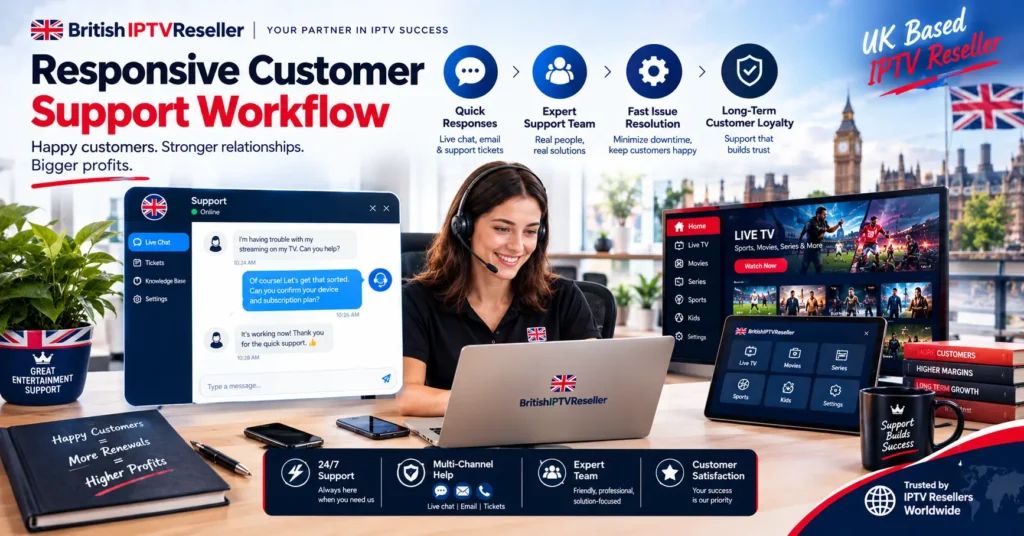
Reviews matter more here than in most sectors, precisely because trust is scarce. Ask satisfied customers directly, at the moment they’ve just told you something worked. That moment passes quickly.
Competing for terms like best british iptv is brutally difficult through search alone, and I’d gently suggest most new operators shouldn’t try. Referral, community presence and word of mouth compound far faster for a small brand than a head on content fight with entrenched competitors. Build the reputation first. The search traffic follows a reputation, not the other way round.
Ask yourself what a prospective customer sees in the first ten seconds on your site. Is there a single element there that a scam operation couldn’t replicate in an afternoon? If not, that’s your homework.
Is a White Label IPTV Reseller Model Right for You?
Not for everyone, and I’d rather say that plainly than sell you something that doesn’t fit.
This model suits you if you enjoy customer relationships, you’re willing to be responsive, and you’re building with a two to three year horizon rather than a two to three month one. It suits people who are comfortable with modest technical tasks: configuring a domain, setting up email, understanding what a panel is doing. It suits anyone who already has an audience, a community or a network they can serve honestly.
It doesn’t suit you if you want something entirely hands off. It doesn’t suit you if you’re unwilling to research the legal framework in your operating market. And it doesn’t suit anyone hoping to get rich in a quarter, because the operators I know who’ve done well took eighteen months to get there.
The deciding factor, honestly, is temperament rather than skill. A white label IPTV reseller who answers messages within the hour will outperform a technically brilliant competitor who answers within the week. Every single time.
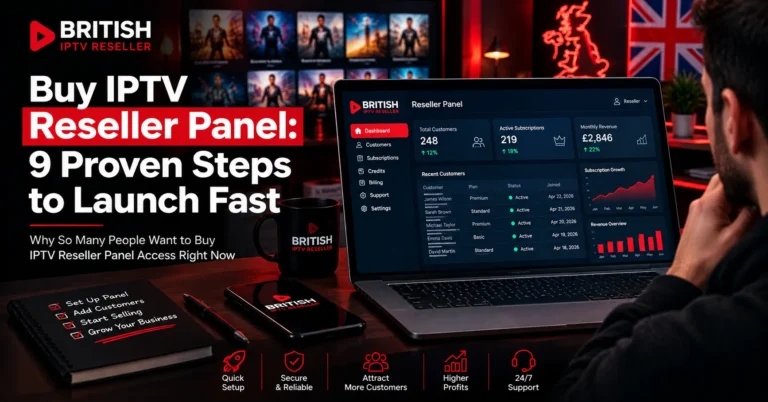
Why So Many People Want to Buy IPTV Reseller Panel Access Right Now Guide → /buy iptv reseller panel
Frequently Asked Questions
What does a white label IPTV reseller need to get started?
You’ll need three things at minimum: a reliable infrastructure partner, a domain with proper branding, and a working payment route. Beyond that, a simple support system and a clear pricing structure will carry you a long way. Most operators overestimate the technical requirements and dramatically underestimate the customer service commitment. Budget your time accordingly, because the first three months are the busiest.
How much can a white label IPTV reseller realistically earn?
Earnings depend almost entirely on retention rather than headline pricing. A modest base of a hundred well served customers on annual plans can outperform four hundred monthly customers who churn constantly. Your revenue per customer, your renewal rate and your support efficiency are the three levers that matter. Anyone quoting you guaranteed figures is selling something, and you should be sceptical.
Is the iptv UK market too saturated for new entrants?
Saturated at the generic level, yes, but not at the niche level. Broad competition for terms like best iptv subscription is fierce and largely won by established players with significant budgets. Smaller operators tend to succeed by serving a defined community extremely well rather than chasing everyone. Specificity is the advantage available to newcomers.
What’s the difference between a white label setup and a standard reseller account?
A standard reseller account puts the supplier’s branding in front of your customers, which means the relationship never fully belongs to you. A white label arrangement hides the infrastructure entirely and presents your brand at every touchpoint. The practical consequence is ownership: your customer list, your pricing authority and your ability to build something with resale value. The cost difference is usually smaller than people expect.
How do I choose an infrastructure partner I can trust?
Test before you commit, and test during peak hours rather than quiet ones. Ask specific questions about maintenance windows, escalation procedures and what happens during an outage, then judge the clarity of the answers as much as their content. Speak to existing clients if you can, and be wary of any partner who won’t allow that. Vague answers at the sales stage reliably become vague answers during a crisis.


[…] works in detail should read our White Label IPTV Reseller Guide: Margins, Panels and Trust → / white label iptv reseller. It explains why the same underlying service can appear under a dozen brand names at a dozen […]