An IPTV Reseller Free Trial Strategy only works if the trial length, the lead qualification step, and the follow-up timing are all designed together rather than bolted on separately. Most resellers treat trials as a giveaway and wonder later why so few convert. The truth is that a trial is a sales tool with a cost attached, and every hour you don’t manage deliberately is credit spent on someone who was never going to buy.
Why Trial Length Is the First Decision, Not an Afterthought
Most UK IPTV panel resellers default to 24 or 48 hours because that’s what they saw another panel offer, not because they worked out what the number needs to achieve. A trial has to be long enough for a genuine prospect to test the thing that actually worries them, usually buffering during peak hours and channel stability on their specific device, but short enough that it doesn’t become a free ongoing service.
A 24-hour window rarely covers a full evening of normal viewing plus a weekend peak, which means the prospect never sees the panel under real pressure. A 72-hour window shows more, but it also gives casual browsers three days to disappear without ever making a decision. Somewhere between 48 and 72 hours tends to strike the right balance for most reseller panels, long enough to include at least one evening peak period, short enough that follow-up still feels timely rather than like you’ve forgotten about them.
The right length also depends on what you’re actually testing. If your main selling point is channel breadth, a shorter trial with a specific bouquet works. If your selling point is stability under load, the trial needs to run through at least one high-traffic window, which for UK-focused reseller panels usually means a Saturday.
Qualifying Leads Before You Hand Over Access
Not every trial request deserves a trial. Handing out unrestricted access to anyone who fills in a form is how resellers end up burning credits on people who were shopping five other panels at the same time, or worse, people testing your service purely to find gaps to exploit.
A short qualification step doesn’t need to feel like an interrogation. Asking for a device type, a rough idea of how many connections they need, and how they found you gives you three useful signals in under a minute. Someone who can’t answer basic questions about their own setup is less likely to convert than someone who already knows they need two connections for a Fire Stick and a Smart TV.
Resellers who skip this step often see a wide gap between trial volume and paid conversions, and the gap is rarely about the panel’s quality. It’s about handing trials to people who were never realistic buyers in the first place.
Table: Matching Trial Length to Your Sales Goal
| Trial length | Best suited to | Trade-off |
|---|---|---|
| 24 hours | High trial volume, quick decision-makers | May not cover a peak viewing window |
| 48 hours | Most general reseller businesses | Requires a fast, well-timed follow-up |
| 72 hours | Prospects specifically testing stability | Higher risk of casual, low-intent sign-ups |
Stopping Trial Abuse Without Punishing Genuine Customers
Abuse is the part most guides gloss over, and it’s the part that actually determines whether a free trial program is sustainable. The usual pattern is the same person requesting trials repeatedly from different email addresses, or a single trial account being shared across a household or resold informally for the trial period.
Limiting one trial per device MAC address or per verified phone number closes off the most common workaround without adding friction for legitimate customers. Watching for identical IP addresses requesting multiple trials within a short window catches most of the rest. None of these checks need to be visible to the customer. They just need to run quietly in the background of your reseller dashboard so you’re not manually cross-referencing spreadsheets every time someone signs up.
Pro tip: Cap the number of active connections on a trial line lower than your standard package. A trial that mirrors your full package too closely gives away everything a household needs before anyone has paid for it.
It’s also worth deciding in advance what happens when abuse is confirmed rather than reacting case by case. A consistent policy, applied the same way every time, protects your credit balance and keeps your terms defensible if a customer disputes being cut off.
The Follow-Up Cadence That Actually Converts
A trial that ends without a follow-up message is a wasted trial, even if the person genuinely liked the service. People get distracted, forget the trial existed, or simply don’t think to come back and pay unless prompted at the right moment.
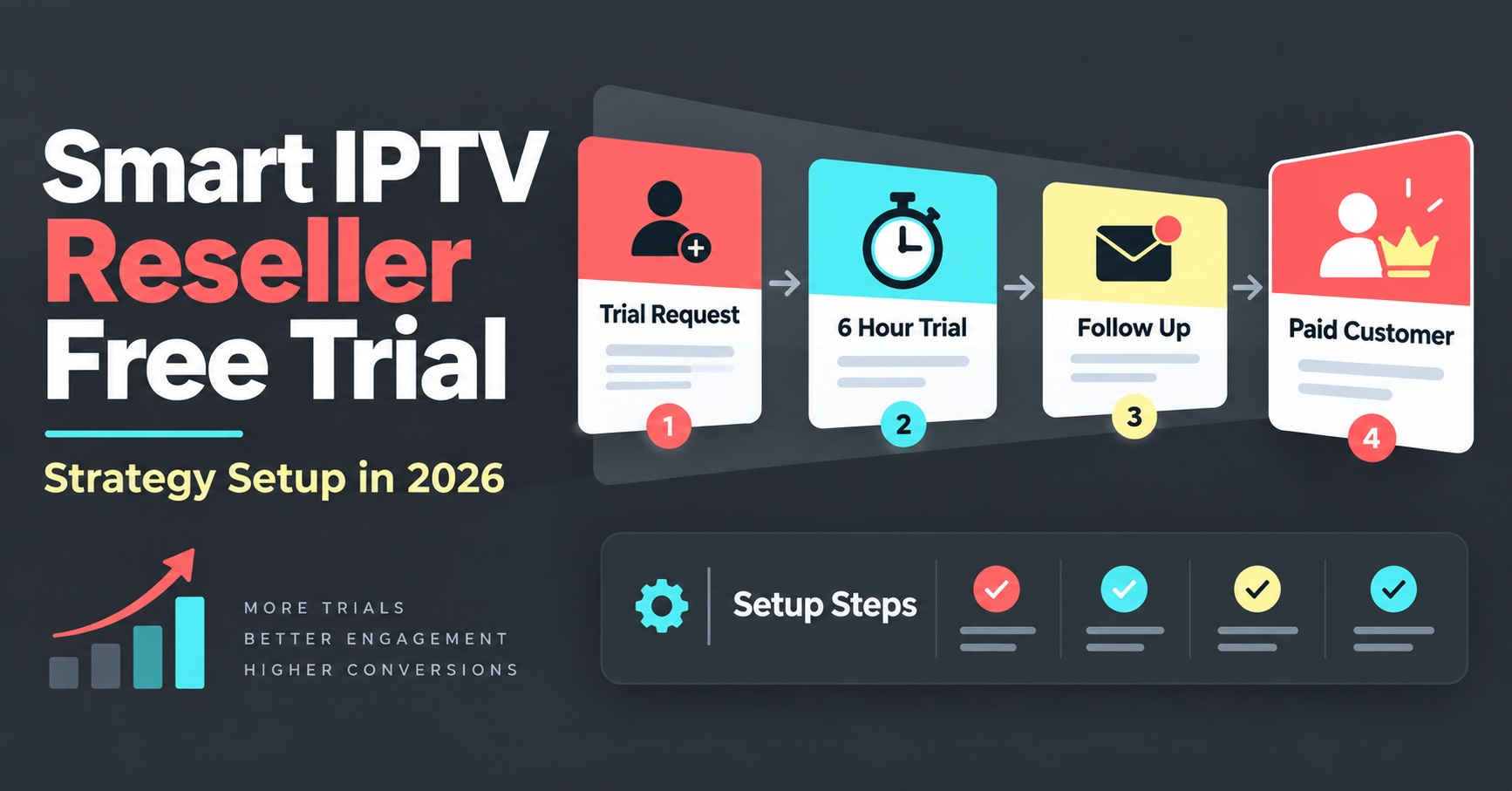
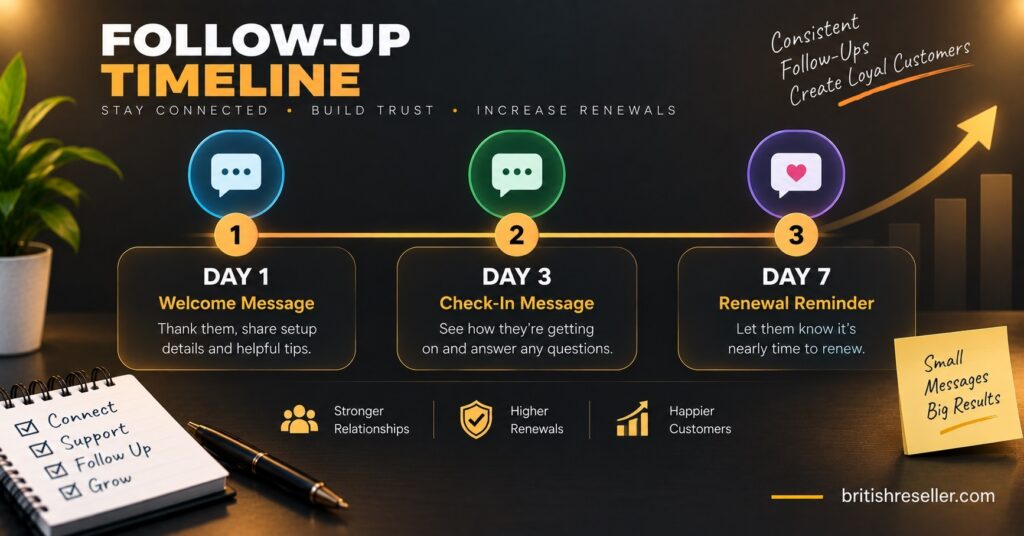
The most effective pattern isn’t a single message at the end. It’s a short sequence: a message roughly a third of the way through the trial checking whether everything is working correctly, a second message as the trial nears its end with a clear and simple way to convert, and a final message within a few hours of expiry for anyone who hasn’t responded. Spacing matters more than volume here. Three well-timed messages outperform five generic ones sent too close together.
Pro tip: Send the mid-trial check-in as a genuine support offer, not a sales nudge. Prospects respond far better to “is everything working alright” than to “don’t forget to upgrade.”
The tone of the final message also matters more than IPTV resellers usually expect. A blunt “your trial has ended, buy now” reads as transactional and gives the prospect nothing to respond to. A message that references something specific from their trial, the device they used or the package they were testing, feels like it came from a person who was actually paying attention.
Measuring Trial-to-Paid Conversion Properly
Tracking conversion by gut feeling is how resellers keep repeating the same mistakes. If you can’t say what percentage of trials convert, you can’t tell whether a change to trial length, qualification, or follow-up actually helped or just felt like it did.
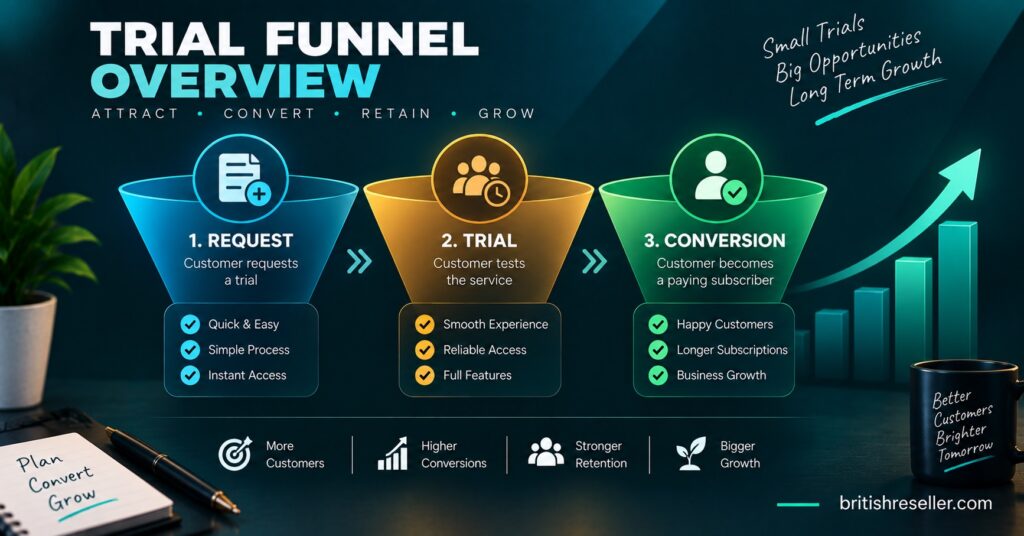
The simplest useful measurement is tracking three numbers against each other: trials issued, trials that reached the follow-up stage without being flagged for abuse, and trials that converted to a paid line within a set window, typically seven days after expiry. Comparing conversion rate month to month, rather than trial to trial, smooths out the noise from small sample sizes and shows whether your process is actually improving.
It’s worth separating conversion by lead source too. A trial requested through a WhatsApp referral will usually convert differently than one requested through a cold web form, and lumping them together hides which channels are actually worth your credit spend.
Reseller Trial Program Checklist
- Set a trial length that includes at least one peak viewing window
- Require a short qualification step before granting access
- Limit trial connections below your standard package
- Block repeat trials from the same device or verified contact
- Schedule a mid-trial check-in message
- Send a clear, low-pressure conversion message before expiry
- Track trials issued, flagged, and converted separately by source
Common Questions About Running IPTV Trials
How long should an IPTV reseller trial actually last?
Somewhere between 48 and 72 hours generally gives a fair test without becoming a free service, though the right figure depends on whether you’re proving channel breadth or peak-time stability.
Should trial customers get full access to every channel package?
Not necessarily. Offering a representative bouquet rather than the entire catalogue still lets a prospect judge quality while keeping something back for the paid tier.
What’s the fastest way to spot a fake or repeat trial request?
Matching device identifiers, IP addresses, and contact details against previous trial records catches most repeat attempts without needing manual review of every sign-up.
Is it worth offering a second trial to someone who didn’t convert the first time?
Only if something material changed, such as a new device or a specific issue that’s since been fixed. A second trial with no changed circumstances rarely produces a different outcome.
How do refund or cancellation terms interact with trial customers?
Trial users who convert to paid should still be pointed to your standard refund policy so expectations are set clearly before payment, not after a dispute arises.
A working IPTV Reseller Panel Free Trial Strategy comes down to treating the trial as a managed sales process rather than a free giveaway: the right length to prove your strengths, a light qualification step to filter genuine prospects, abuse controls that run quietly in the background, a follow-up sequence timed to when people actually decide, and conversion numbers you track by source rather than guess at. None of these pieces work well in isolation. Start with whichever one is weakest in your current process, fix that first, and measure the change before touching anything else.