Three summers ago, a reseller I’d been chatting with on a trade forum messaged me in a mild panic. Let’s call him Danny. He’d bought a cheap IPTV reseller panel at roughly half the going rate, loaded up two hundred credits, and signed forty customers in a fortnight. By week six he had eleven left, a pile of refund requests, and a supplier who’d stopped answering on Telegram.
So, is a cheap IPTV reseller panel a mistake? Not automatically. A low price is fine when it comes from lean operations and honest margins, and it’s a disaster when it comes from oversold servers, expiring credits and support that vanishes after checkout. The rest of this piece shows you how to tell the difference before your money, and your reputation, are on the line.
I’ve spent the best part of fifteen years writing about telecoms and streaming technology, and a fair chunk of the last few testing reseller dashboards first hand. What follows isn’t a ranking of brands. It’s the set of questions I wish Danny had asked before he clicked “buy”.
The Short Answer Before the Long Story
Price, on its own, tells you almost nothing. Two panels can both charge under a pound per monthly credit, and one will run happily for years while the other folds by spring.
What separates them is everything underneath the price tag. Who is the upstream IPTV provider, how much server capacity backs each credit, does the software give you real control over your customers, and what happens when something breaks at 9pm on a Saturday? A good cheap IPTV reseller panel is cheap because the operator runs efficiently, while a bad one is cheap because someone, somewhere, is cutting a corner you’ll eventually pay for.
Here’s the thing most first-time resellers miss. Your customer never sees the panel. They see the IPTV service on their TV, and if it buffers, freezes or disappears, they blame you, not the wholesale supplier you found on a forum.
Keep that single fact in mind, because it should shape how you judge every bargain that lands in your inbox.
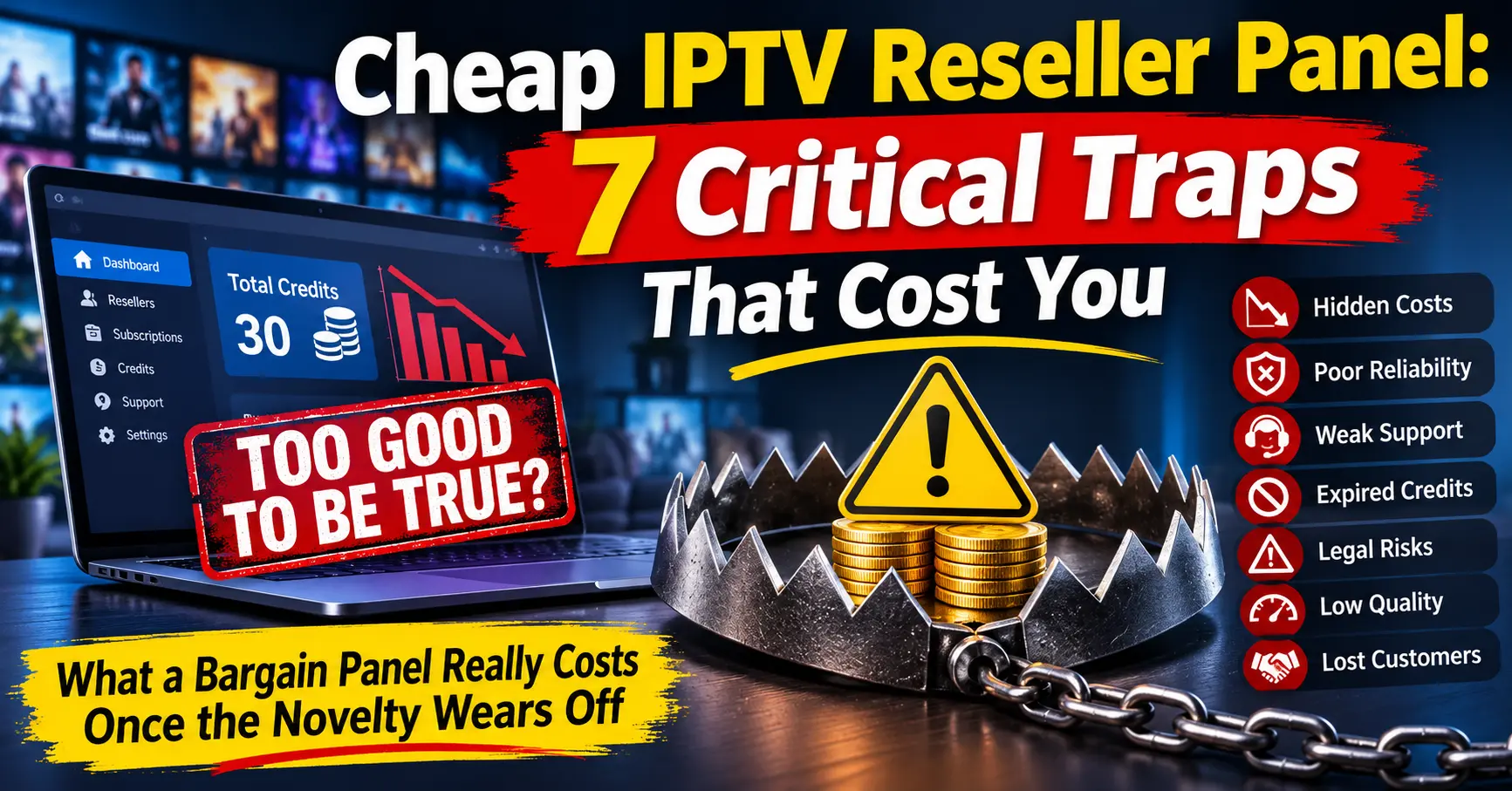
Seven Critical Traps Inside a Cheap IPTV Reseller Panel
Grouped roughly in the order they tend to bite, these are the problems I see again and again. Some are obvious once you know to look. Others hide in plain sight on the pricing page.
Trap One: Credits That Quietly Expire
Almost every cheap IPTV reseller panel I’ve reviewed sells credits in bundles, and a surprising number put a shelf life on unused ones. Buy five hundred credits at a lovely discount, sell two hundred in three months, and you may discover the remaining three hundred lapse at the end of the quarter. That “discount” has just become a loss.
Always ask, in writing, whether unused credits expire and whether they survive a price change. A panel that’s vague on this point is telling you something without saying it.
Pro tip: start with the smallest bundle that still gets you a usable rate, even if the per-credit price is slightly higher. A discount on a big bundle only matters if you actually spend it.
Trap Two: The Supplier Behind the Supplier
Plenty of so-called wholesale panels are themselves resellers of a larger IPTV provider, sometimes two or three layers deep. Each layer takes a margin, and each layer adds another point of failure you can’t see. When the top of the chain has a bad night, everyone underneath has one too.
How do you spot it? Look for branding that changes between the sales page and the dashboard, login domains that don’t match the company name, or support staff who need to “check with the team” for basic server questions. None of these prove anything alone, but a pattern of them usually does.
Trap Three: Uptime Claims With Nothing Behind Them
“99.9% uptime” costs nothing to type. I’ve seen it proudly displayed on a cheap IPTV reseller panel that went dark for an entire weekend, with no status update and no apology.
Ask for a public status page, and if there isn’t one, set up your own check with a free tool such as UptimeRobot during the trial period. A week of independent monitoring tells you more than any sales chat ever will. Keep the log, too, because it becomes useful evidence if you ever need to argue for credit compensation.
Trap Four: Support That Evaporates After Payment
Pre-sale support on budget panels is often brilliant. Replies arrive in minutes, the tone is friendly, and questions about bundle pricing get answered instantly.
Post-sale support is the real test. Before buying, send a technical question at an awkward hour, say late on a Friday, and time the reply. If it takes a day and a half when you’re a prospect, imagine how long it’ll take once you’re just another account in the queue.
Trap Five: A Dashboard That Fights You
Software matters more than most people expect. A decent panel lets you create trial lines, extend or suspend accounts, set connection limits, tag customers and pull basic reports without opening a support ticket. These aren’t luxuries; they’re the daily tools of the job.
Cheaper platforms sometimes strip these features out or bolt them on badly. You’ll spend evenings doing manually what a better dashboard does in two clicks, and your time has a price even if it never appears on the invoice. Ten minutes lost per customer each month adds up to whole days by the end of the year.
Trap Six: Costs That Don’t Appear on the Pricing Page
Minimum top-up amounts, fees for extra connections, charges for trial lines, currency conversion on payments made in dollars or euros. Individually small. Together, they can wipe out the saving that drew you to a cheap IPTV reseller panel in the first place.
My rule is simple: I ask for a full fee schedule before I compare any two panels. If a supplier can’t produce one, I assume the real price is higher than advertised, and I’m rarely wrong.
Trap Seven: The Questions Nobody Wants to Ask About Rights
This one’s uncomfortable, so it often gets skipped. Panel software is a technology product, and content licensing is a separate matter entirely. A cheap IPTV reseller panel doesn’t come with any rights to the streams that run through it, whatever the sales page implies.
In the UK, the Intellectual Property Office publishes clear guidance on copyright and online infringement, and Which? has repeatedly warned consumers about the security risks of unofficial streaming setups. Read both before you build a business on top of a supplier. Working with someone who can explain where their content comes from protects you, and it protects your customers.
Running the Numbers on a Real Month
Let’s put some figures to all this. Imagine two panels, both selling one-month credits, and a reseller who sells sixty monthly lines at £10 each. Panel A is the bargain. Panel B costs more but runs on stable infrastructure with proper support.
| Cost or outcome | Panel A (budget) | Panel B (mid-range) |
|---|---|---|
| Price per monthly credit | £0.90 | £1.60 |
| Credits used for 60 customers | 60 | 60 |
| Credit spend | £54 | £96 |
| Hidden fees (top-ups, trials, currency) | £18 | £0 |
| Customers refunded after downtime | 12 | 2 |
| Revenue kept | £480 | £580 |
| Rough monthly margin | £408 | £484 |
Panel A looks nearly half the price on paper. Over a single month, it earns you around £76 less, and that’s before you count the hours spent fielding complaints or the customers who quietly tell friends to go elsewhere.
These numbers are illustrative, not a promise, and your own churn will differ. If you want the full breakdown of how credits, panel fees and profit interact over a longer stretch, I’ve covered it in The Honest Maths Behind Reseller Credits, Panels and Profit → /honest maths reseller credits panels profit.
Still, the lesson isn’t that a cheap IPTV reseller panel always loses. It’s that the per-credit price is the least useful number on the sheet.
My Five Step Test Before I Spend a Penny
Whenever someone asks me to look at a cheap IPTV reseller panel, I run the same routine. It takes about a week and costs, at most, the price of a trial bundle. I’ve yet to regret the delay.
- Request a trial line and use it like a customer. Install it on a Firestick with an app such as IPTV Smarters Pro or TiviMate, and watch during weekday evenings and weekend afternoons. Peak hours are where oversold servers give themselves away.
- Monitor independently. Point UptimeRobot or a similar tool at the panel login and the stream endpoints. Note every outage, however brief, along with the time it happened.
- Test support twice. Send one simple question and one genuine technical problem. Compare the quality of the answers, not just the speed.
- Read the terms properly. Look for credit expiry, refund rules, what happens if the supplier shuts down, and whether your customer data stays yours to export.
- Ask the awkward question. Where do the streams originate, and what’s the supplier’s position on content licensing? A straight answer is a good sign. A dodge is a red flag.
If a panel passes all five, the price stops being a worry. Fail two or more, and no discount is deep enough to justify the risk.
What Your Subscribers Will Actually Notice
Dashboards and credit tables can swallow your attention, so let me switch seats for a moment. Picture a family in Leeds paying for a UK IPTV subscription so they can watch live sport at the weekend and a couple of dramas in the evenings.
They don’t know what a reseller panel is. They don’t care. They notice three things: whether it starts quickly, whether it stays smooth during busy evenings, and whether someone answers when it doesn’t.
Ofcom’s annual Media Nations research has charted, year after year, how firmly streaming has settled into British living rooms. Viewers now compare every service against the polished apps they already use, so their patience with buffering is thinner than it has ever been.
That’s the standard your cheap IPTV reseller panel is being judged against, whether you like it or not. A UK IPTV subscription priced at £10 a month competes, in the customer’s mind, with platforms that rarely stutter. You don’t have to match them feature for feature, but you can’t afford to be noticeably worse.
One small, telling detail stands out from the resellers I know. Those who keep customers longest rarely compete on price alone; they compete on reliability and on answering messages quickly. Price gets the first sale. Consistency gets the renewal.
When a Cheap IPTV Reseller Panel Is the Right Call
Cheap isn’t always wrong, and I’d be doing you a disservice to pretend otherwise. There are situations where a budget panel makes perfect sense.
Testing the market is the obvious one. If you’re not sure whether you can sell fifty lines, risking a small bundle on a cheap IPTV reseller panel that passed your trial checks is sensible, provided you treat it as an experiment rather than a foundation.
A second case is the side project. Someone serving a handful of friends and family, with no plans to scale, may happily accept rougher support in exchange for a lower price.
Where it stops making sense is the moment you’re building something meant to last. Once you have more than a few dozen customers, every outage costs real money and every refund dents your reputation. At that point, a reliable IPTV service backed by a supplier you trust is worth paying more for.
There’s also a middle path that rarely gets mentioned. Some resellers keep a dependable mid-range panel as their main platform and a cheaper one purely for trial lines, so prospects can test without burning premium credits. It’s not for everyone, but it works well if you’re organised and keep clear records of which customer sits where.
The Before You Buy Checklist
Pin this somewhere you’ll see it before topping up any cheap IPTV reseller panel. It’s written for resellers, not end users.
- Confirm in writing whether unused credits expire
- Get the complete fee schedule, including top-ups, trials and extra connections
- Run a trial at peak hours for at least five days
- Monitor uptime independently rather than trusting the sales page
- Time support responses outside office hours
- Check that the dashboard handles trials, suspensions and connection limits
- Ask who the upstream IPTV provider is and how many layers sit between you
- Understand the supplier’s position on content rights
- Make sure you can export your own customer list
- Start with the smallest sensible bundle, then scale
The Last Word
Danny, for what it’s worth, is still reselling. He moved to a pricier panel, rebuilt slowly, and now has more customers than he started with, most of whom have renewed for over a year. He told me recently that the cheapest thing he ever bought turned out to be the most expensive.
Which brings us back to the point. A cheap IPTV reseller panel can be a smart starting point or a slow leak in your business, and the price alone won’t tell you which. Run the tests, ask the awkward questions, and let reliability, not a headline rate, make the decision. Your customers will never thank you for saving 70p a credit, but they’ll stay for years if the service simply works.
Spend the week. Test properly. Then buy with confidence.
Frequently Asked Questions
Is a cheap IPTV reseller panel worth it for beginners?
Yes, as long as you treat it as a low-risk way to learn rather than a long-term home. Start with the smallest bundle, run a proper trial at peak hours and check how support responds. If the panel holds up, you’ve found a genuine bargain. If it doesn’t, you’ve lost very little and learned a great deal.
How much should a cheap IPTV reseller panel cost per credit?
Prices vary widely between suppliers, bundle sizes and currencies, so there’s no single fair figure. Rather than chasing the lowest number, compare the total cost once fees, credit expiry and likely refunds are included. A cheap IPTV reseller panel with a slightly higher credit price but no hidden charges often works out cheaper over a month. The worked example earlier in this article shows how quickly the gap can flip.
How can I tell if an IPTV provider is reliable before buying credits?
Request a trial line and use it during busy evening hours for several days. Monitor the service independently with a tool like UptimeRobot, and test support with a genuine technical question. Check whether the supplier can explain its infrastructure and content sources clearly. Consistent answers across all of these are a far better signal than any uptime claim on a sales page.
Will my customers notice the difference between a budget and premium IPTV service?
Usually, and most often during peak viewing hours when cheaper servers are under the most strain. Customers rarely complain about the panel itself, because they never see it. They complain about buffering, slow loading and unanswered messages. Those three things decide whether they renew.
Can I use a cheap IPTV reseller panel to sell a UK IPTV subscription legally?
The panel itself is software, and software alone doesn’t grant any rights to the content delivered through it. Whether a UK IPTV subscription is lawful depends on how the streams are licensed, which is a separate question from the price of the panel. Read the Intellectual Property Office’s guidance and ask your supplier directly where its content comes from. If you’re unsure, take independent legal advice before selling.