
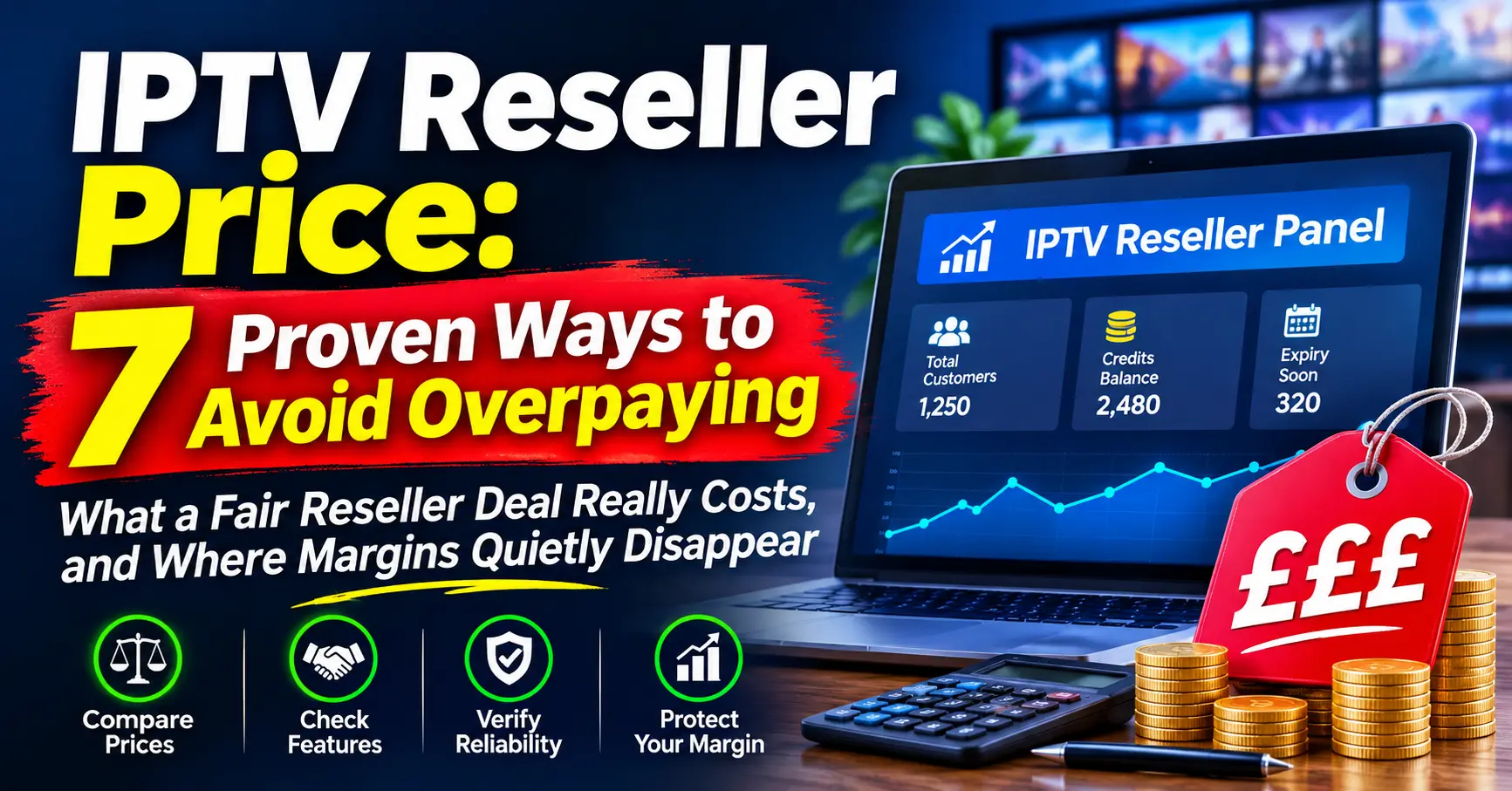
Last spring, a reseller I’d been helping messaged me at half past midnight. He’d found a panel selling credits for almost half what he was paying, moved his entire customer base across in one weekend, and by Tuesday he had forty unhappy messages about frozen screens and failed logins. He saved about ninety pounds. He lost eleven customers.
So what’s a fair IPTV reseller price? Honestly, the number that matters isn’t what one credit costs. It’s what one working, supported, renewing connection costs you once refunds, support time and churn are added back in. A mid-market wholesale rate from a stable supplier almost always beats the bargain basement, and the rest of this guide explains exactly why.
I’ve written about telecoms and subscription businesses for fifteen years, and for the last few I’ve spent a lot of time inside reseller dashboards, talking to the people who run them and watching where the money actually goes. What follows isn’t theory. It’s the conversation I wish someone had had with my midnight messenger before he moved a single account.
Why the Cheapest Sticker Number Usually Lies
Every pricing page leads with one figure: the cost per credit. It’s big, it’s bold and it’s designed to be compared. The trouble is that it tells you almost nothing about what you’ll really spend.
Think of it like buying a used car on the asking price alone. Two cars at the same price can cost wildly different amounts over a year once fuel, repairs and the odd breakdown are counted. Credits work the same way, and a cheap credit attached to an unstable server, slow support or a panel that crashes on renewal day isn’t cheap at all.
There’s also a psychological trap here. When an IPTV reseller price looks unusually low, many resellers assume the supplier has simply found efficiencies. Sometimes that’s true. More often, it means corners are being cut on capacity, uptime monitoring or support, and you’ll be the one absorbing the cost.
How an IPTV Reseller Price Is Built, Layer by Layer
Before you can judge whether a deal is good, it helps to know what you’re actually paying for. Most wholesale pricing breaks down into three layers, and each one can quietly push your costs up or down.
Credits and What One Actually Buys
On most panels, one credit buys one month of service for one connection. Some suppliers bend that rule, offering a 12-month line for 10 credits, or charging extra credits for multi-device lines. Always check the conversion table inside the panel itself rather than trusting the sales page.
This is where comparing an IPTV reseller price across suppliers gets slippery. A supplier charging slightly more per credit but giving a two-month discount on annual lines can work out cheaper for anyone who mostly sells yearly plans. Do the maths on your actual sales mix, not on a single month.
Connections, Devices and the Multiplier Effect
Customers rarely want just one screen any more. A household might need a living room box, a phone and a tablet, and many panels charge a full credit for each extra connection. Your cost per customer can double or triple overnight if you don’t price multi-device plans carefully.
Here’s a quick hypothetical. You sell a three-device plan at what looks like a healthy premium, but your supplier bills three credits per month for it. If your retail premium doesn’t cover two additional credits plus a little extra support time, you’re losing money on your most “valuable” customers.
Panel Access, Features and the Quiet Monthly Fees
Some suppliers charge a one-off fee to open a reseller account, while others bundle access into a minimum credit purchase. A few add monthly fees for sub-reseller management, white label branding or API access. None of these is unreasonable on its own, but they rarely appear next to the headline credit cost.
Running an IPTV panel with sub-resellers underneath you? Then check how credits flow downstream. Can you set your own sub-reseller rates, and are transfers instant or do they need manual approval? These details shape your margin as much as the base rate does.
Three Pricing Models, Side by Side
Not every IPTV panel reseller buys the same way. The three models below cover most of what you’ll see on the market, and each suits a different stage of business.
| Pricing model | Typical upfront commitment | Per-credit cost | Best suited to | Main risk |
|---|---|---|---|---|
| Pay-as-you-go credits | Very low | Highest | New resellers testing demand | Margins too thin to absorb refunds |
| Bulk credit bundles | Medium to high | Lower, falls with volume | Established resellers with steady renewals | Cash tied up in unused credits |
| Monthly panel subscription | Fixed monthly fee | Often lowest per line | Larger operations with sub-resellers | Paying for capacity you don’t use |
My own view? Most people should start on smaller bundles rather than pure pay-as-you-go. The per-credit saving is usually meaningful, and it forces you to understand your renewal cycle before committing serious money. Jumping straight to the largest bundle on the strength of one good month is among the most common mistakes I see.
It’s worth adding that a lower IPTV reseller price on a big bundle only helps if you’ll actually use the credits. Ask whether credits expire, because some suppliers quietly put a shelf life on them.
Seven Proven Ways to Avoid Overpaying
These are the habits I’ve seen separate profitable resellers from the ones who give up after six months.
- Calculate cost per active customer, not per credit. Divide your total monthly spend, including fees and refunds, by the number of customers who actually renewed. That figure is your true IPTV reseller price, and it’s the only one worth comparing.
- Buy a small test batch first. Ten or twenty credits is enough to test stability, panel speed and support response before committing to a larger bundle. A good supplier won’t mind, and an evasive one will tell you a lot.
- Test support at an awkward hour. Send a question late on a Friday evening and time the reply. Your customers will have problems at awkward hours, and you’ll need help when they do.
- Check what happens to unused credits. Ask whether they expire, whether they’re refundable and whether they move with you if you change panels within the same supplier.
- Price multi-device plans separately. Never assume a flat retail premium covers extra connections. Map each plan to its real credit cost.
- Factor in payment fees. Card processors such as Stripe take a percentage of every transaction, and that adds up quickly on low-value monthly subscriptions. Build it into your margin from day one.
- Negotiate once you’ve proven volume. After three or four months of consistent purchases, ask for a better tier. Suppliers value reliable resellers, and a polite request backed by real numbers often works.
Pro tip: Keep a simple spreadsheet logging every credit purchase, every refund and every support ticket per supplier. After a quarter, you’ll know your real costs better than any sales page could tell you.
Choosing an IPTV Provider Without Getting Burned
Price only means something when the service behind it is dependable. A strong IPTV provider gives you a stable panel, clear documentation, honest uptime information and support staff who understand reseller problems. A weak one gives you a low headline number and very little else.
I’d look first at transparency. Do they explain their credit rules openly, and do they warn resellers about planned maintenance? Silence during an outage is far more expensive than a slightly higher IPTV reseller price.
Seasonal promotions deserve particular scepticism. Around holidays and big viewing weekends, offers appear that look generous but often hide shorter durations, capped connections or credits that expire quickly. I covered this in more detail in Trick or Treat? How to Tell a Real October Streaming Bargain From a Costume → /real october streaming bargain, and the same logic applies all year round.
Consumer groups like Which? regularly warn shoppers that deals which seem too good to be true usually are, and that advice applies to wholesale buyers too. The difference is that a reseller doesn’t just lose their own money. They lose their customers’ trust.
One question too many people skip is this: what content rights does the service behind the panel actually hold? Panel software is simply technology, but what flows through it needs proper licensing, and the UK Intellectual Property Office publishes clear guidance on copyright and online streaming that’s worth reading before you sign with anyone. A cheap deal built on unlicensed content isn’t a bargain. It’s a liability with your name on it.
Setting Your Own IPTV Reseller Price for Customers
Once your wholesale costs are clear, the next job is deciding what to charge. Your retail IPTV reseller price needs to cover credits, fees, refunds and your own time, and still leave enough to grow. Here’s a worked example using illustrative figures, not a quote from any particular supplier.
Imagine 60 active customers, each on a single-connection monthly plan at £9, with credits bought at £3.50 each.
| Item | Monthly amount |
|---|---|
| Revenue (60 × £9) | £540.00 |
| Credits (60 × £3.50) | £210.00 |
| Payment processing (about 3%) | £16.20 |
| Refund and churn buffer (5%) | £27.00 |
| Panel or tool fees | £15.00 |
| Gross margin before your time | £271.80 |
Healthy, right? Not once you count the hours. If support, setup and renewals take you six hours a month and you value your time at £15 an hour, real profit drops to £181.80, which is respectable but a very different picture from the headline.
Now flip the scenario. Suppose you switched to a supplier at £2.20 per credit, saving roughly £80 a month, but complaints doubled your support time and five customers left. You’d lose £45 in revenue and another £90 worth of hours, leaving you about £55 worse off. Which deal really costs less?
Quick win: Offer three, six and twelve-month plans priced so the annual option feels like an obvious choice. Longer plans reduce churn and payment fees, and they smooth out your cash flow.
Resist the urge to simply undercut competitors. If your retail IPTV reseller price is the lowest in your market, you attract the customers most likely to leave for the next cheaper offer. Compete on reliability, setup help and response times instead.
Red Flags Worth Walking Away From
Run through this checklist before you top up with any supplier. If more than one or two points ring alarm bells, keep looking.
- No test batch available, even at a small cost
- Credit rules explained only in chat, never in writing
- Pricing pages that change week to week without notice
- Payment accepted only through untraceable methods
- Support replies taking more than a day during normal hours
- Vague or evasive answers about content licensing
- An IPTV reseller price far below every comparable supplier, with no clear explanation
- No way to export your customer list if you decide to leave
The final point is underrated. If an IPTV panel locks your customer data inside its own system, switching becomes painful, and that gives a supplier quiet power over your future pricing.
Where Wholesale Pricing Is Heading Next
Honestly, I don’t expect the race to the bottom to last. Ofcom’s Online Nation and Media Nations research keeps showing how much UK viewing has moved towards streaming and connected devices, and a maturing market tends to reward reliability over rock-bottom pricing. Customers who’ve been burned once become far more willing to pay a little extra for something that simply works.
For the IPTV panel reseller, that’s good news. The margin battle will increasingly be won on service rather than on shaving pennies off each credit. Suppliers are already adding automated renewal reminders, sub-reseller dashboards and API access, and those tools can save more money than any discount.
Expect more consolidation, too. Smaller suppliers running on thin margins struggle when costs rise, and resellers tied to them get caught out. Choosing an established IPTV provider with a track record isn’t just about today’s IPTV reseller price; it’s about whether they’ll still be around in eighteen months.
A Final Word Before You Top Up
If there’s one thing I’d want you to take away, it’s this: the number on the pricing page is the start of the conversation, not the end. A fair IPTV reseller price is one that leaves you with happy, renewing customers and enough margin to sleep at night.
As for my midnight messenger, he moved back to his original supplier within a month. He now buys in modest bundles, tests every new panel with twenty credits and checks his cost per active customer every quarter. His margin is better than it’s ever been. Run your own numbers this week, ask your supplier the awkward questions, and build a business that doesn’t depend on being the cheapest.
Frequently Asked Questions
What is a typical IPTV reseller price per credit?
Wholesale credit costs vary widely depending on volume, supplier and the features included. Small pay-as-you-go purchases usually cost the most per credit, while larger bundles bring the unit cost down. Rather than chasing a specific figure, compare suppliers on cost per active, renewing customer. That gives you a far more honest picture than the headline rate.
How do I choose a reliable IPTV provider for my reseller business?
Start with a small test batch and judge stability, panel speed and support response before committing. Look for clear written credit rules, transparent maintenance notices and straight answers about content licensing. Ask other resellers about their experience, but weigh your own test results most heavily. A dependable supplier is worth a slightly higher unit cost.
Is a lower IPTV reseller price always better for profit?
No, and it’s often the opposite. Very cheap credits can come with unstable service, which drives up complaints, refunds and churn. Once you factor in your own support time, a mid-market supplier frequently delivers better real profit. Judge every deal on total cost per retained customer.
Can an IPTV panel reseller set different prices for sub-resellers?
Yes, on many panels. Suppliers that support sub-reseller accounts usually let you transfer credits downstream and set your own rates. Check how transfers work, whether they’re instant and whether you can see sub-reseller activity in your dashboard. Those controls make a big difference to both your margin and your workload.
How often should I review my IPTV reseller price for customers?
A quarterly review works well for most resellers. Look at wholesale costs, payment fees, refund rates and support hours, then check whether your retail plans still leave a healthy margin. If your supplier changes their rates, review straight away rather than waiting. Small, regular adjustments are far easier on customers than sudden large increases.

[…] These numbers are illustrative, not a promise, and your own churn will differ. If you want the full breakdown of how credits, panel fees and profit interact over a longer stretch, I’ve covered it in The Honest Maths Behind Reseller Credits, Panels and Profit → /honest maths reseller credits panels profit. […]