IPTV Credit Forecasting is the process of predicting how many credits your IPTV reseller panel will need before renewals fall due, rather than reacting once your balance runs dry. Most resellers only think about credits when a low balance warning appears, by which point there’s little room to top up without risking a customer’s line lapsing. Forecasting flips that around: you look at your active subscriber base, upcoming renewal dates and average consumption, then work out roughly how many credits the next one, two or three billing cycles will actually cost you.
Building an IPTV Credit Forecasting Model From Your Renewal Calendar
IPTV Credit Forecasting doesn’t need a spreadsheet full of formulas to be useful. At its simplest, it needs three inputs: how many active lines you’re carrying, how those lines are split across monthly, quarterly and annual cycles, and how many credits each renewal type actually costs on your panel. Once those three numbers are in front of you, forecasting becomes a matter of mapping renewal dates onto a calendar and adding up what’s due.
Where resellers usually go wrong isn’t the maths. It’s that they never write the renewal dates down anywhere, so every top up decision gets made from memory or from whatever the balance happens to show that day. A forecast only works if it’s looking forward, not just reporting the current number.
The Weekly Numbers Worth Tracking
You don’t need to forecast daily. A weekly check against three figures covers most of what matters for a small to mid-sized reseller operation.
The first is how many renewals fall in the next seven, fourteen and thirty days, broken down by cycle length. The second is your current credit balance measured against that upcoming demand, not against some arbitrary round number. The third is anything unusual on the horizon, such as a batch of new sign-ups from a promotion, that will pull credits forward faster than your normal renewal rhythm suggests.
Tracking these three things weekly, even in a basic spreadsheet with renewal dates and cycle lengths, turns forecasting from a guess into a habit. It also makes it obvious well in advance when a particular week is going to need more credits than usual, rather than finding out on the day itself.
Three common renewal mixes tend to shape how far ahead you need to be looking and how large your buffer should be:
Where Forecasts Go Wrong: Renewal Clustering and Demand Spikes
The biggest reason forecasts fall apart isn’t bad maths, it’s renewal clustering. If a reseller picked up twenty new customers in the same fortnight, those twenty renewals will land in the same fortnight every cycle after that, creating a recurring spike rather than a smooth monthly draw. Left untracked, that spike arrives as a surprise every single time.
Seasonal demand adds a second layer. Major live sporting events and holiday periods tend to bring a wave of new sign-ups rather than renewals, and those new lines then set their own renewal clock running a month or a quarter later. A forecast built purely on historical averages misses this, because the spike hasn’t happened yet on the calendar you’re looking at.
Pro tip: When you get a burst of new sign-ups, mark the date and cycle length somewhere separate from your general renewal tracker. That cluster will reappear on your books every renewal cycle, and knowing it’s coming beats discovering it again each time.
Setting a Minimum Credit Buffer Above the Renewal Threshold
Most panels, including ours, set a minimum credit amount required to process a renewal, and on our platform that threshold sits at 60 credits. A forecast that only tells you whether you’ll technically have enough credits to cover renewals isn’t much use if your balance is going to sit right on that line. Payment processing delays, a customer paying a day late, or simply forgetting to log in over a weekend can all tip a balance that was theoretically sufficient into one that can’t actually process a renewal when it’s due.
The practical fix is to forecast against a buffer figure, not against zero. Decide on a number comfortably above your panel’s minimum renewal threshold, work out roughly how many days of typical renewal activity that buffer covers, and treat a dip below it as your signal to top up rather than waiting until the balance is close to empty. Credit packages priced by volume tend to bring the cost per credit down, so building the buffer into a slightly larger top up is often cheaper per credit than several smaller ones.
A Simple Weekly Forecasting Routine
A routine only has to take a few minutes to be worth doing consistently. One version that works for a small reseller operation runs like this.
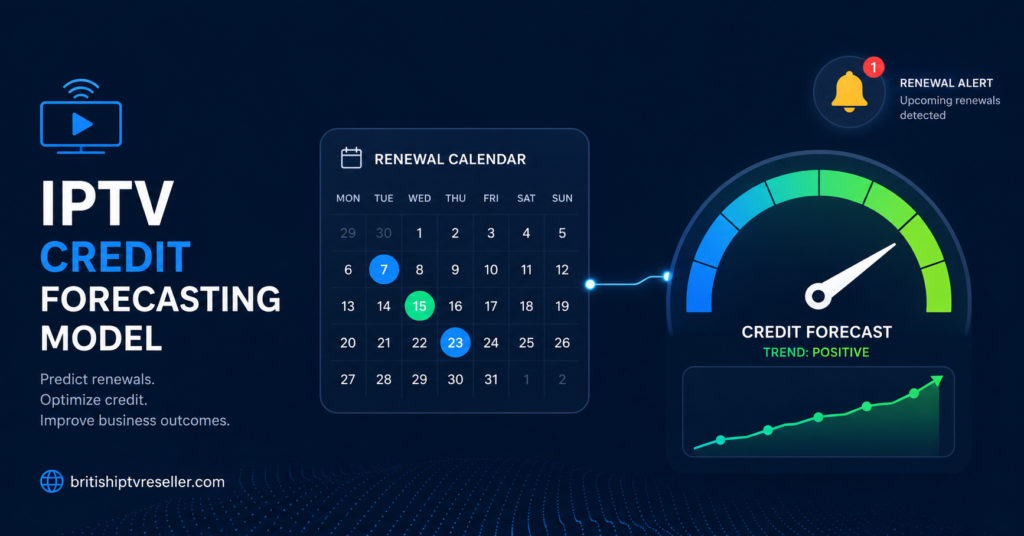
Start by pulling up every line renewing in the next fourteen days and note the cycle length against each. Add those credit requirements together against your panel’s actual credit-to-duration ratio, since the credit cost each provider sets rarely matches a round number. Compare that total, plus your buffer, against your current balance. If the balance clears the total comfortably, no action needed. If it’s close or short, top up before the renewal window opens rather than on the day itself.
Pro tip: Keep this routine on the same day each week. A forecast that gets checked irregularly tends to get skipped entirely during busy weeks, which is exactly when a renewal cluster is most likely to catch you out.

Getting the forecasting habit right sits alongside the rest of your operational setup. If your dashboard permissions or line creation process aren’t fully understood yet, getting the UK IPTV reseller panel set up correctly first makes the forecasting numbers easier to trust, since a misconfigured panel can make renewal data look inconsistent even when your maths is fine. Forecasting also connects directly to a wider reseller pricing strategy, since knowing your credit costs in advance is what lets you set retail margins with confidence instead of guessing.
Reseller Forecasting Checklist
- Log every active line by renewal date and cycle length
- Review renewals due in the next fourteen and thirty days every week
- Compare your balance against upcoming demand plus your buffer, not against zero
- Note any sign-up bursts separately so their recurring renewal cluster doesn’t surprise you later
- Set a top up trigger point comfortably above your panel’s minimum renewal threshold
IPTV Credit Forecasting: Frequently Asked Questions
How far ahead should I forecast my credit needs?
Fourteen to thirty days covers most short-notice risk for monthly-heavy reseller books. If your customer base leans towards quarterly or annual lines, extending your forecast window to sixty or ninety days gives you more useful warning of larger, less frequent draws.
Does forecasting change if most of my customers pay monthly rather than annually?
Yes. A monthly-heavy book needs frequent, smaller forecasts since renewals come round constantly. A book weighted towards longer subscriptions needs fewer forecasting checks but each one covers a larger credit draw, so the buffer matters more than the checking frequency.
What’s a safe credit buffer to keep on hand?
There’s no single figure that suits every IPTV panel reseller, since it depends on your renewal volume and how quickly you can top up when needed. The starting point is simply keeping your balance comfortably clear of your panel’s minimum renewal threshold, then adjusting upward if you notice renewals clustering in particular weeks.
Can forecasting help with bulk credit pricing?
Indirectly, yes. Once you can see your credit needs several weeks out, it’s easier to judge whether a larger top up at a better per-credit rate makes sense, rather than buying small amounts reactively at a worse price each time.
What should I do if my forecast shows I’ll fall below the renewal minimum?
Top up before the shortfall arrives rather than waiting for a renewal to fail. If the gap is a recurring pattern rather than a one-off, it usually means your buffer or top up trigger point needs adjusting upward.
IPTV Credit Forecasting isn’t about predicting every renewal to the exact credit. It’s about knowing your upcoming demand well enough that a low balance is something you plan around rather than something that catches you mid-renewal. Track your active lines by cycle length, check the numbers on the same day each week, and keep your buffer comfortably clear of your panel’s minimum renewal threshold. Get that routine running and credit shortfalls stop being a surprise and start being something you saw coming weeks in advance.