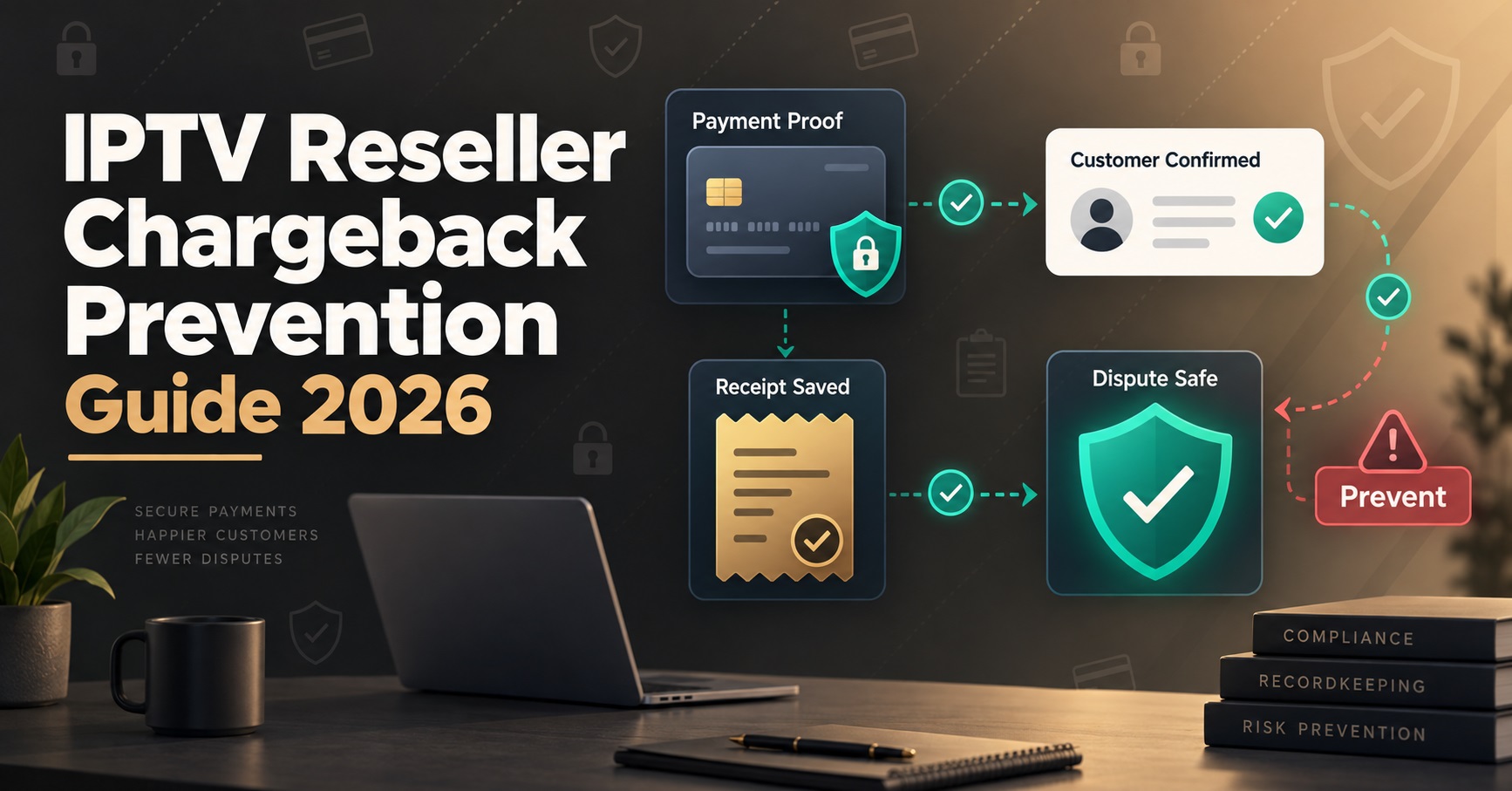
IPTV Reseller Chargeback Prevention comes down to three habits: a billing descriptor your customer actually recognises, records you can produce the moment a dispute lands, and a refund process that gives an unhappy subscriber somewhere to go before they call their bank. Most chargebacks in this business aren’t fraud. They’re confusion, and confusion is fixable.
Why Subscribers Dispute Charges Instead of Contacting You
A chargeback happens when a cardholder goes to their bank instead of the seller. For an IPTV panel reseller, that’s almost always a sign that something upstream failed, not proof that the customer is trying to cheat you. Three patterns show up again and again.
The first is a billing entry the subscriber doesn’t recognise. If your payment processor shows a generic string of letters and numbers on a bank statement, a customer who forgot they signed up two months ago will assume it’s fraud and dispute it on reflex. The second is a support channel that’s slow or absent when a stream stops working. If a subscriber can’t get an answer within a reasonable window, a chargeback becomes the fastest way for them to get their money back. The third is a mismatch between what was promised at sale and what was delivered, whether that’s channel availability, device compatibility, or renewal terms nobody explained clearly.
None of these are solved by tightening your terms and conditions alone. They’re solved operationally, before the dispute ever reaches a bank.
IPTV Reseller Chargeback Prevention Starts With Your Billing Descriptor
This is the single highest-leverage fix available to most resellers, and it’s also the one most commonly ignored. Your billing descriptor is the text that appears on a subscriber’s bank or card statement. If it reads as a random processor name, an unrelated company, or an abbreviation with no connection to your brand, you are manufacturing chargebacks even when your service works perfectly.
Check what actually appears on a real transaction, not what you assume your payment gateway shows. Many UK IPTV resellers set up a merchant account once and never look again. If your descriptor doesn’t include a recognisable trading name and, ideally, a contact number or short URL, ask your payment provider whether a custom descriptor is available. Some gateways allow a “soft descriptor” that pairs your brand name with the processor’s underlying entity. Where that option exists, use it. Where it doesn’t, that’s a reasonable factor in choosing a different payment processor altogether.
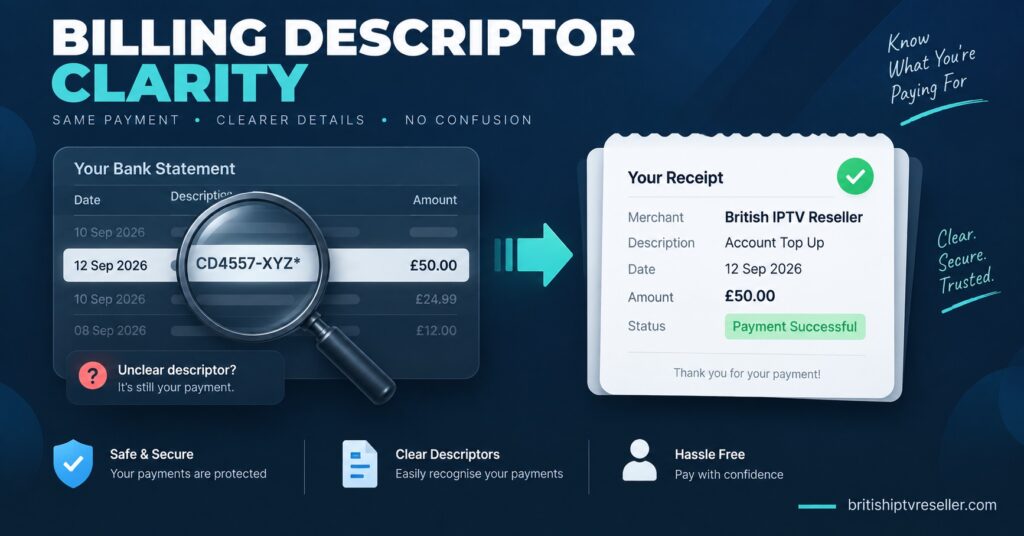
Pro tip: Text or WhatsApp new subscribers the exact wording that will appear on their statement, before the first charge lands. It costs nothing and removes the single biggest cause of “I don’t recognise this charge” disputes.
Invoicing and Evidence Retention That Actually Hold Up
When a dispute is raised, your payment processor will ask for evidence within a fixed window, often as short as a few days. Resellers who scramble to reconstruct records at that point usually lose the dispute regardless of whether the service was delivered as promised.
Build the habit before you need it. For every subscriber, keep a dated record of the original sale (what was agreed, at what price, for what duration), proof of delivery (activation timestamp, credentials issued, device used if known), and any support contact that followed. A simple spreadsheet or your reseller dashboard’s export function is usually enough. What matters is that the record exists and is timestamped independently of the subscriber’s own claims.
Send a proper invoice or receipt at the point of sale, not just a payment confirmation from your processor. An invoice that states the service period, the price, and your trading details gives you something concrete to submit if a dispute does arise, and it also reduces the odds of a dispute happening at all, because the subscriber has clear paperwork rather than a vague memory of a purchase.
Pro tip: Store evidence outside your payment processor’s own system. If your account gets flagged or restricted mid-dispute, you don’t want your only copy of the proof sitting inside the account under review.
Building a Refund Workflow That Stops Disputes Before They Start
A working refund policy is a chargeback prevention tool, not just a customer service nicety. Subscribers who know they can ask for their money back through you are far less likely to go straight to their bank. Subscribers who don’t know that option exists, or who’ve had a refund request ignored once already, will use a chargeback as their only remaining route.
The workflow needs three things to actually function. It needs to be visible before purchase, not buried in a terms page nobody reads. It needs a realistic response time that you can actually meet, since a refund policy that promises 24-hour turnaround and then takes a week does more damage than having no stated timeframe at all. And it needs a documented outcome for every request, even a decline, so that if the subscriber disputes anyway, you can show the bank that a resolution process existed and was followed.
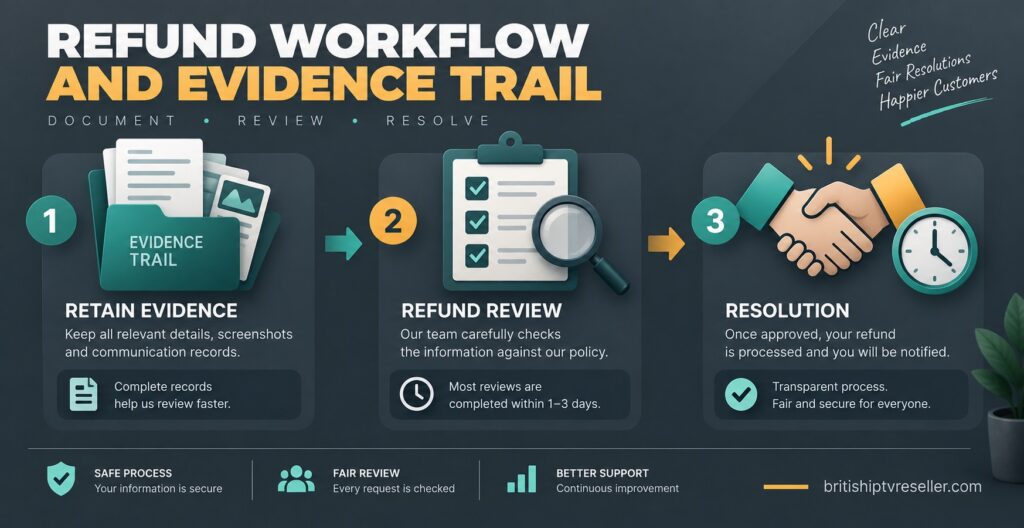
Where a technical fault is genuine, such as a device incompatibility discovered after purchase, resolving it quickly with a partial credit or replacement line is almost always cheaper than the chargeback fee, the lost inventory, and the processor risk that follows repeated disputes. Read our British IPTV reseller refund policy for the structure we use as a working example.
Setting Clear Pre-Sale Expectations With Subscribers
A large share of avoidable disputes trace back to the sale itself, not the service afterward. If a subscriber buys expecting something that was never actually promised, in specific technical detail, in supported devices, or in renewal terms, the eventual disappointment tends to surface as a chargeback rather than a support ticket.
Be specific about what a subscription includes and, just as importantly, what it doesn’t. State the renewal cycle plainly, including whether it auto-renews and how a subscriber cancels it. If pricing is tied to wholesale credits, make sure the retail terms you communicate to subscribers are consistent from one sale to the next, since inconsistent pricing between resellers under the same brand creates exactly the kind of confusion that ends in a dispute.
Where you’re new to structuring subscriber-facing terms, our guide on how IPTV reselling actually works covers the basic operational shape of the business, including where pricing clarity fits into the IPTV reseller relationship.
| Mistake | Better approach |
|---|---|
| Generic or unrecognisable billing descriptor | Custom descriptor showing your trading name and a contact route |
| No written refund policy before purchase | Refund terms stated clearly at checkout, with a realistic response window |
| Evidence only stored in the payment processor’s dashboard | Independent, dated records of sale, delivery and support kept separately |
| Vague promises about channels or devices at point of sale | Specific, written confirmation of what’s included before payment |
| Ignoring low-value refund requests to save margin | Resolving genuine faults quickly, since the cost is usually lower than a chargeback |
Pro tip: Review your chargeback rate against your total transaction volume monthly, not just when your processor flags it. A rate creeping upward is far easier to fix at 0.5% than at the point your account gets frozen.
Frequently Asked Questions
What’s the difference between a refund and a chargeback for an IPTV reseller?
A refund is initiated and controlled by you, the seller, usually after a subscriber contacts you directly. A chargeback is initiated by the subscriber’s bank, bypasses you entirely, and typically carries an additional fee from your payment processor regardless of the outcome.
How many chargebacks before a payment processor takes action?
This varies by processor, but many use a threshold based on the ratio of disputes to total transactions, often somewhere around 1%. Once crossed, expect additional monitoring, reserve requirements, or account review rather than an automatic ban.
Can I fight a chargeback once it’s been filed?
Yes, through the representment process your payment processor offers. Success depends heavily on the quality of the evidence you can submit within the response window, which is why keeping records before a dispute happens matters more than reacting after one lands.
Does a clear cancellation process actually reduce disputes?
It does. Subscribers who can’t work out how to cancel a recurring charge frequently dispute it instead of contacting support, particularly around a renewal date they’d forgotten about.
Should sub-resellers handle chargebacks the same way?
Largely yes, though a sub-reseller operating under a parent panel should confirm in advance who holds responsibility for a dispute financially, since the payment relationship and the support relationship aren’t always with the same party.
Getting IPTV Reseller Panel Chargeback Prevention right isn’t about outsmarting subscribers or hardening your terms until nobody can complain. It’s an operational discipline: a billing descriptor people recognise, invoices and delivery records kept before they’re needed, and a refund process visible enough that a subscriber has somewhere to go other than their bank. Start with the descriptor, since it’s the fastest fix and usually the biggest source of avoidable disputes, then build the record-keeping and refund workflow around it.
Reseller Chargeback Prevention Checklist
- Confirm the exact billing descriptor shown on a live transaction, not just what the gateway dashboard claims
- Ask your payment provider whether a custom or soft descriptor is available
- Send a dated invoice or receipt for every sale, separate from the processor’s payment confirmation
- Keep activation and delivery records outside your payment processor’s own system
- Publish refund terms before checkout, with a response time you can consistently meet
- Log the outcome of every refund request, including declines
- State renewal terms and cancellation steps clearly at the point of sale
- Track your monthly chargeback ratio rather than waiting for a processor warning