Three years ago, the dominant conversation in IPTV operator circles was about content volume. More channels. Bigger VOD libraries. Unlimited streams. That race is effectively over, and the resellers still chasing it are the ones bleeding customers the fastest right now.
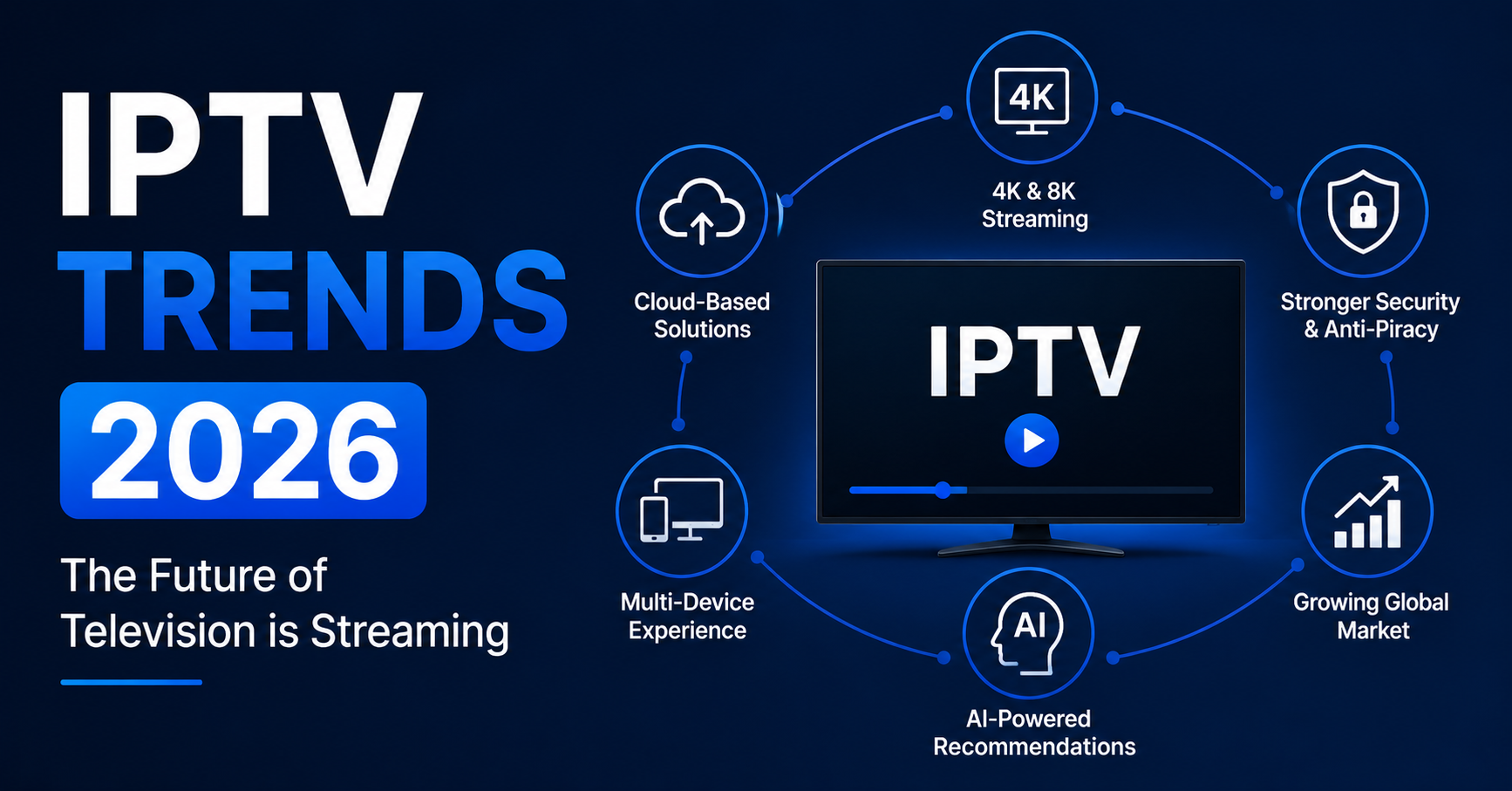
What’s actually happening in 2026 is quieter, more structural, and in many ways more interesting. The operators who are growing aren’t necessarily the ones with the biggest catalogues. They’re the ones who solved reliability, figured out ISP pressure, and stopped treating infrastructure as an afterthought. The IPTV trends 2026 is producing aren’t trend pieces, they’re field observations from an industry that’s quietly maturing under serious external pressure.
ISP Throttling Has Become Surgical, Not Blunt
This is the change that caught the most operators off guard coming into 2026. ISPs, particularly in the US, moved away from broad throttling of IPTV traffic toward what can only be described as targeted interference. Instead of slowing all HLS streams, some ISPs began identifying specific CDN origin patterns and introducing latency at the routing level.
The practical result: a subscriber on one ISP would experience near-perfect 4K delivery, while a neighbour on a different carrier with the same panel access would see constant rebuffering on the same channel. Same server. Same stream. Different ISP.
We saw this pattern emerge repeatedly during Q1 this year across panels serving US customers. The fix isn’t a simple one. It requires:
- Multi-CDN routing with automatic ISP-aware switching
- Fallback delivery paths that bypass common throttling signatures
- Monitoring granular enough to detect ISP-level degradation rather than server-level
IPTV Reseller Panel who don’t have visibility into ISP-level performance are flying blind. Their customers assume it’s a panel quality issue, submit support tickets, and churn. The real cause never gets identified.
Pro Tip: If your customer complaints cluster around specific zip codes or telecom providers rather than device types or times of day, you’re almost certainly dealing with ISP-level throttling, not server load. Geo-filtering your support data by carrier changes the diagnosis entirely.
Why “Unlimited Streams” Stopped Being a Selling Point
For years, IPTV resellers competed aggressively on stream count. Five simultaneous streams. Ten streams. Unlimited. It was a reliable differentiator, until panels started bucketing under the load of customers who actually used all ten connections at once.
In 2026, the market has corrected this. Not through regulation, but through churn data.
The resellers who offered unlimited streams without the infrastructure to back it up created an interesting problem: they attracted the highest-consumption customers, households with multiple TVs, sports-obsessed viewers, people genuinely replacing cable, who then became their most vocal complaint sources during peak load.
One reseller we worked with had an 18% monthly churn rate despite competitive pricing. After reviewing their support tickets and tracking complaints against stream usage logs, the pattern was clear. Their top 12% of users by stream count generated 71% of all complaints. Unlimited connections had attracted exactly the customers their infrastructure couldn’t serve.
The 2026 shift is toward tiered, honest capacity planning: selling connection counts that match actual server capacity, and pricing accordingly. Here’s roughly how that tiering breaks down:
| Tier | Streams | Target customer | Infrastructure requirement |
|---|---|---|---|
| Basic | 1 to 2 | Single household, light use | Standard HLS delivery |
| Family | 3 to 4 | Multi-TV homes | Moderate load balancing |
| Power | 5 to 6 | Sports households | CDN offloading recommended |
| Operator | 10+ | Sub-resellers | Full redundancy required |
Why 4K Stopped Being a Premium Feature
This one matters for infrastructure planning more than marketing. In 2024, advertising 4K content was still a differentiator. In 2026, a subscriber who doesn’t see 4K options in your panel assumes it’s an outdated or budget service. The expectation has shifted completely.
The problem is that 4K delivery isn’t just a bitrate issue. It’s a cascading infrastructure challenge.
A 1080p stream running at 8 Mbps becomes a 4K stream at 20 to 25 Mbps. At scale, across thousands of concurrent viewers, that difference collapses infrastructure that was sized for HD delivery. Load balancers that handled 10,000 concurrent 1080p streams will buckle at 4,000 concurrent 4K streams.
During a major NFL playoff event in January this year, several mid-tier panels that had added 4K channels as a marketing upgrade, without rescaling their delivery infrastructure, experienced complete outages within the first 90 minutes. The channels worked fine during testing (low concurrent load). They failed in production (simultaneous demand spike).
Pro Tip: Never test 4K stream stability at single-connection load. Simulate 500+ concurrent connections to the same channel before making it live. Most outages happen not because the stream is broken but because the infrastructure was sized for testing conditions, not live peak demand.
Subscription Models Are Replacing Credit Systems in the US Market
This is one of the cleaner IPTV trends 2026 has produced, and it’s largely driven by subscriber behaviour rather than operator preference.
The credit-based reseller model, dominant in UK and EU markets, never fully transferred to US consumer expectations. American subscribers are conditioned to monthly billing. They understand $14.99/month. They don’t understand “60 credits = 2 connections for 3 months.” The friction in the sales conversation is real and measurable in conversion rates.
Several panel operators serving primarily US markets have migrated toward hybrid models this year: credit-based at the reseller and sub-reseller level (for flexibility and inventory management), with clean subscription-facing storefronts at the customer end that present monthly/annual pricing.
This separation, wholesale credit logic in the back-end, clean subscription presentation on the front-end, is where US-facing IPTV businesses are landing in 2026.
- Reseller buys credits in bulk from the panel
- Panel credits are allocated to monthly subscription slots
- Customer sees only a clean monthly price
- Reseller margin comes from the credit-to-slot conversion rate
EPG Reliability Has Become a Customer Retention Variable
Nobody talks about Electronic Programme Guide quality as a churn driver, but after reviewing hundreds of support requests across several panels, it consistently appears in complaints that lead to cancellations.
The pattern is subtle. A subscriber doesn’t call to say “your EPG is inaccurate.” They say “half the shows aren’t what they say they are” or “the guide never loads properly on my Firestick.” What they’re describing is EPG data sync failure, either stale guide data, time zone mismatches, or XML feed errors, but they experience it as a service quality problem.
In 2026, EPG expectations have risen alongside content expectations. Subscribers now compare IPTV EPG quality against their memory of Sky or Comcast guide interfaces. If your guide looks broken, the entire service feels broken.
Pro Tip: EPG complaints often spike after daylight saving time changes. If you manage your own XML EPG feeds, build in an automated time zone correction trigger around DST transitions. Panels that rely on third-party EPG providers need to audit whether those providers handle DST correctly for US time zones, many don’t.
The Anti-Piracy Infrastructure Is Getting Smarter
This isn’t a comfortable topic, but experienced operators don’t pretend it doesn’t exist. The enforcement landscape in 2026 has evolved significantly from the days of simple domain seizures.
Modern enforcement operations targeting IPTV services in the US and EU are now using:
Watermarking detection: some content providers embed invisible, session-specific watermarks in live streams. When that watermarked stream appears on an IPTV panel, the origin reseller can theoretically be traced upstream.
Streaming fingerprinting: automated systems monitor known IPTV panel URLs and compare stream fingerprints against licensed content databases. Detection can happen within minutes of a new channel going live.
DNS-level blocking coordination: US ISPs have been increasingly cooperative with coordinated DNS blocking requests from rights holders, moving faster than court-ordered injunctions in some cases.
The practical implication for operators and UK IPTV resellers: service continuity planning matters more than ever. Panels that run on a single domain with no failover mechanism are one DNS block away from complete customer loss. Here’s how the different enforcement risks compare:
| Risk type | Detection speed | Reseller impact | Mitigation |
|---|---|---|---|
| Domain seizure | Days to weeks | Total panel loss | Backup domain + auto-redirect |
| DNS blocking | Hours to days | Customer loss | Alternative DNS delivery |
| Watermark trace | Minutes to hours | Source suspension | Upstream supply awareness |
| ISP throttling | Ongoing | Churn increase | Multi-CDN routing |
What the Hardware Shift Means for Delivery Architecture
The device landscape has shifted meaningfully. In 2023, Android boxes and Firesticks dominated US IPTV usage. In 2026, the mix looks different:
- Apple TV uptake among higher-income US households has grown substantially
- Smart TV app usage (Samsung Tizen, LG webOS) is rising as users prefer not to manage separate devices
- Firestick remains strong in price-sensitive segments
- Android boxes are declining among new subscribers (though existing users persist)
This matters for delivery architecture because each platform handles HLS buffering differently, Apple TV, for instance, applies its own adaptive bitrate logic that can conflict with panel-side stream quality settings. Samsung Tizen’s IPTV player behaviour differs from LG webOS in how it handles stream reconnects.
Operators building device-specific delivery configurations in 2026 are seeing meaningfully lower buffering complaints than those running a one-size delivery approach. The overhead is real, but so is the support ticket reduction.
For resellers looking to serve US households with reliable, multi-device delivery, britishseller.co.uk offers panel access built with device-aware stream routing and multi-CDN fallback, infrastructure details worth verifying before committing.
Pro Tip: If your panel allows it, segment your Apple TV users separately in monitoring. ATV has distinct buffering behaviour that can make a stream look broken in logs while it’s actually functioning within Apple’s own adaptive buffer parameters. Alerting calibrated for Android will generate false positives on ATV traffic.
Why Margins Are Compressing, and How Smart Operators Are Responding
Credit prices haven’t moved dramatically. But reseller acquisition costs, customer support overhead, and churn-driven revenue instability have all increased. The effective margin, what’s left after credits, support time, refunds, and payment processing fees, is thinner in 2026 than it was in 2022.
A mistake we repeatedly see is resellers responding to margin pressure by lowering prices further to compete. That accelerates the problem. The operators actually growing margin are doing the opposite: moving upmarket, serving fewer but higher-value customers, and reducing support volume through better onboarding.
A reseller who serves 300 customers paying $12/month and generates 180 support tickets monthly is working harder for less money than one serving 150 customers paying $22/month with 30 support tickets. The economics of quality-over-volume in IPTV reselling become more pronounced every year.
The 2026 trend among experienced operators is toward tiered pricing with genuine service differentiation, not just selling the same stream quality at different prices, but actually providing different SLA commitments, dedicated support channels, and device setup assistance at premium tiers.
Frequently Asked Questions
What are the biggest IPTV trends in 2026 for US subscribers?
The most visible changes are the shift to 4K as a standard expectation, better EPG quality requirements, and the move toward clean monthly subscription billing. Subscribers in 2026 expect IPTV to match or exceed the reliability and interface quality of traditional streaming services like Netflix or Hulu.
How is ISP throttling affecting IPTV services in 2026?
ISP interference has become more sophisticated this year, moving from broad traffic throttling to targeted CDN-level interference. Subscribers on certain US carriers experience degraded quality not because of panel issues but due to ISP routing decisions. Multi-CDN delivery and ISP-aware stream routing are the main technical responses.
Are IPTV reseller panels still profitable in 2026?
Yes, but margins have compressed compared to previous years. The profitable operators in 2026 are those who moved upmarket, reduced support overhead through better customer onboarding, and built recurring revenue through subscription-style pricing rather than competing purely on credit prices.
What IPTV trends 2026 should new resellers know before starting?
New resellers should understand that panel reliability and infrastructure quality now matter more than catalogue size. Prioritise panels with documented uptime history, multi-CDN delivery, and backup domain infrastructure. Avoid choosing a panel based solely on credit price.
Why do IPTV streams buffer differently on different devices?
Each device platform, Apple TV, Firestick, Samsung Tizen, LG webOS, handles adaptive bitrate streaming and buffer management differently. A stream that delivers perfectly on a Firestick may behave differently on an Apple TV due to platform-level buffer logic. Panels with device-aware delivery configurations reduce this problem.
How should resellers protect their business against domain seizures or DNS blocks?
Build redundancy into your customer communication from day 1. Maintain a subscriber email list. Have backup domains registered and ready. Some panels provide automatic customer redirect mechanisms. Never rely on a single URL as your only access point.
What is the credit-to-subscription hybrid model and why is it relevant in 2026?
It’s an architecture where resellers manage inventory through traditional credit systems but present customers with clean monthly subscription pricing. It’s growing because US subscribers don’t easily understand credit systems, so separating the wholesale (credit) and retail (subscription) layers improves conversion rates significantly.
How important is EPG quality for subscriber retention in 2026?
More important than most resellers realise. EPG failures, including stale data, time zone errors, and guide loading failures, consistently appear in support tickets that precede cancellations. Subscribers experience EPG problems as a general service quality failure, even when streams themselves are functioning correctly.
2026 Execution Checklist
For Subscribers
- Test your IPTV service on every device in your household separately, don’t assume consistent performance across platforms
- Check whether your provider offers a backup access URL or alternative login method
- Verify your EPG is loading correctly after any daylight saving time change
- If you experience buffering on specific channels only, report the channel name and your ISP to your reseller, it may be carrier-level interference, not a panel fault
- Ask your IPTV UK reseller what player app is recommended for your specific device
For Resellers
- Audit your support tickets by ISP or carrier region, identify if complaints cluster around specific providers
- Move away from “unlimited streams” marketing if your infrastructure hasn’t been sized to support it honestly
- Build a subscriber email list independent of your panel, it’s your only continuity asset if your domain goes down
- Review your EPG provider’s DST handling before US time zone transitions in March and November
- Test your 4K channels at 500+ concurrent simulated connections before advertising them
For Sub-Resellers
- Understand your upstream panel’s redundancy architecture, ask specifically about backup domains and failover systems
- Price your tiers based on actual infrastructure capacity, not what competitors are advertising
- Separate your customer-facing pricing presentation from your credit management, consider monthly subscription framing for US-market customers
- Monitor device-specific complaint patterns and flag them upstream with specifics, not just “buffering complaints”
- Review your refund and churn data quarterly, the pattern almost always reveals an infrastructure or EPG issue before it becomes a crisis
IPTV in 2026 is no longer a catalogue war. Reliability, redundancy, routing intelligence and customer experience are becoming the real competitive advantages.