
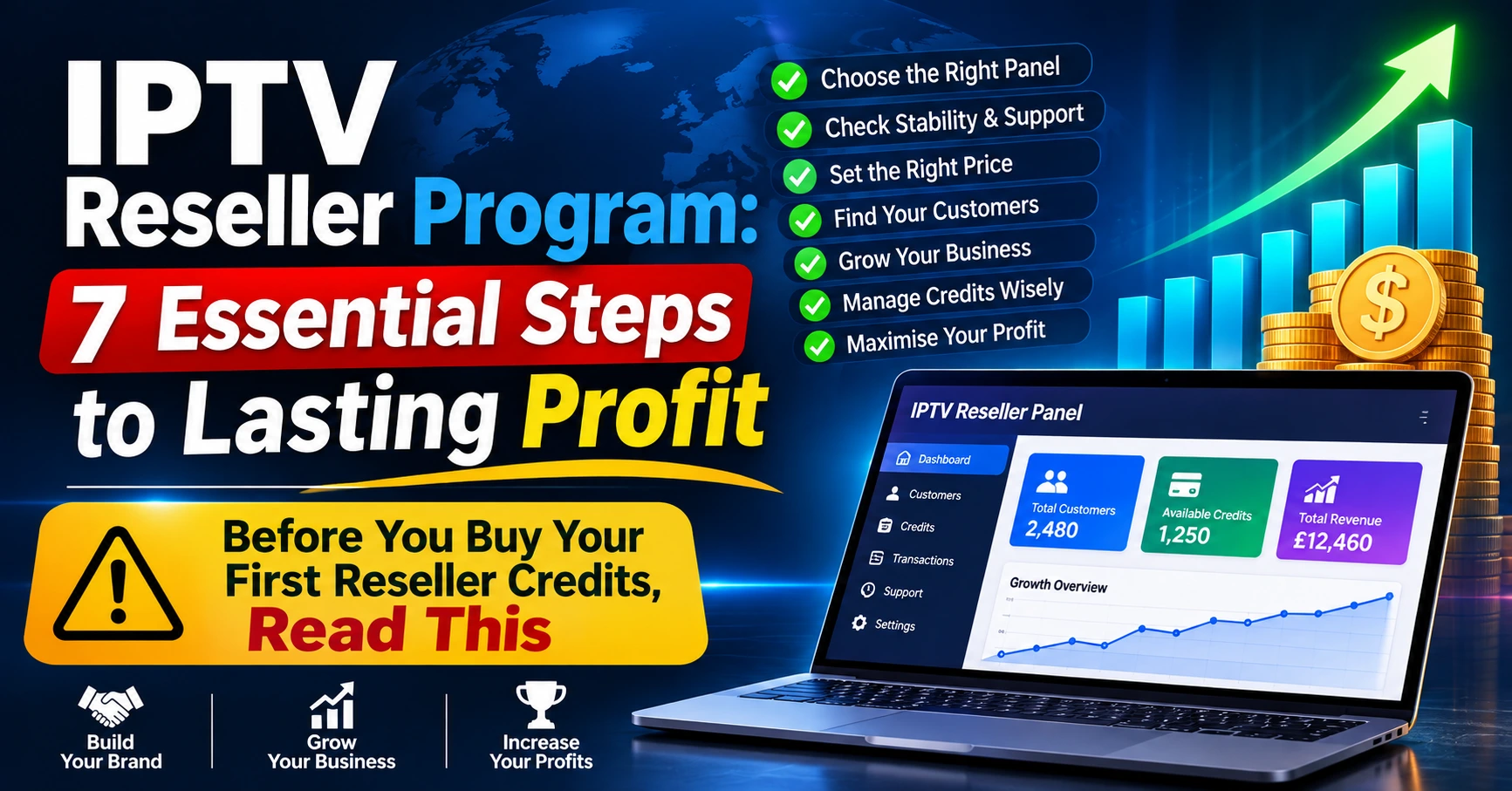
Last spring, a mate who runs a phone repair shop in Walsall rang me with a question I’ve heard a hundred times. He’d seen an advert for an IPTV Reseller Program, bought a starter pack of credits, and sold six subscriptions in his first week. Then the complaints started, and he wanted to know whether he’d been sold a dud or simply didn’t understand what he’d signed up for.
Here’s the honest answer I gave him, and the one I’ll give you. An IPTV Reseller Program can be a solid, low-overhead business, but only if you choose the right IPTV panel provider, price for the long haul rather than the first sale, and treat support as part of the product. Get those three right and the rest is detail. Get them wrong and no amount of marketing will save you.
I’ve spent the better part of fifteen years around telecoms and streaming infrastructure, and lately much of that time has been on the panel side of the industry. So this isn’t a brochure. It’s the conversation I wish someone had had with me before my first credit purchase.
What an IPTV Reseller Program Really Means
Strip away the marketing and an IPTV Reseller Program is a wholesale arrangement. A provider runs the servers, the panel software and the delivery network, and you buy access in bulk, usually as credits. You then create customer accounts from your own dashboard and set your own retail prices.
Think of it like a mobile virtual network operator. Brands such as Giffgaff don’t own the masts; they rent capacity and build a customer relationship on top. Your role is similar. You’re the storefront, the support desk and the brand, while the heavy infrastructure sits with someone else.
That distinction matters more than people expect. When a customer’s picture buffers, they don’t ring the IPTV panel provider. They ring you. A good IPTV Reseller Program gives you the tools to diagnose and fix most problems quickly, while a poor one leaves you apologising for faults you can’t even see.
What you actually get from the IPTV panel
Most reseller dashboards cover the same ground: creating and extending lines, setting connection limits, generating M3U or Xtream Codes logins, and tracking expiry dates. The better ones add sub-reseller management, activity logs and trial accounts. If an IPTV panel can’t show you when a customer last connected, treat that as a warning sign rather than a minor gap.
The Credit Model, Explained Without the Jargon
Credits are the currency of almost every IPTV Reseller Program I’ve worked with. One credit typically equals one month of service for one connection, though some providers price a twelve-month line at ten or eleven credits to reward longer terms. You buy credits upfront, and they’re deducted each time you create or renew a subscription.
Why does this matter so much? Because your margin lives in the gap between what a credit costs you and what you charge for the month it represents. Buy credits in larger batches and that gap widens. Buy too many and you’ve tied up cash in stock you may struggle to shift.
Below is a simplified example of how bulk pricing tends to look across the market. The figures are illustrative rather than any single provider’s rate card, but the pattern holds almost everywhere.
| Credit pack | Typical cost per credit | Retail price per month | Gross margin per month |
|---|---|---|---|
| 50 credits | £3.20 | £8.00 | £4.80 |
| 120 credits | £2.70 | £8.00 | £5.30 |
| 300 credits | £2.20 | £8.00 | £5.80 |
| 600 credits | £1.90 | £8.00 | £6.10 |
Look closely and you’ll see that the jump from 50 to 120 credits does more for your margin than the jump from 300 to 600. Early on, the sensible move is usually a mid-sized pack you can realistically sell through in two or three months. I’d rather see a new reseller run out of credits and reorder than sit on 600 of them hoping the market arrives.
Picking an IPTV Panel Provider You Can Trust
This is the decision that shapes everything else. Your IPTV panel provider determines your uptime, your support burden and, frankly, your reputation. I judge providers on five things, roughly in this order.
- Evidence of uptime. Ask for status history or monitoring data, not promises. A provider that publishes incident notes, even unflattering ones, is usually more trustworthy than one claiming perfection.
- Support response times. Send a pre-sales question at an awkward hour and time the reply. If they’re slow before you’ve paid, they won’t be faster afterwards.
- Panel depth. Check for connection logs, bulk actions, sub-reseller controls and trial creation. These save hours every week once you have more than a handful of customers.
- Trial availability. Any serious IPTV Reseller Program should let you test the service on your own devices before you commit to a large pack.
- Clear terms. Look for written policies on credit refunds, server migrations and account suspensions. Vague terms favour the provider every single time.
A quick word on “unlimited” claims
Be wary of any provider promising unlimited connections, unlimited credits or zero downtime. Infrastructure costs money, and capacity has limits. When a deal looks too generous, the shortfall usually shows up later as overloaded servers during busy evenings.
Why 9pm Is the Real Test
Any IPTV service looks good at ten on a Tuesday morning. The servers are quiet, the bandwidth is plentiful and every stream loads in a second. The honest test comes on a weekend evening, when thousands of households press play within the same half hour.
I learned this the hard way. Years ago I recommended a provider to a small reseller in Birmingham after testing it all afternoon. By Saturday night his WhatsApp was full of screenshots of spinning wheels, and I spent the evening on the phone feeling thoroughly embarrassed.
Peak-hour freezing usually comes down to one of three things: an oversold server, a weak link between the customer and the nearest delivery node, or a home network that simply can’t cope. As a reseller, you need to know which is which before you start refunding people. I’ve covered the causes in practical detail in Why Your Stream Freezes at 9pm, and the 7 Fixes That Stop It → /why your stream freezes at 9pm 7 fixes, and it’s worth bookmarking for your support replies.
The practical lesson? Test any IPTV Reseller Program during your own market’s busiest hours, ideally across two or three evenings, before you commit serious money.
Pricing an IPTV Service That Survives Month Three
New resellers joining an IPTV Reseller Program almost always price for the first sale. They undercut the nearest competitor by a pound, win a burst of customers, and then discover that thin margins can’t absorb a single refund or a busy week of support. Month three is where the cracks appear.
Sustainable pricing starts with your real costs, not just the credit price. Factor in payment processing fees, the time you spend on support, any refunds, and the occasional free extension you’ll hand out to keep a loyal customer happy. Once you add those up, a £2.20 credit is rarely a £2.20 cost.
Let’s put some numbers on it, because vague advice helps nobody.
Take a reseller with 80 active monthly customers paying £8 each, buying credits at £2.70. Revenue is £640 and credit cost is £216. Allow around £20 for payment fees, £30 for refunds and goodwill extensions, and value your support time at a modest £100 a month. You’re left with roughly £274, which is real money but far less than the headline margin suggested.
Longer plans help enormously here. A customer on a six or twelve-month subscription costs you far less support per pound earned, and they’re less likely to drift away. I’d always nudge buyers toward longer terms with a sensible discount rather than slashing the monthly rate to win attention.
The Legal Ground You Need to Stand On
Sales pages rarely mention this part, so I’ll be blunt. Reselling access to streaming technology is one thing; distributing content you don’t have the rights to is another entirely. A legitimate IPTV Reseller Program should be clear about content licensing, and you should be clear with yourself about what you’re actually selling.
In the UK, the Intellectual Property Office publishes plain-English guidance on copyright and online infringement, and it’s worth reading before you sell a single subscription. Ofcom’s annual Online Nation report is also useful for a broader view of how British households watch content, which helps you understand both the opportunity and the regulatory mood.
My own approach is simple. Work with providers who can explain where their content rights come from, keep your marketing focused on the technology and service quality, and avoid promising specific channels or events you can’t verify are licensed. If a provider gets evasive when you ask, that tells you everything you need to know.
7 Proven Steps to Launch Your IPTV Reseller Program
Starting from scratch tomorrow, this is the order I’d work in. It isn’t glamorous, but it’s the sequence that keeps cash, customers and stress under control.
- Shortlist three providers. Compare their panels, terms and support using the criteria above, and request a trial from each.
- Test at peak hours. Run the trials on a smart TV, a phone and a streaming stick during your busiest local evenings.
- Pick one provider and a mid-sized credit pack. Resist the urge to buy the biggest bundle just for the lowest unit price.
- Set your pricing tiers. Offer monthly, quarterly and annual options, with the best value clearly sitting on the longer terms.
- Prepare your support kit. Write setup guides for the main devices and saved replies for common questions about buffering, logins and expiry.
- Launch small. Sell to a few people you can reach easily, gather feedback, and fix the rough edges before you advertise.
- Review monthly. Track renewals, refunds and support tickets, and adjust your provider or prices if the numbers start to drift.
None of these steps is complicated. The resellers who struggle tend to skip steps two and five, then spend months firefighting problems they could have spotted in a single weekend.
Who This Suits, and Who Should Walk Away
Not everyone should sign up for an IPTV Reseller Program, however good the margins look on paper. The table below is the honest version of the conversation I have with people before they buy their first credits.
| You’ll probably do well if… | You may want to reconsider if… |
|---|---|
| You already have a customer base, such as a phone shop or repair business | You’re hoping for passive income with no customer contact |
| You enjoy troubleshooting and can explain tech calmly | You dislike evening and weekend messages |
| You can afford to hold a modest credit stock for a few months | Your budget only stretches to one large credit purchase |
| You’re comfortable vetting providers and asking hard questions | You want to compete purely on the lowest price |
Very little of that list is about technical skill. The strongest resellers I know are good communicators first and tech enthusiasts second. Customers forgive the odd outage, but they rarely forgive being ignored.
A Pre-Launch Checklist for New Resellers
Before you take your first payment through your IPTV Reseller Program, run through this list. Every item on it comes from a mistake I’ve watched someone make.
- Confirm your IPTV panel provider offers trial lines, and test them during peak hours
- Read the provider’s terms on credit refunds, suspensions and server changes
- Set retail prices that cover fees, refunds and your own support time
- Prepare device setup guides for smart TVs, Android boxes and Fire TV Sticks
- Write saved replies for buffering, login errors and renewal reminders
- Decide how you’ll take payments and record each customer’s expiry date
- Check that your marketing describes the service and technology, not specific channels or events
- Keep a small credit buffer so renewals never fail for lack of stock
Small Habits That Separate Good Resellers From Great Ones
Log everything. A simple spreadsheet with each customer’s start date, plan, device and support history will save you hours. When someone insists they paid for a year, you’ll know the truth in seconds.
Reply fast, even if you can’t fix it yet. A two-line acknowledgement within ten minutes calms most customers. Silence turns a minor buffer into a refund request.
Watch your renewal rate, not your sign-ups. New customers feel exciting, but a healthy IPTV Reseller Program business is built on people who come back month after month. My rough rule of thumb is that if renewals dip much below 70 percent, something in your service or support needs attention.
Own the outages. When your IPTV service has a problem, tell customers before they tell you. A short message explaining the issue and a realistic fix time builds more loyalty than any discount ever will.
Where This Leaves You
An IPTV Reseller Program isn’t a get-rich-quick scheme, and anyone selling it that way deserves a raised eyebrow. What it can be is a genuinely useful sideline or even a full business, provided you treat it like one. Choose your provider carefully, price for the long run, and make support your selling point.
So, what happened to my mate in Walsall? He switched providers after testing three of them across a fortnight of evenings, raised his prices on annual plans, and wrote a one-page setup guide that cut his support messages in half. Eighteen months on, he’s running a little over 200 lines alongside his repair shop, and the phone rarely rings after 9pm.
Weighing up an IPTV Reseller Program right now? Take your time, test properly and ask awkward questions. The providers worth working with will welcome every one of them.
Frequently Asked Questions
What is an IPTV Reseller Program and how does it work?
Put simply, an IPTV Reseller Program is a wholesale arrangement where you buy service credits from a provider and use them to create customer subscriptions through your own panel. The provider handles the servers and delivery, while you manage pricing, sales and support. Most programmes use one credit per connection per month. Your profit is the difference between your credit cost and your retail price.
How much does it cost to start an IPTV Reseller Program?
Starter packs of 50 to 120 credits are common, and they typically cost somewhere between £160 and £330 depending on the provider. You’ll also want a small budget for payment processing and perhaps a simple website or social page. It’s sensible to keep a few weeks of credits in reserve so renewals never fail. Avoid spending your whole budget on one large pack before you’ve tested demand.
How do I choose a reliable IPTV panel provider?
Request a trial and test it during your busiest local evenings rather than mid-afternoon. Ask about uptime history, support response times and written policies on refunds and suspensions. A good IPTV panel provider will answer clearly and won’t pressure you into buying the largest credit pack. Panel features such as connection logs and sub-reseller controls are also worth checking.
Can I offer free trials to my customers as a reseller?
Nearly all reseller panels let you create short trial lines, often lasting 24 to 48 hours, and some don’t deduct credits for them. Trials are one of the best sales tools you have, because customers can test the service on their own devices and network. Set a clear limit, such as one trial per household, to prevent abuse. Follow up when the trial ends, as that’s when most people decide.
What should I do when customers report buffering on my IPTV service?
Work out first whether the problem sits with the server, the connection or the customer’s home network. Ask which device they’re using, whether they’re on Wi-Fi or a cable, and whether the issue happens at certain times of day. Peak-evening buffering across several customers usually points to the provider, while a single affected customer often has a local network issue. Keeping saved replies for these checks will make your IPTV service support much faster.


[…] to grips with how credits work, read Before You Buy Your First Reseller Credits, Read This → / before you buy your first reseller credits before you plan any seasonal […]