Good channel management means keeping your list lean and verified, matching EPG data to what subscribers actually watch, and building redundancy into every high-demand stream so one source outage doesn’t take your whole panel down with it. Here’s what that actually looks like once you’re running it at scale, not in a course, but in the middle of a real Friday-night crisis.
Nobody talks about the moment you realise half your channel list is dead weight. You’ve got 15,000 lines in the playlist, your subscribers are complaining about buffering on three premium sports streams, and you’re sitting there at 2 AM toggling categories in your panel like a DJ who lost the crowd. That moment, that’s where real IPTV channel management begins. Not in a tutorial. Not in a course. In the wreckage of a Friday night when your main source goes dark and you’ve got 400 active connections asking where the football went.
This piece isn’t theory. It’s what actually works when you’re running an UK IPTV reseller operation at scale and need your channel infrastructure to hold up under real pressure. If you’ve ever had a subscriber tell you “Channel X was working yesterday,” and you had no answer, keep reading.
What Good Channel Management Looks Like at Panel Level
Most newcomers think channel management is about having the biggest channel list. More channels, more value, that’s the assumption. It’s also the fastest way to destroy your reputation.
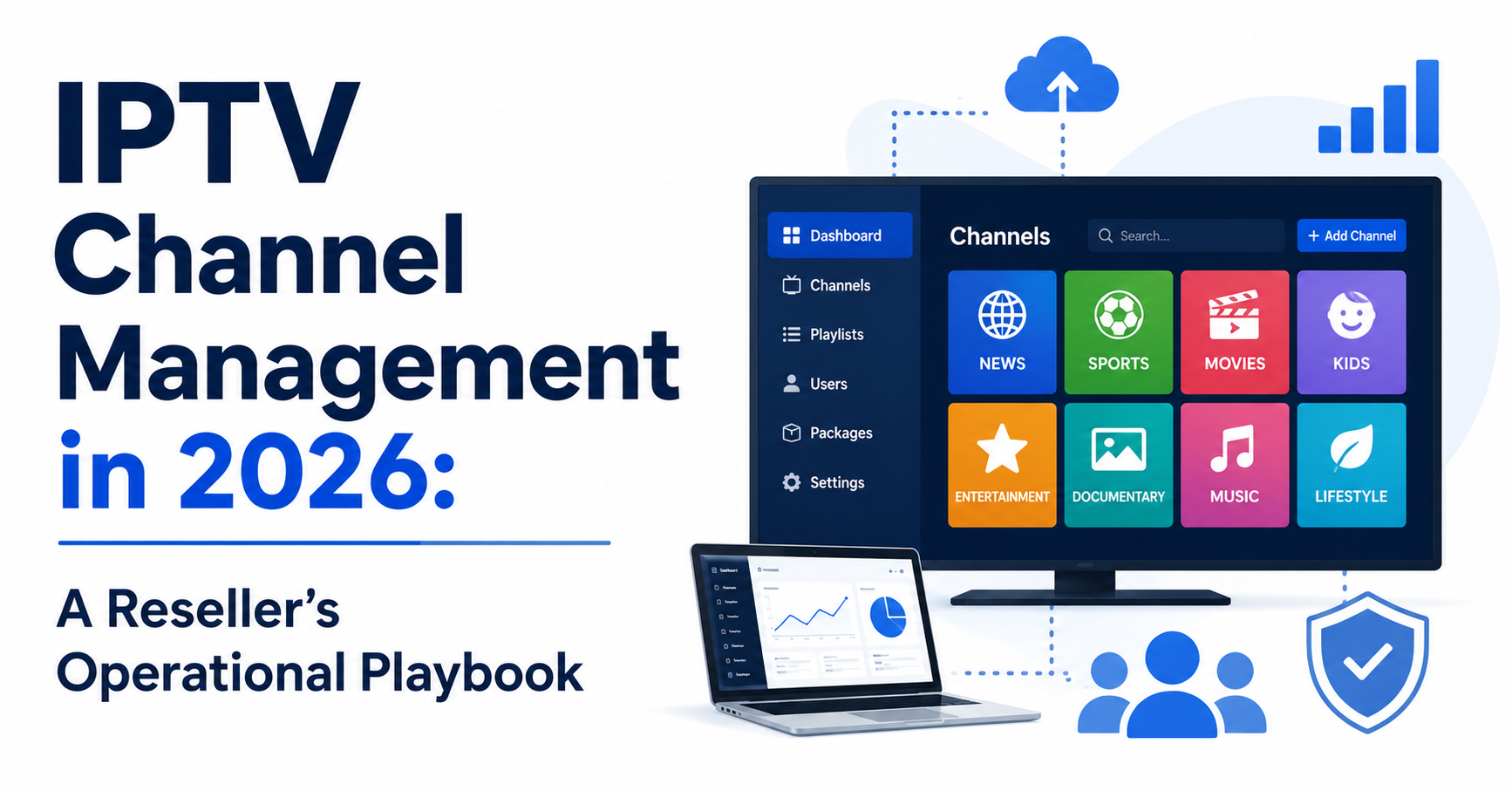
At the panel level, channel management is the discipline of curating, organising, monitoring, and maintaining your channel portfolio so that every single line a subscriber sees actually works. It means knowing which streams are redundant, which sources are unreliable, and which categories your specific market actually watches.
Pro Tip: Audit your channel list monthly. If a channel hasn’t been streamed by any subscriber in 30 days, it’s clutter, and clutter increases EPG load times and confuses new users.
Here’s what separates hobbyists from operators: operators treat their channel list like inventory. Dead stock gets pulled. High-demand streams get backup sources. And every category is structured so a subscriber can find what they need in under three taps.
The EPG Problem Nobody Warns You About
Electronic Programme Guide data is the silent killer of subscriber satisfaction. Your channel management strategy can be flawless on paper, but if EPG data is mismatched, delayed, or missing entirely, your panel looks amateur.
EPG issues usually cascade from three sources:
- Mismatched XMLTV IDs: your source assigns one ID, your EPG provider uses another, and the guide shows blank
- Stale caching: your panel caches EPG data for 24 hours but the source updates every 6, so subscribers see yesterday’s schedule
- Timezone misalignment: a subscriber in Manchester sees programme times listed in CET because the EPG feed wasn’t normalised
The fix isn’t glamorous. It’s manual mapping, regular XMLTV validation, and setting your panel’s EPG refresh cycle to match your provider’s update frequency. If you’re managing IPTV channel management across multiple sources, you’ll need a unified EPG aggregator, not just whatever your panel ships with by default.
Building a Channel Architecture That Doesn’t Collapse Under Load
Think of your channel list as a building. Most resellers stack floors without checking the foundation. When 200 concurrent viewers hit the same premium sports stream during a major fixture, HLS latency spikes, buffering begins, and your support inbox explodes.
Solid channel management architecture means:
- Source redundancy: every high-demand channel should have at least two upstream sources, with automatic failover configured at the panel or middleware level
- Load-distributed playlists: instead of pointing all subscribers to one stream URL, rotate across multiple balanced endpoints
- Category segmentation by demand: separate your high-traffic categories (sports, entertainment, news) from niche content so load spikes don’t cascade
Here’s how a budget setup stacks up against a professional one across the factors that actually matter:
| Factor | Budget setup | Professional setup |
|---|---|---|
| Source redundancy | Single source per channel | 2–3 sources with failover |
| EPG refresh | Every 24 hours | Every 4–6 hours |
| Load balancing | None, single endpoint | Multi-node with DNS rotation |
| Channel audit frequency | Never | Weekly or monthly |
| Backup uplink servers | None | Dedicated backup uplinks |
| HLS segment tuning | Default panel settings | Optimised segment duration and buffer |
If you’re running your operation without at least the “professional” column above, you’re operating on borrowed time. One source outage during peak hours will cost you subscribers you spent months acquiring.
Pro Tip: Set up a private test line on every upstream source. Check it daily at peak hours. If your test line buffers, your subscribers are already suffering, they just haven’t messaged you yet.
Why Subscriber Churn Starts With Poor Channel Organisation
Here’s something most channel management guides completely ignore: how your channel list is organised directly impacts retention. Subscribers don’t cancel because they found a cheaper Iptv provider. They cancel because they couldn’t find what they wanted quickly enough and assumed you didn’t have it.
The psychology is simple. A subscriber opens the app, scrolls through 300 channels with inconsistent naming (“UK: BBC O N E” next to “BBC 1 HD” next to “BBC1 FHD”), gives up, and starts looking elsewhere. You had the channel. You lost the customer anyway.
Standardise your naming conventions. Every channel name should follow a consistent pattern: country prefix, channel name, quality tag. No exceptions. If you’re pulling from multiple sources with different naming formats, normalise them in your panel before they ever reach a subscriber’s screen.
This is the unsexy side of IPTV channel management that directly affects your bottom line.
Handling Source Outages Without Losing Your Entire Subscriber Base
Every reseller has lived through the nightmare: your primary source drops 60% of its channels at 8 PM on a Saturday. No warning. No ETA for recovery. And your Telegram support group is already on fire.
The operators who survive these moments are the ones who built redundancy into their workflow long before the crisis hit. Here’s the playbook:
Maintain relationships with at least two independent sources, not resellers of the same provider, genuinely separate infrastructure
Pre-map backup channels in your panel. When Source A drops Channel X, your system should automatically route to Source B’s equivalent
Communicate proactively. A single message saying “We’re aware of issues on select channels and switching to backup feeds” buys you hours of goodwill that silence never will
Pro Tip: Build a “war room” checklist, a simple document listing every action you take during a source outage, in order. When adrenaline is high and subscribers are angry, you don’t want to be thinking. You want to be executing.
Reactive channel management is a death spiral. Proactive operators map their failure scenarios in advance and have switching procedures documented.
DNS Poisoning, ISP Blocking, and the 2026 Enforcement Landscape
Let’s address the elephant. In 2026, AI-driven ISP blocking has become significantly more sophisticated. Major broadcasters are funding detection systems that identify IPTV traffic patterns, not just domains. DNS poisoning is no longer the primary vector, deep packet inspection and behavioural analysis are increasingly common.
What does this mean for your channel infrastructure specifically? It means delivery needs layers:
- Encrypted transport: ensure all stream delivery uses HTTPS with valid certificates
- Geographically distributed CDN nodes: don’t serve all your UK subscribers from a single London endpoint
- Regular domain rotation for playlist URLs: static URLs are easier to flag and block
- Backup uplink servers: if your primary delivery path gets disrupted, a secondary uplink on a different network and IP range keeps streams flowing
Resellers who treat channel management as purely a content curation exercise are missing the infrastructure dimension entirely. Your channels are only as available as your delivery network allows them to be.
Panel Credit Economics and How Channel Count Affects Your Margins
Here’s a dimension of this that nobody writes about: channel count directly affects your panel credit costs and, by extension, your margins.
Most panel systems charge credits per active line, but some upstream providers also tier pricing based on channel package access. If you’re offering a “full package” with 20,000 channels when 80% of your subscribers only watch 200 of them, you might be paying for capacity that delivers zero value.
Smart channel management includes financial modelling:
- Track which channel categories generate the most viewing hours per subscriber
- Consider tiered packages, a core package with popular channels and a premium add-on for niche content
- Negotiate with your source based on actual usage data, not raw channel counts
Pro Tip: Export your panel’s connection logs monthly. Sort by channel. You’ll find that roughly 10–15% of your channel list accounts for 80% of all viewing. That’s your core product. Everything else is either insurance or dead weight.
This kind of data-driven approach separates businesses that scale from ones that bleed credits on channels nobody watches.
Scaling From 100 to 1,000 Subscribers Without Breaking Your Channel Infrastructure
The jump from a small operation to a mid-scale reseller business is where most channel management systems break. What worked with 100 subscribers, a single source, default panel settings, manual EPG mapping, simply collapses at 1,000.
At scale, you need:
Automated monitoring: scripts or tools that check stream availability every 15 minutes and alert you to dead channels before subscribers notice
Tiered support workflows: not every channel issue needs your personal attention. Build a troubleshooting guide for basic stream problems so you or your team can triage quickly
Panel-level caching optimisation: at higher concurrent connections, your panel’s default caching behaviour may cause stale playlist delivery. Tune your cache TTL settings based on your actual update frequency
Here’s roughly how priorities shift as your subscriber count grows:
| Scale | Key priority |
|---|---|
| 0–100 subscribers | Manual curation, basic EPG setup |
| 100–500 subscribers | Source redundancy, naming standardisation |
| 500–1,000 subscribers | Automated monitoring, load balancing |
| 1,000+ subscribers | Multi-source failover, CDN distribution, financial optimisation |
The mistake is thinking you can manage things the same way at every scale. You can’t. Each tier demands different infrastructure, different processes, and different time investment.
VOD Libraries: The Overlooked Half of Your Channel Lineup
Live channels get all the attention, but VOD content is increasingly what keeps subscribers between live events. Your channel management strategy should include VOD curation, removing dead links, organising by genre and release year, and ensuring poster art and metadata display correctly.
A VOD library full of broken links and missing thumbnails signals neglect. Subscribers notice. They might not complain, but they’ll quietly start testing competitors who present their content more professionally.
Treat VOD as an extension of your channel infrastructure. Audit it. Organise it. Remove what’s broken. It’s the same discipline applied to a different content type.
FAQ
How often should I audit my channel list as an IPTV reseller?
A thorough channel management audit should happen at minimum once a month. During the audit, remove dead or duplicate channels, verify EPG mapping accuracy, and check stream quality on high-demand categories. Resellers with over 500 subscribers benefit from weekly spot-checks on their top 50 most-watched channels to catch issues before subscribers report them.
What causes EPG data to show incorrect programme times?
Timezone misalignment between your EPG source and your panel’s configuration is the most common cause. If your XMLTV feed delivers schedules in UTC but your panel doesn’t apply the correct offset, every programme listing will be wrong. Always verify your panel’s timezone setting matches your target subscriber region and confirm your EPG provider’s output format.
Can I run a profitable reseller operation with just one upstream source?
You can start with one source, but single-source dependency is the biggest risk in channel management. One outage during peak viewing hours can trigger a wave of refund requests and cancellations. At minimum, maintain a secondary source for your highest-demand categories, sports, entertainment, and news, so you have failover options when problems hit.
How does AI-driven ISP blocking affect my channel delivery in 2026?
Modern ISP enforcement uses behavioural traffic analysis and deep packet inspection rather than simple domain blocking. This means even rotating DNS won’t fully protect delivery. Effective channel management now requires encrypted transport, geographically distributed endpoints, and backup uplink servers on separate IP ranges to maintain consistent channel availability.
What’s the ideal number of channels to offer subscribers?
There’s no universal number, but quality consistently outperforms quantity. A curated list of 2,000 to 4,000 working, well-organised channels with accurate EPG data will retain subscribers far longer than a bloated list of 15,000 where half are dead or duplicated. Focus your efforts on reliability over raw count.
Why do subscribers leave even when all channels are technically working?
Poor channel organisation and inconsistent naming drive more churn than outages do. If subscribers can’t find content quickly, because naming conventions are messy, categories are illogical, or search functionality is unreliable, they assume the service is low quality. Clean organisation is a retention tool that most UK IPTV resellers underestimate.
Should I offer tiered channel packages or a single full package?
Tiered packages allow smarter channel management and better margins. A core package covering popular categories at a lower price point attracts budget-conscious households, while a premium tier with niche and international content captures higher-paying subscribers. This also reduces your panel credit costs by not provisioning full access for every single line.
How do backup uplink servers help with channel management?
Backup uplink servers sit on a separate network and IP range from your primary delivery infrastructure. If your main uplink gets disrupted, whether from ISP blocking, DDoS attacks, or provider-side failures, the backup uplink takes over stream delivery with minimal interruption. This is essential infrastructure for any reseller managing more than a few hundred active subscribers.
Your Channel Management Action Checklist
- Export your full channel list this week and delete every channel with zero viewer connections in the past 30 days
- Standardize all channel names to a consistent format: [Country Prefix] [Channel Name] [Quality Tag]
- Map a secondary upstream source for your top 20 most-watched channels and configure panel-level failover
- Set your EPG refresh cycle to match your provider’s actual update frequency, not the panel default
- Check your stream delivery is running over HTTPS with valid certificates across all endpoints
- Set up a private test line on each source and check it daily during peak hours (7–10 PM in your target region)
- Review your panel credit spend against actual viewing data, cut packages or channels that cost credits but deliver no watch time
- Build a documented outage response checklist so your next crisis is execution, not panic
- Audit your VOD library for broken links, missing thumbnails, and miscategorised content
Visit britishseller.co.uk to explore IPTV panel credit packages built for resellers who take channel management seriously.