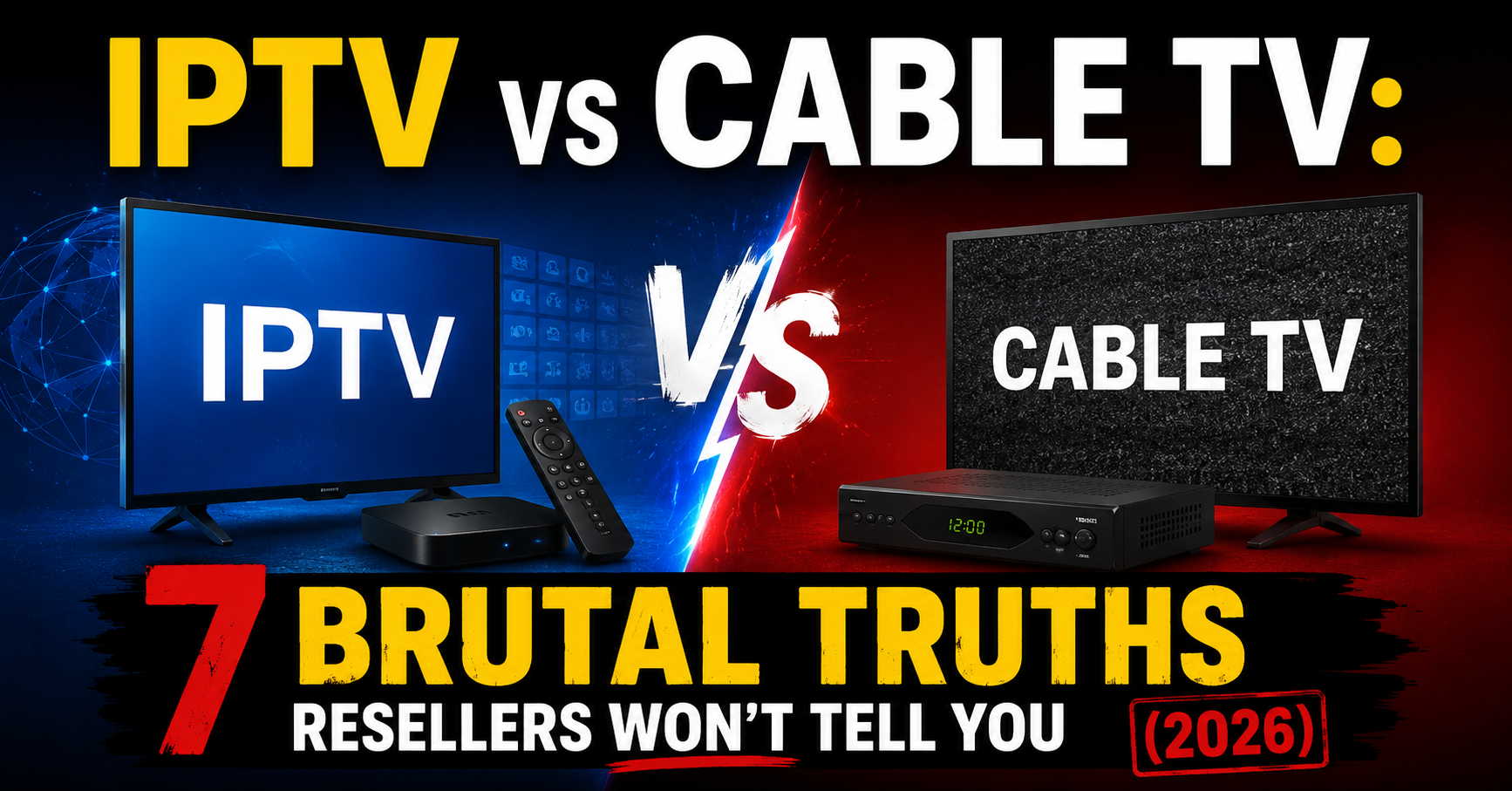
Somewhere around 2019, the IPTV vs Cable TV argument stopped being theoretical. Households weren’t debating anymore, they were cutting cords and cancelling contracts mid-cycle, eating the early termination fees like the cost of freedom. By 2026, that trickle became a flood. What used to be a niche conversation among tech enthusiasts is now a kitchen table decision for millions of families wondering why they’re still paying triple-digit bills for channels they never watch.
But here’s what most articles about IPTV vs Cable TV get completely wrong: they treat it like a feature comparison. Channels versus channels. Price versus price. That’s surface-level nonsense. The real gap between IPTV and cable sits underneath, in infrastructure economics, delivery architecture, and the raw mathematics of how content reaches your screen.
If you’re a IPTV reseller trying to understand why your subscribers churn, or a household trying to figure out where your money actually goes, the IPTV vs Cable TV question deserves a deeper autopsy than anyone’s given it.
Pro Tip: The biggest indicator that cable is losing isn’t subscriber counts, it’s how aggressively cable providers are launching their own IPTV-based streaming apps. They see the infrastructure writing on the wall.
How Cable Infrastructure Actually Bleeds Money
Cable television runs on coaxial and hybrid fibre-coaxial networks that were laid decades ago. Maintaining that physical plant, the buried cables, the junction boxes, the headend facilities, costs operators billions annually. Those costs don’t shrink as subscribers leave. They stay fixed. That’s the death spiral cable companies don’t advertise when you’re comparing IPTV vs Cable TV on a spec sheet.
Every truck roll for a technician visit, every damaged line after a storm, every neighbourhood node upgrade, these are costs baked into your monthly bill whether you watch three channels or three hundred. IPTV delivery eliminates the last-mile physical dependency entirely. Content travels over existing broadband infrastructure that the subscriber already pays for independently. The IPTV provider’s cost is server-side: bandwidth, CDN nodes, and panel management.
For IPTV resellers, this distinction matters enormously. When you’re operating in the IPTV vs Cable TV ecosystem, your margin isn’t eaten by truck rolls. It’s eaten by poor server selection, bad load balancing, and upstream providers who oversell capacity.
The Real Cost Anatomy: Not What You’ve Been Told
Most IPTV vs Cable TV comparisons throw out a monthly price and call it analysis. That’s lazy. Let’s dissect what a household actually spends across both models over twelve months.
| Cost factor | Cable TV (avg/year) | IPTV (avg/year) |
|---|---|---|
| Base subscription | £600-£1,200 | £50-£120 |
| Equipment rental (box/DVR) | £60-£120 | £0 (own device) |
| Installation fee | £50-£100 (one-time) | £0 |
| Hidden fees & surcharges | £80-£180 | £0 |
| Contract lock-in penalty | £100-£250 (if leaving) | £0 (monthly rolling) |
| Internet (required for IPTV) | Already paid separately | Already paid separately |
The maths speaks louder than any marketing copy. When households examine IPTV vs Cable TV through annual expenditure, the cable model looks like a legacy tax. That equipment rental line alone, paying monthly to rent a box you’ll never own, is a business model that wouldn’t survive five minutes if it were introduced today.
But cost alone isn’t why IPTV wins this comparison. It’s the structural flexibility beneath the pricing that creates separation.
Why Channel Bundles Are Cable’s Weakest Argument
Cable providers have leaned on channel count as a selling point for decades. “Get 500+ channels!” The problem? Research consistently shows the average cable household watches between 15 and 20 channels regularly. The rest is expensive noise padding out a bundle designed to subsidise licensing fees the provider negotiated for content most viewers never touch.
IPTV vs Cable TV flips this model. IPTV services, particularly at the IPTV panel level, allow operators to build packages around what subscribers actually consume. Sports-heavy packages. Entertainment-only tiers. Regional content bundles for diaspora communities. The granularity is a competitive weapon cable structurally cannot match because their licensing agreements mandate bundled carriage.
For resellers, this means your IPTV vs Cable TV pitch to potential subscribers isn’t about having more channels. It’s about having the right channels without the financial bloat.
- Identify your subscriber base’s top 3 content preferences before building packages
- Create micro-bundles that address specific viewing habits (sports, films, kids)
- Use panel analytics to track which channels actually get watched versus which ones sit idle
- Prune dead channels quarterly, they consume server resources without generating retention value
Pro Tip: The resellers who retain subscribers longest aren’t the ones with the biggest channel lists. They’re the ones who curate tightly and deliver those channels without buffering. Quality of 40 channels beats quantity of 4,000 every single time.
Buffering, Latency, and the Technical Truth About IPTV Delivery
Here’s where honesty matters more than salesmanship. The IPTV vs Cable TV reliability conversation is nuanced, and anyone telling you IPTV never buffers is either lying or selling something.
Cable TV, for all its cost inefficiency, delivers content through a dedicated closed network. Barring a physical line fault, the signal is consistent. There’s no dependency on your neighbour’s Netflix binge consuming shared bandwidth. That’s cable’s last remaining technical advantage, and it’s a legitimate one.
IPTV content travels over the open internet. It’s subject to congestion, ISP throttling, DNS poisoning, and routing inefficiencies. HLS latency can spike during peak hours, especially during major live sporting events when thousands of concurrent streams hit the same origin server.
The difference in 2026? Operators who understand infrastructure have largely solved these problems. The IPTV vs Cable TV buffering gap has narrowed to near-zero for well-managed services. The solutions aren’t secret:
- Multiple uplink servers across geographically diverse locations
- Proper load balancing that distributes concurrent streams across server clusters
- CDN integration that caches content closer to end users
- Proactive monitoring that reroutes traffic before a node goes critical
The resellers who still struggle with buffering are almost always running on a single upstream provider with no redundancy. That’s not an IPTV problem. That’s a business decision problem.
AI-Driven ISP Blocking: The 2026 Battlefield
Any serious IPTV vs Cable TV discussion in 2026 has to address the elephant nobody wants to name: ISP-level blocking powered by machine learning.
Major broadband providers have moved far beyond simple URL blacklists. Current enforcement systems use deep packet inspection combined with AI pattern recognition to identify IPTV traffic signatures, even when encrypted. They analyse connection patterns: sustained high-bandwidth streams to specific port ranges, DNS query patterns associated with known panel architectures, and traffic timing that correlates with live broadcast schedules.
This is the single biggest operational risk in the IPTV vs Cable TV landscape for resellers. Your service can be technically flawless, your streams can run at perfect quality, and a subscriber’s ISP can still degrade or block the connection at the network level.
Mitigation requires layered thinking:
- Educate subscribers about DNS configuration, switching away from ISP-default DNS prevents the simplest form of blocking
- Recommend VPN usage for subscribers in regions with aggressive enforcement
- Maintain backup uplink servers that rotate IPs and CDN endpoints
- Monitor ISP blocking trends by region and adjust server routing accordingly
Pro Tip: The resellers surviving ISP enforcement waves aren’t just technically sharp, they communicate proactively. When a blocking event hits, sending your subscriber base a clear, calm guide on switching DNS or enabling a VPN turns a crisis into a trust-building moment.
What Cable Still Does Better (And Why It Won’t Matter)
Intellectual honesty demands acknowledging where cable maintains advantages in the IPTV vs Cable TV matchup. Ignoring these makes you sound like a shill, not an analyst.
Cable handles emergency broadcast integration seamlessly, IPTV services often lack native emergency alert systems. Cable provides a single-bill simplicity that appeals to less technical households. And cable’s customer service infrastructure, however frustrating, does exist as a structured support channel with regulatory accountability.
But none of these advantages address the core economic problem. Cable’s cost structure was designed for an era of monopoly distribution. IPTV vs Cable TV isn’t a fight between two equal models, it’s a legacy system being outpaced by a delivery method that sits on infrastructure someone else already built and maintains.
The cable companies know this. That’s precisely why every major provider has quietly launched or acquired a streaming platform. They’re migrating themselves to IPTV architecture while still charging cable prices to the subscribers who haven’t noticed yet.
Reseller Margins: Where IPTV vs Cable TV Becomes a Business Case
For anyone operating a reseller panel, the IPTV vs Cable TV comparison isn’t academic, it’s your livelihood. Understanding margin structure is what separates resellers who scale from resellers who stall.
Cable reselling barely exists as a model. The infrastructure costs, licensing requirements, and regulatory overhead make it a closed ecosystem dominated by a handful of massive operators. IPTV reselling, by contrast, operates on a credit-based panel system where your margins are directly tied to your purchasing volume, subscriber management efficiency, and churn control.
| Factor | Cable reselling | IPTV reselling |
|---|---|---|
| Entry cost | £50,000+ (licensing/infrastructure) | £50-£200 (panel credits) |
| Margin per subscriber | Fixed by franchise agreement | Variable (30-70% depending on volume) |
| Subscriber management | Handled by parent company | Full control via panel |
| Churn response time | Weeks (bureaucratic process) | Minutes (panel-level action) |
| Scaling capability | Requires physical infrastructure | Server-side only |
This table alone explains why IPTV vs Cable TV isn’t just a consumer comparison, it’s an entrepreneurial one. The barrier to entry in IPTV reselling is low enough that anyone with operational discipline can build a sustainable business. The barrier in cable is a fortress.
Customer Churn Psychology in the IPTV vs Cable TV World
Cable companies have spent decades engineering retention through contracts, bundled discounts, and the sheer friction of cancellation. Ever tried cancelling cable? The retention department alone is a psychological operation designed to exhaust you into staying.
IPTV operates without that safety net. In the IPTV vs Cable TV retention game, your subscribers can leave at the end of any month with zero friction. That means your retention strategy has to be built on actual service quality rather than contractual entrapment.
The psychology of IPTV churn breaks down into three triggers:
Buffering during high-value content. A subscriber will tolerate occasional hiccups during a Tuesday afternoon cooking show. Buffer during a major live sporting event on Saturday night, and they’re gone before full-time.
Communication blackouts during outages. When something breaks, silence is the killer. Subscribers don’t leave because of downtime, they leave because nobody told them what was happening or when it would be fixed.
Stale channel lineups. If your competitor adds popular content and you don’t, subscribers notice. Panel operators who don’t audit their channel offerings monthly are handing churn to competitors on a plate.
Pro Tip: Build a simple broadcast channel, even just a Telegram group, where you post status updates during outages. The resellers with the lowest churn rates aren’t the ones with perfect uptime. They’re the ones with perfect communication.
Scaling an IPTV Operation Without Collapse
One of the least discussed angles in the IPTV vs Cable TV conversation is what happens when an IPTV reseller actually succeeds. Scaling from 50 subscribers to 500 exposes every infrastructure weakness you’ve been ignoring.
Cable scales through physical expansion, new lines, new nodes, new neighbourhoods. It’s slow and expensive but predictable. IPTV scaling is faster but far less forgiving. Your server that handled 50 concurrent streams beautifully will buckle under 300 during a peak event if you haven’t planned for load distribution.
The scaling checklist that separates survivors from casualties:
- Never rely on a single uplink server, one server going down shouldn’t mean your entire subscriber base goes dark
- Monitor concurrent connection counts daily, not monthly
- Upgrade server capacity before you need it, not after subscribers start complaining
- Negotiate volume credit pricing with your panel provider as you grow, your per-subscriber cost should decrease as your base increases
- Automate trial-to-paid conversion tracking so you’re not manually chasing leads
IPTV vs Cable TV scaling mechanics are fundamentally different, and understanding that difference is what keeps growing resellers from imploding under their own success.
The 2026 Verdict on IPTV vs Cable TV
Strip away the marketing, ignore the brand loyalty, and look at the infrastructure economics alone. IPTV vs Cable TV in 2026 isn’t a close contest. Cable is a delivery model built on physical scarcity, scarce bandwidth, scarce channels, scarce distribution points. IPTV is built on abundance, abundant bandwidth, customisable content, and global distribution at marginal cost.
Cable isn’t dead. It still serves millions of households who value simplicity and are either contractually locked in or simply haven’t explored alternatives. But every demographic and economic trend points in one direction.
For resellers, the IPTV vs Cable TV landscape represents an ongoing opportunity window. The market is maturing, ISP enforcement is increasing, and the operators who survive will be the ones who treat their infrastructure like a real business, redundant servers, proactive communication, curated content, and disciplined scaling.
The question was never really IPTV vs Cable TV.
The question is: how long until cable admits it?
Frequently Asked Questions
How does IPTV vs Cable TV differ in terms of content delivery technology?
Cable TV sends signals through physical coaxial or fibre-coaxial networks directly to your home, operating on a closed system. IPTV delivers content as data packets over your existing broadband internet connection using protocols like HLS. This fundamental architectural difference means IPTV relies on internet quality while cable relies on line infrastructure, each with distinct failure points and maintenance requirements.
Is IPTV vs Cable TV a fair comparison for live sports viewing?
For live sports, the comparison is closer than most areas. Cable delivers with minimal latency on its dedicated network. IPTV can experience HLS latency spikes during peak concurrent viewership, sometimes resulting in delays of 15-45 seconds behind live broadcast. However, well-managed IPTV services with proper load balancing and CDN integration have closed this gap significantly in 2026, making the difference negligible for most viewers.
Can I switch from cable to IPTV without losing local channels?
Most IPTV services include regional and local channel options, though coverage varies by provider and geography. Before switching, verify that your preferred local channels are available in the IPTV package you’re considering. Many households supplement IPTV with a low-cost digital antenna for local over-the-air channels, creating a hybrid setup that outperforms cable on both coverage and cost.
What internet speed do I need to make IPTV vs Cable TV a viable switch?
A stable connection of 25 Mbps handles standard definition and HD streams comfortably for a single device. For households running multiple simultaneous streams or 4K content, 50-100 Mbps is recommended. The critical factor isn’t raw speed, it’s connection stability. A consistent 30 Mbps connection outperforms a fluctuating 100 Mbps line for IPTV streaming quality every time.
Why do some IPTV services buffer while cable TV doesn’t?
Buffering occurs because IPTV data travels across the open internet, competing with all other traffic on your connection and network path. Cable operates on a dedicated closed circuit immune to internet congestion. IPTV buffering typically results from server overload, poor load balancing, ISP throttling, or inadequate subscriber-side bandwidth. Resellers can mitigate this through redundant uplink servers and geographic server distribution.
How does IPTV vs Cable TV compare for reseller profitability?
IPTV reselling operates on dramatically lower overhead than cable distribution. Entry costs are minimal, typically panel credits costing under £200, compared to the six-figure licensing and infrastructure investment cable distribution requires. IPTV reseller margins range from 30-70% per subscriber depending on volume, with full panel control over subscriber management, pricing, and package customisation.
Is ISP blocking a serious risk when choosing IPTV vs Cable TV?
In 2026, ISP-level blocking using AI-driven deep packet inspection is a real operational challenge for IPTV services in certain regions. Major broadband providers can identify and throttle IPTV traffic patterns. However, subscribers can mitigate this through DNS configuration changes and VPN usage. Resellers should maintain backup uplink servers with rotating endpoints and communicate proactively with subscribers about bypass methods during enforcement events.
Does cable TV offer better customer support than IPTV services?
Cable providers offer structured customer support with regulatory accountability, call centres, and technician dispatches. Most IPTV services rely on ticket systems, live chat, or messaging platforms for support. The quality gap depends entirely on the operator, some IPTV resellers provide faster, more personalised support through direct communication channels, while others offer virtually no support infrastructure at all. For resellers, responsive support is a direct competitive advantage.
IPTV vs Cable TV: Your Reseller Action Checklist
- Audit your current server infrastructure, identify single points of failure and add at least one backup uplink server this week
- Build a cost comparison sheet using real figures from your panel to demonstrate IPTV vs Cable TV savings to prospective subscribers
- Set up a subscriber communication channel (Telegram or WhatsApp broadcast) for outage updates and service announcements
- Review your channel lineup against actual viewership data from your panel, remove dead channels consuming server resources
- Create a simple DNS and VPN setup guide for subscribers in ISP-enforcement regions
- Negotiate volume credit pricing with your panel provider if you’ve crossed 100 active subscribers
- Establish a monthly churn audit, identify why subscribers leave and address the top reason before the next billing cycle
- Register your UK IPTV reseller business at britishreseller.com to access competitive panel pricing and multi-server infrastructure built for scale
- Monitor ISP blocking trends in your primary subscriber regions and adjust server routing quarterly
- Test your own service during peak hours every weekend, if you wouldn’t watch it, your subscribers won’t either