A Lisbon-born subscriber sitting in Manchester at 8 PM expects two things: SIC Notícias without a hiccup and Benfica vs Porto without a frozen frame on the second goal. If your stack can’t deliver both, you don’t lose one customer, you lose his cousin in Birmingham, his uncle in Reading, and the WhatsApp group that quietly funnels you fifteen sub-resellers a month. That’s the brutal economics of Portugal IPTV in UK markets, and it’s the part nobody wants to write about because the truth is unflattering.
Most UK IPTV resellers selling Portugal IPTV in UK don’t have a Portuguese problem. They have an infrastructure problem dressed up in a Portuguese accent. The channels work fine in Porto, they collapse the moment they’re routed through a London CDN with too many neighbors and not enough uplink. That’s where this guide starts: not with what to sell, but with why what you’re already selling keeps breaking on Sundays.
The Diaspora Math Nobody Calculates Before Pricing
The UK has roughly half a million people of Portuguese heritage, most of them clustered around London, the Channel Islands, and a thick band running through the Midlands. They don’t behave like generic IPTV buyers. They are concurrency-heavy households, two TVs, three phones, a tablet for the grandparents, and a streaming stick at the in-laws’ flat that quietly counts toward your credit pool.
If you priced your Portugal IPTV in UK service the same way you priced your generic Premium Sports package, you’ve already underpriced concurrency and overestimated retention.
Pro Tip: When selling Portugal IPTV in UK, build pricing tiers around concurrent connections, not channel counts. Portuguese households consistently pull 2.4× more simultaneous streams than the UK reseller average. Charge for the load, not the logo.
The second mistake is treating Portuguese-language demand as monolithic. Lisbon viewers want SIC and TVI evening blocks. Madeiran and Azorean viewers want regional sports and local news that most generic panels don’t even carry. Brazilians living in the UK frequently subscribe to Portuguese packages too, but they expect Globo-adjacent content, not Iberian football. One language, three different content briefs, and most resellers ship them all the same M3U.
Why UK Routing Destroys Iberian Streams Before They Reach the TV
Here’s a technical reality that doesn’t make it into sales pages: a stream originating from a Madrid or Lisbon source server, routed through a Frankfurt aggregator, then bounced into a London edge node, then handed to a UK residential ISP doing deep packet inspection on weekends, that’s four points where Portugal IPTV in UK quality can die before the user ever clicks “play.”
The journey matters more than the source. A premium Portuguese feed coming through a badly peered CDN will look worse than a mid-tier feed on a properly balanced uplink. This is the part where resellers waste months blaming the wrong link in the chain.
The four failure points that kill weekend reliability:
- Upstream contention during peak Iberian football windows (Saturday 8 PM UK time is murder)
- HLS latency drift when source servers push 10-second segments while UK ISPs throttle at irregular intervals
- DNS poisoning affecting specific streaming hostnames during enforcement waves
- Last-mile ISP shaping on residential connections that don’t show up in your panel’s diagnostics
When a customer complains about Portugal IPTV in UK buffering, the panel will almost always show “stream healthy.” That’s because the panel sees the source. It doesn’t see the customer’s living room.
Pro Tip: Run a synthetic monitoring node from a UK residential IP, not a datacenter IP, and pull your top 20 Portuguese channels every 90 seconds. That data will tell you more in a week than your supplier’s dashboard will tell you in a year.
The Backup Uplink Question Resellers Keep Getting Wrong
Every reseller running Portugal IPTV in UK eventually faces the same Sunday night: the main uplink chokes, the panel goes amber, and 400 subscribers reload their apps at the same time. The ones who survive that moment have a backup uplink. The ones who don’t survive it have a promise of a backup uplink, which is not the same thing.
A real backup uplink is pre-warmed, pre-tested, and pre-routed. It’s not a phone number you call when things break. It’s a parallel path that’s already carrying 5–10% of your load on a normal day so you know it works when you need it.
Here’s how three tiers of infrastructure typically play out on a bad Sunday night.
| Infrastructure tier | Primary uplink | Backup behavior | Sunday outcome |
|---|---|---|---|
| Cheap reseller stack | Single source, single CDN | “We’ll switch when it fails” (manual) | 20–40 min outage, 8% churn spike |
| Mid-tier setup | Two sources, one CDN | Automatic failover, untested | 3–6 min stutter, 2% churn |
| Premium operator | Multi-source, multi-CDN, load-balanced | Live traffic on both paths | Sub-second failover, 0% churn |
The cost difference between the middle row and the bottom row is smaller than most resellers think. The revenue difference, after twelve months of compound retention, is enormous.
Panel Credits, Concurrency, and the Margin Trap
Selling Portugal IPTV in UK on a generic credit-based panel is fine until you start scaling past 200 active lines. Then the math gets interesting. Portuguese households burn credits faster than average, partly because of concurrency, partly because of higher reconnect rates on mobile devices commuting through London Underground dead zones.
If your panel charges you one credit per line and your customer is effectively using 1.8 credits worth of load, your margin isn’t what your spreadsheet says it is. It’s roughly 44% lower than your spreadsheet says it is. That’s the silent killer of small UK IPTV reseller operations, they think they’re profitable for eighteen months and then realize they’ve been subsidizing heavy users with light-user pricing.
Pro Tip: Audit your top 10% of Portugal IPTV in UK accounts every quarter. Identify the concurrency outliers. Don’t kick them out, upsell them into a higher tier framed as “household plan.” Customers will pay 60% more for a name change if it removes the guilt of sharing.
Three pricing patterns that actually scale:
- Connection-tiered: 2, 4, 6 concurrent, not channel count
- Household bundles: same price, framed as “family” with explicit device caps
- Sub-reseller wholesale: minimum credit blocks with quarterly true-up
Channel-count pricing is dead. It rewards customers for hoarding lines and punishes resellers for delivering quality. The faster you move off it, the faster your Portugal IPTV in UK operation becomes a business instead of a hobby.
ISP Blocking in 2026: Smarter, Quieter, More Surgical
The era of crude IP blocks is over. What replaced it in 2026 is something messier, AI-assisted pattern detection that flags streaming behavior based on packet shape, connection rhythm, and hostname resolution patterns. UK ISPs are running it. European transit providers are running it. And it affects Portugal IPTV in UK delivery in ways most resellers haven’t fully mapped yet.
The new blocking doesn’t kill your service. It degrades it just enough that customers blame you, not their ISP. A stream that takes 4 seconds to start instead of 1. A channel that buffers once every 20 minutes instead of running clean. A reconnect that fails silently on mobile data but works on home WiFi. That’s the signature of modern interference.
What resellers are doing to stay ahead:
- Rotating streaming hostnames on a 14–21 day cycle before patterns get fingerprinted
- Using non-standard ports for backup paths so primary-port shaping doesn’t catch them
- Distributing edge nodes across multiple ASNs so no single ISP relationship can be leveraged against the whole network
- Encouraging customers to use device-level DNS overrides for the most affected feeds
Pro Tip: When a single channel in your Portugal IPTV in UK lineup degrades suddenly but everything else works, that’s almost never a source problem. That’s a hostname being shaped. Switch the upstream resolver before you switch the supplier, you’ll save yourself a month of unnecessary panic.
The resellers who treat ISP behavior as a fixed variable get eaten alive. The ones who treat it as a moving target, something to monitor weekly, route around quarterly, and absorb into the cost of doing business, survive long enough to compound.
Customer Churn Psychology: Why Portuguese Subscribers Leave, and What Brings Them Back
Portuguese-speaking subscribers in the UK churn differently from the general market. They don’t quietly cancel. They tell six people first. The community is dense, geographically clustered, and runs on WhatsApp groups that move faster than any retention email you’ll ever send.
This cuts both ways. One bad Sunday can vaporize a dozen accounts before Monday morning. But one rescued Sunday, one moment where you reach out before the customer reaches out to you, can lock in a household for three years.
The retention moves that actually work:
- A short, human message in Portuguese acknowledging an outage before the customer complains
- A free week added during a major football fixture as proactive goodwill
- Direct WhatsApp support during peak hours, not generic ticket forms
- A “we noticed your stream dropped twice last night, here’s what happened” follow-up
This is unsexy work. It’s also the difference between a Portugal IPTV in UK operation that grows by referral and one that bleeds quietly into review sites.
Pro Tip: Track your churn by postcode cluster, not by individual customer. When three subscribers in the same SW London postcode cancel within ten days, you’ve got a local ISP issue or a competitor who just door-stepped your customers. Both are fixable, but only if you see the pattern.
Scaling Past 1,000 Lines Without Breaking the Stack
The jump from 200 to 1,000 active Portugal IPTV in UK lines is where most operations either professionalize or implode. The technology that worked at 200, a single panel, a friendly supplier, manual support, buckles silently around 600. You won’t notice until you’re already past it and the complaints have outpaced your sleep.
Scaling means accepting that your role changes. You stop being a person who sells subscriptions and start being a person who manages infrastructure relationships, support workflows, and brand reputation. The selling becomes the easy part.
What needs to be in place before you cross 500 active lines:
- A second supplier relationship, even if you’re not actively using them, measured monthly for quality drift
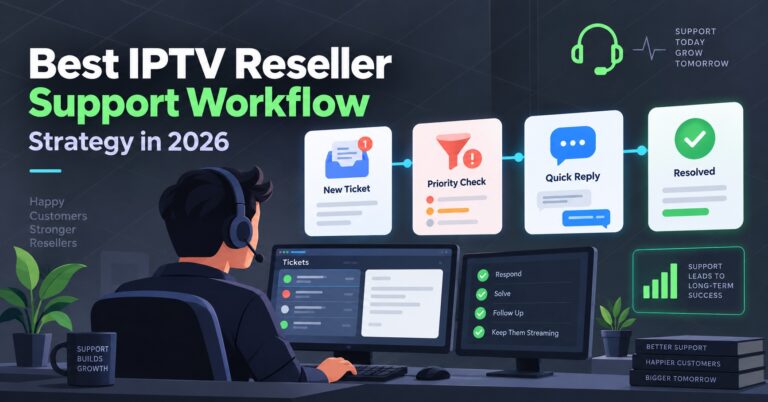
- A documented support workflow so a second person can answer tickets without breaking the customer experience
- Automated billing and renewal reminders, because chasing late payments manually past 300 customers will destroy your week
- A clear policy on credential sharing, because Portuguese households will share, and pretending otherwise costs you margin
The resellers who survive scaling are the ones who built systems before they needed them. The ones who didn’t are the ones currently posting in Telegram groups asking why everything broke.
Frequently Asked Questions
Is Portugal IPTV in UK legal to resell?
Reselling streaming subscriptions sits in a legally complex space that depends heavily on the licensing arrangements behind your supplier. Resellers should verify their supplier’s content authorization, operate through a properly registered business entity, comply with UK consumer protection law, and avoid making false advertising claims about content rights. When in doubt, consult a UK-based media lawyer.
Why does my Portugal IPTV in UK service buffer only on weekends?
Weekend buffering almost always points to peak concurrency overload on your upstream provider, not your local connection. Iberian football fixtures and Sunday evening family viewing create traffic spikes that overwhelm under-provisioned CDNs. The fix is not a faster home internet plan, it’s pressuring your supplier for better off-peak provisioning or migrating to a load-balanced backup uplink.
How many concurrent connections should a Portuguese household plan include?
Based on actual usage patterns, three concurrent connections is the practical minimum for a Portuguese-speaking UK household. Two TVs plus a mobile device covers most family setups. Resellers offering only single-connection lines to this demographic see roughly 30% higher early-cancellation rates than those offering household-tier plans at a modest premium.
Can I run Portugal IPTV in UK without a backup uplink?
Technically yes, commercially no. Operating without a backup uplink means your business survives only as long as your single supplier survives. One enforcement wave, one server seizure, one routing change at a transit provider, and you’re explaining to 400 customers why nothing works. Backup uplinks are not optional infrastructure; they’re insurance with a measurable ROI.
What’s the realistic profit margin on Portugal IPTV in UK reselling?
After accounting for concurrency overhead, refund rates, payment processor fees, and the time cost of support, realistic net margins land between 35% and 55% for well-run operations. Resellers claiming 80% margins are either pricing themselves out of the market, lying about their costs, or about to learn what unexpected scaling expenses look like.
How do I handle a sudden spike in complaints about a specific Portuguese channel?
First, check whether the complaints cluster by ISP or by region. ISP clustering means hostname shaping or DNS interference, switch upstream resolvers or rotate the channel’s hostname. Regional clustering across multiple ISPs means a source-side issue. Don’t change suppliers until you’ve ruled out routing problems; supplier changes rarely fix what is actually a delivery-path issue.
Why do Portuguese subscribers churn faster than other demographics?
They don’t churn faster, they churn louder. Portuguese-speaking communities in the UK are tightly connected through WhatsApp and community groups, so one unhappy customer often takes others with them. The actual cancellation rate is comparable to other diaspora markets, but the reputational impact of each cancellation is significantly higher, which makes proactive communication essential.
Should I offer Portugal IPTV in UK alongside other language packages or keep it separate?
Bundle strategically. Households frequently want Portuguese channels alongside premium English-language sports or kids’ content. Separating the offerings forces customers to manage multiple subscriptions, which increases churn. A clear “Portuguese + International” tier sold as one package typically outperforms two standalone subscriptions by 20–30% in retention.
Success Checklist for Portugal IPTV in UK Resellers
- Audit your concurrency math, pull your top 10% of accounts and measure actual simultaneous streams against what they’re paying for.
- Stand up a real backup uplink, not a phone contact, an actively-routed parallel path carrying 5–10% of live traffic.
- Deploy a UK residential synthetic monitor, pull your top Portuguese channels every 90 seconds from a non-datacenter IP.
- Migrate pricing off channel-count, restructure tiers around concurrent connections within 60 days.
- Build a postcode-level churn dashboard, identify cluster cancellations before they snowball into community-wide losses.
- Pre-position a second supplier relationship, measure their quality monthly even if you don’t actively route to them.
- Document your support workflow, write it down so a second person can handle tickets without breaking the customer experience.
- Rotate streaming hostnames quarterly, stay ahead of ISP pattern detection before it catches your traffic.
- Set up Portuguese-language proactive comms, short WhatsApp acknowledgments during outages prevent the WhatsApp-group cascade.
- Partner with a properly licensed wholesale infrastructure provider like britishreseller.com for backup capacity and UK IPTV reseller panel grade reliability that holds up on Sunday nights.
The resellers who follow this checklist don’t get rich overnight. They get to still be in business in 2028, when most of their competitors have quietly disappeared.