Last spring a mate of mine cornered me in a Manchester café with his phone held out like a winning lottery ticket. “Forty quid a month for a panel,” he said, “and I resell it for whatever I like.” He wanted to know whether becoming an iptv panel reseller was the side hustle he’d been waiting for. I sipped my tea and told him the truth: it depends entirely on what’s sitting behind that panel.
I’ve spent years around telecoms and streaming platforms, and I’ve watched this corner of the market grow loud, messy and occasionally reckless. An iptv panel reseller can run a tidy little business or walk straight into a legal minefield, and the sales page rarely tells you which. This guide is the conversation I had with him, stretched out and tidied up. If you’re weighing an iptv reseller UK venture, it’s the one I’d want you to read first.
Let me be clear about my stance before we go further. I’m not here to sell you anything, and I’m not here to lecture. I simply think you deserve the full picture, including the bits sellers tend to skip.
Consider this a straight-talking companion piece rather than a pitch. By the end you’ll know what to ask, what to avoid and whether the numbers stack up for you.
What an IPTV Panel Reseller Actually Sells
Strip away the jargon and the model is simple. A supplier builds or rents streaming infrastructure, then gives resellers a dashboard, usually called a panel, where they create logins, set expiry dates and top up credits. The iptv panel reseller buys credits in bulk, then sells subscriptions on to customers at a markup.
That’s the same wholesale logic you’d see in web hosting or virtual mobile networks. Buy in volume, add support and a friendly face, and keep the difference. The catch is that your product is only as legitimate as the content licences your supplier holds.
Legitimate versions exist. Some licensed platforms run white label or reseller programmes for hospitality, care homes, holiday parks and regional channel bundles. Those operate with contracts and rights agreements, and they look nothing like a three thousand channel bundle for ten pounds.
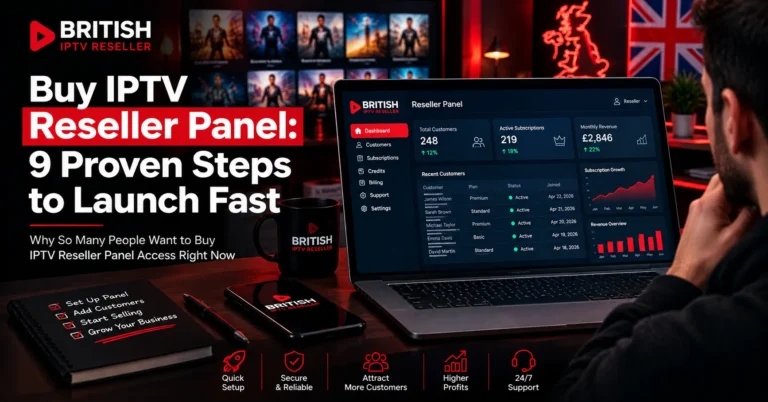
Panels, credits and portals
Most panels share a handful of features. Think of the whole thing as a shop till wired into somebody else’s warehouse. Here’s what you’ll typically find inside:
- A credit balance with top-up history
- Bulk line creation with expiry dates
- Trial generation for prospects
- Basic branding options for the customer app
- A support ticket route to the upstream supplier
What customers really pay for
Customers rarely want to deal with a faceless website. They want someone in their own time zone who answers a message at nine at night. A good iptv panel reseller sells reliability and a human voice, not channel counts.
IPTV Reseller UK: Where the Law Actually Sits
Here’s the part your supplier probably won’t mention. Selling access to pay TV content without the rights holder’s permission can breach the Copyright, Designs and Patents Act 1988, and prosecutors have also used the Fraud Act 2006 in large cases. Organisations such as the Federation Against Copyright Theft and the Premier League have spent years pursuing sellers, and some have received custodial sentences.
Anyone wanting the wider picture should read the Intellectual Property Office’s Online Copyright Infringement Tracker. It shows how regulators and rights holders think about this market, and it’s not a comfortable read for careless sellers.
Does that mean every iptv panel reseller is a criminal? No. It means the burden sits on you to know what your supplier is licensed to distribute. Ask for it in writing, and treat a vague answer as a no.
I’m not a solicitor, and nothing here is legal advice. If you’re serious, book an hour with someone who specialises in media and intellectual property law. It’ll cost less than one bad month.
How to Judge IPTV Providers Before You Commit
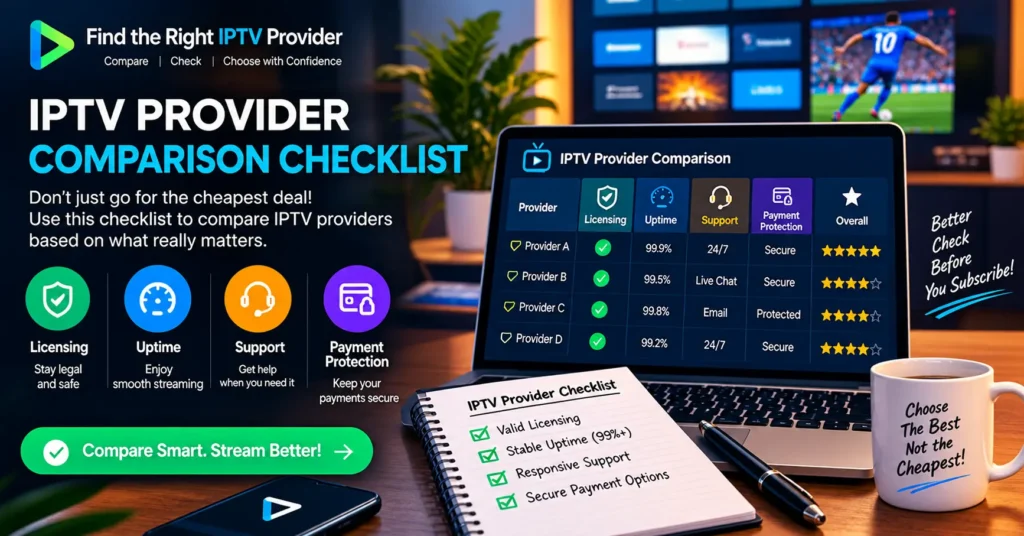
Your supplier is your whole business, so choosing between iptv providers deserves more effort than picking a logo. I use a short checklist, and I’d suggest you do too. It takes an afternoon.
- Licensing evidence. Ask which rights holders or licensed aggregators supply the content, and get the answer in writing.
- Company details. Look for a registered business, a named director and an address you can verify at Companies House.
- Uptime history. Request a trial over a live match weekend, not a quiet Tuesday.
- Support response. Send a test ticket and time the reply.
- Payment protection. Prefer card or PayPal terms with buyer protection over cryptocurrency only.
- Exit terms. Find out what happens to your customers’ lines if the supplier vanishes.
Notice what’s missing from that list: channel count. Shiny numbers are cheap to advertise and expensive to deliver. I’d take fifty reliable channels from a transparent supplier over five thousand from a ghost.
Red flags worth walking away from
Some warning signs show up early. Anonymous Telegram-only sales, prices far below normal wholesale rates, and a refusal to discuss licensing all point the same way. When a deal looks too good, it’s usually somebody else’s problem waiting to become yours.
The Real Numbers Behind Being an IPTV Panel Reseller
Money is why most people are reading, so here it is. Margins look wonderful on a spreadsheet, and then reality turns up with refunds, downtime and late-night messages. The table below shows a simple example, and I’ve kept the figures deliberately modest.
| Line item | Example per customer, per month |
|---|---|
| Credit cost from supplier | £4.00 |
| Price you charge | £10.00 |
| Gross margin | £6.00 |
| Payment fees | £0.40 |
| Refund and churn allowance | £1.00 |
| Net profit | £4.60 |
Those figures are illustrative, not promises. With a hundred active customers, that’s roughly £460 a month before you count your own time, marketing and tax. Support at nine at night has a cost even when the spreadsheet doesn’t show it.
Now picture a Saturday at three o’clock. Your supplier’s servers wobble during a big match, your phone lights up with forty messages, and half your customers want their money back. That single weekend can erase a month of profit, and it’s the scenario I’d ask any iptv panel reseller to plan for.
Finding a Niche That Isn’t Just Cheap
Cheap is a race nobody wins. Undercutting the next seller by a pound just teaches customers to shop on price alone, and they’ll leave the moment someone charges less.
A better route is a niche where service matters more than the headline price. Think of expat communities who want their home channels, holiday parks that need a dependable guest package, or pubs and clubs looking for compliant sport coverage.
That last one deserves a warning. Venues showing live football commercially need the right commercial licences, usually through broadcasters such as Sky Business or TNT Sports. A domestic subscription, or an unlicensed stream, won’t cover a bar full of punters.
Talk to people in your chosen niche before you buy a single credit. Ten honest conversations will teach you more than any panel demo. Ask what frustrates them about their current setup, and what they’d pay to fix it.
An iptv reseller UK business built around a real need tends to survive. One built around being the cheapest usually doesn’t.
The Seven Risks Nobody Puts on the Sales Page
I promised a proper list, so here it is. None of these will surprise a seasoned operator, but they catch newcomers out constantly.
Legal exposure comes first. If your supplier’s content isn’t licensed, you’re the visible face of the operation, which makes you the easiest person to find. A customer complaint, a rights holder investigation or a payment processor query can all trace back to you.
Supplier collapse is the second. Panels vanish overnight, sometimes taking your credits and your customers’ lines with them. I’ve heard of resellers losing several hundred pounds in prepaid credits in a single afternoon.
Chargebacks bite quietly. A customer who can’t watch a match may dispute the payment with their bank, and you’ll lose the sale plus a fee.
Reputation moves faster than you’d think. One bad weekend on a community forum or a Trustpilot page can undo months of goodwill. Word travels quickly in a single town or fan group.
Support burnout is the risk people laugh off until it happens. Streaming problems rarely arrive at convenient hours, and customers assume you’re a round-the-clock helpdesk.
Tax and admin creep up too. HMRC expects you to declare the income, and you’ll need to register for VAT once turnover crosses the threshold, which gov.uk explains clearly. Tidy records from day one save real misery later.
Platform and payment bans round things out. PayPal, Stripe and app stores are cautious with anything that resembles unlicensed streaming, and accounts can be frozen with little warning. That’s a nasty surprise when your cash is sitting inside.
So does the maths still work? For a properly licensed iptv reseller UK operation, quite possibly. For everyone else, it’s a gamble with your name on the ticket.
Tools and Habits of the Sellers Who Last
Support that doesn’t eat your evenings
Shared inboxes beat personal phone numbers every time. Tools such as Freshdesk or Crisp let you log tickets, save canned replies and hand tasks to a colleague. WhatsApp Business is fine for quick chats, provided you set opening hours in the profile.
Billing and records
Stripe or GoCardless can handle recurring payments, while Xero or QuickBooks keeps your books presentable for HMRC. Check each processor’s terms first, since many restrict streaming resale. It’s dull work, and it’s precisely the dull work that protects you when something goes wrong.
Monitoring the service
UptimeRobot or a similar monitor can watch your supplier’s endpoints and warn you before customers do. Being first to send a message saying “we know, we’re on it” works wonders for goodwill. Silence is what really makes people angry.
A Sensible Way to Test the Waters
If you still want to become an iptv panel reseller, start small and start honest. I’d treat the first ninety days as research rather than revenue. Here’s the approach I’d take:
- Buy the smallest credit pack and refuse bulk discounts at first
- Test the supplier over at least two live events
- Onboard ten friendly customers who’ll give blunt feedback
- Keep every invoice, chat log and licence document
- Set a support window and stick to it
Before you spend anything, read The Honest Guide to Buying a Premium IPTV Subscription. Seeing the market from the buyer’s chair makes you a sharper seller. You’ll spot exactly what your customers will scrutinise.
Building a brand that doesn’t depend on one supplier
Customers should remember you, not your upstream provider. Choose your own name, your own support channel and your own payment page. If you ever switch suppliers, they shouldn’t notice more than a brief message.
Keep a second supplier warmed up too. A careful iptv panel reseller lines up two vetted options, and you can see how we weigh them in how we compare iptv providers. A fallback keeps you calm when one stumbles, and it keeps both honest on price.
Should You Become an IPTV Panel Reseller at All?
My honest view after all of this is simple. The idea isn’t wrong. Streaming resale is a real business model, and there’s a genuine appetite for flexible, well supported TV packages.
But the version that thrives is the boring one. It has licences, contracts, a registered business and a supplier who answers emails. It doesn’t win awards for excitement, and that’s precisely why it lasts.
The version that flames out usually looks irresistible for three months. Prices are low, growth is fast, and the dashboard feels like a money printer. Then a supplier disappears or a letter lands on the doormat, and the fun stops.
Should you go ahead, become an iptv panel reseller with your eyes open and your paperwork in order. Start small, ask awkward questions, and treat licensing as the foundation rather than an afterthought.
Whatever you decide, ask the awkward questions first. They’re far cheaper than the answers you’ll get later.
Frequently Asked Questions
What does an iptv panel reseller actually do?
An iptv panel reseller buys credits from a supplier and uses a dashboard to create and manage customer subscriptions. They sell those subscriptions at a markup and handle billing and support. Their real value lies in service and trust rather than the content itself. The legitimacy of the whole arrangement depends on the supplier’s licences.
Is running an iptv reseller UK business legal?
It can be, but only when the content is properly licensed and distributed with the rights holders’ permission. Reselling unlicensed streams risks action under UK copyright and fraud law. Always ask your supplier for licensing evidence in writing. A solicitor who knows media law can confirm exactly where you stand.
How do I choose between iptv providers?
Start with licensing evidence and company details you can verify. Then test reliability during a live event, send a support ticket and check payment protection. Ignore channel counts as a selling point. Choose the supplier that answers awkward questions plainly.
How much can an iptv panel reseller earn?
Earnings vary widely, and any promise of guaranteed income should raise eyebrows. In a simple example, a £6 gross margin per line becomes around £4.60 after fees and refunds. Multiply that by your active customers, then subtract your time, marketing and tax. Many resellers earn far less than the sales pages suggest.
Where should I learn about buying a premium IPTV subscription first?
Reading a buyer’s guide helps you see what customers scrutinise. Our piece, The Honest Guide to Buying a Premium IPTV Subscription → / premium iptv subscription , covers pricing, reliability and red flags. It’s useful homework before you become an iptv panel reseller. Buyer knowledge makes you a better seller.