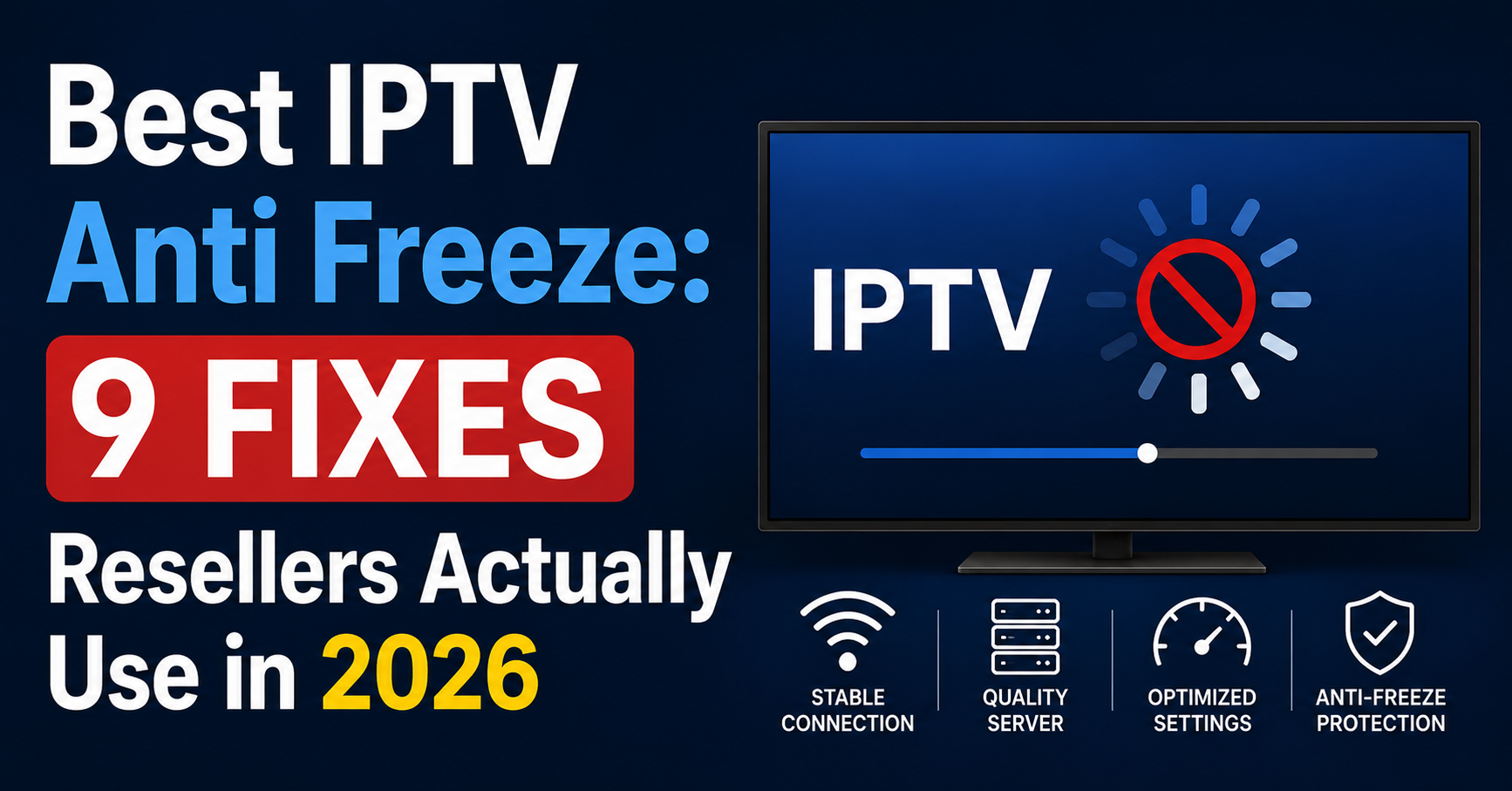
There is a specific silence that fills a room when three hundred subscribers start complaining at once. No dramatic crash. No obvious alarm. Just a wave of WhatsApp messages rolling in, one after another, all saying the same thing, “it’s freezing again.” If you have been on the receiving end of that silence, you already know why best IPTV anti freeze is not optional knowledge. It is survival infrastructure.
Most articles on this subject hand you a list of five player settings and call it a day. That approach fails because freezing is rarely a single-cause problem. The best IPTV anti freeze strategy addresses every layer of the delivery chain simultaneously, from the origin server sitting in a data centre halfway across the continent to the subscriber’s £30 Android box balanced on top of their television.
This is the version of the conversation that nobody publishes. The one built from server crashes at midnight, panicked migrations between providers, and hard lessons about what actually keeps streams stable when thousands of eyeballs are watching at the same time.
Why Freezing Destroys Reseller Businesses Faster Than Price Competition
A subscriber will tolerate a slightly higher price. They will forgive occasional channel list changes. What they will never forgive is a stream that freezes during the final ten minutes of a knockout match.
Freezing is the single highest driver of subscriber churn in the IPTV reseller ecosystem. Not pricing. Not channel count. Freezing. And the financial damage compounds quickly:
- A UK IPTV reseller with 200 subscribers losing 15 percent monthly to freeze complaints bleeds 30 paying customers every billing cycle
- Replacing those customers costs credits, advertising spend, and onboarding time
- Negative word-of-mouth travels faster than any promotional campaign you run
The best IPTV anti freeze approach is not a technical nicety. It is a direct revenue protection strategy. Every freeze you prevent is a subscriber you keep. Every subscriber you keep is profit you do not have to chase again next month.
Pro Tip: Track your freeze-related complaint volume separately from general support tickets. If freeze complaints exceed 8 percent of your active subscriber base in any given week, your infrastructure needs immediate attention, not next month, not after you “see how it goes.”
The Anatomy of a Freeze: Understanding What Actually Breaks
Before throwing solutions at the wall, a competent operator maps the problem. A freeze occurs when the video player’s local buffer empties, the data pipeline from server to screen cannot deliver packets fast enough to maintain continuous playback. But that pipeline has at least five distinct segments, and the break can happen at any one of them.
Segment one is the origin server. When concurrent connections exceed capacity, the server starts dropping packets or queuing requests. During a major sporting event, a single node might jump from 400 to 2,000 active streams in under ten minutes. Without proper load distribution, every subscriber on that node experiences degradation.
Segment two is the middleware or CDN layer. This is where load balancing either saves the stream or becomes the bottleneck. Poor geographic distribution means a subscriber in Manchester might be pulling data from a server in Frankfurt when a closer London node is sitting half-empty.
Segment three is ISP-level interference. In 2026, deep packet inspection technology has become remarkably sophisticated at identifying streaming traffic patterns, and throttling or DNS poisoning can silently degrade streams without producing a clean error message.
Segment four is the local network. Wi-Fi congestion, outdated routers, and competing devices all eat into available bandwidth at the last mile.
Segment five is the player application itself. Buffer settings, decoder selection, and hardware acceleration choices determine how gracefully the player handles micro-interruptions in data flow.
The best IPTV anti freeze strategy treats all five segments as a single system. Fix one while ignoring the others and you are patching holes in a sinking ship.
Server-Side Anti Freeze Configurations That Real Operators Use
This layer sits outside most resellers’ direct control, which is precisely why choosing the right panel provider matters more than almost any other business decision you make. The best IPTV anti freeze performance starts at the server before a single byte reaches your subscriber.
Adaptive bitrate streaming is the foundational technology. A properly configured server detects when a subscriber’s connection cannot sustain the full stream quality and dynamically drops the bitrate, perhaps from 1080p to 720p, for a few seconds rather than letting the buffer drain to zero. The subscriber sees a brief softening of picture quality instead of a hard freeze. That trade-off is invisible to most viewers but catastrophic when absent.
| Feature | Budget infrastructure | Premium infrastructure |
|---|---|---|
| Adaptive bitrate | Rarely supported | Standard across all streams |
| Backup uplink servers | None | 2-3 automatic failover nodes |
| HLS segment length | 8-10 seconds | 2-4 seconds |
| Geographic CDN coverage | Single region | Multi-region with edge caching |
| Concurrent stream capacity | 500-1,000 per node | 3,000+ with auto-scaling |
| Real-time monitoring | Basic or none | Live dashboards with alerts |
Ask your provider these specific questions before committing credits. If they cannot answer clearly, your best IPTV anti freeze efforts downstream will always be fighting against a weak foundation.
HLS Latency and Segment Length: The Technical Detail Most Resellers Miss
Here is a detail that separates informed operators from everyone else. HLS, HTTP Live Streaming, works by chopping the video feed into small segments and delivering them sequentially. The length of those segments directly impacts freeze behaviour.
Longer segments (8-10 seconds) mean the player must wait longer for each chunk. If a single segment fails to arrive, the gap before the next one creates a noticeable freeze. Shorter segments (2-4 seconds) reduce this risk dramatically because the player can recover faster and request the next piece almost immediately.
The best IPTV anti freeze infrastructure uses short HLS segments combined with aggressive prefetching, the player begins downloading the next two or three segments before the current one finishes playing. This creates a rolling buffer that absorbs network hiccups without the subscriber ever noticing.
Pro Tip: When evaluating a new provider, request a test line and use a network analysis tool to inspect the HLS manifest file. Look at the EXTINF values, these tell you the actual segment duration. If you are seeing consistent values above 6 seconds, that provider has not optimised for anti-freeze performance regardless of what their sales page claims.
DNS Poisoning and ISP Blocking: The Invisible Freeze Trigger
Some freezes have nothing to do with your server or your subscriber’s device. They originate silently at the ISP level, and in 2026 this is the fastest-growing category of stream disruption across the UK and European markets.
ISPs deploy DNS poisoning to redirect server requests to dead endpoints. They use deep packet inspection to identify and throttle streaming protocol signatures. Some have begun implementing SNI filtering that targets specific server hostnames. The result from the subscriber’s perspective is identical to a server-side freeze, the stream stutters, buffers, and dies, but no amount of player tweaking will fix it because the data is being strangled before it reaches their router.
The best IPTV anti freeze defence against ISP interference involves multiple layers:
- Encrypted DNS: DNS over HTTPS or DNS over TLS prevents ISP-level DNS poisoning by encrypting resolution queries
- VPN tunnelling: Wrapping the entire stream inside an encrypted VPN tunnel makes deep packet inspection blind to the traffic content
- Server hostname rotation: Premium providers rotate their server domains periodically to stay ahead of SNI filtering lists
- Alternative DNS resolvers: Switching from ISP-default DNS to independent resolvers eliminates one of the simplest interception points
Educating your subscribers on basic DNS and VPN configuration is not optional anymore. It is a core part of delivering a best IPTV anti freeze experience in the current enforcement environment.
Player-Side Buffer Settings: Where Subscribers Can Help Themselves
Not every fix requires server-level intervention. A significant percentage of freeze complaints trace back to player misconfiguration on the subscriber’s own device. Empowering your customers with correct settings reduces your support burden and improves their experience simultaneously, a genuine win on both sides.
The critical player-side settings for best IPTV anti freeze performance are buffer size, decoder type, and hardware acceleration.
Buffer size determines how many seconds of video the player downloads ahead of playback. Most apps default to a conservative 2-3 seconds. Increasing this to 5-8 seconds gives the player a much larger cushion to absorb network fluctuations without visible interruption. On apps like TiviMate, IPTV Smarters Pro, or OTT Navigator, this setting is usually accessible in the player or streaming configuration menu.
Decoder selection matters more than most subscribers realise. Hardware decoding offloads video processing to the device’s dedicated media chip, which is dramatically more efficient than software decoding. However, some older devices have hardware decoders that struggle with certain codecs, particularly H.265/HEVC. In those cases, switching to software decoding or a hybrid mode can actually reduce freezing even though it uses more CPU.
Pro Tip: Create a one-page PDF setup guide customised to your panel’s recommended settings. Send it to every new subscriber during onboarding. This single document will cut your freeze-related support tickets by roughly a third within the first month.
The Wi-Fi Problem Nobody Wants to Admit
Resellers spend hours investigating server performance and player configurations while ignoring the most common freeze culprit in residential environments, Wi-Fi congestion.
A household running a 4K IPTV stream alongside three smartphones, a tablet streaming YouTube, a laptop on a video call, and a smart speaker downloading updates is a household where the router is silently drowning. The best IPTV anti freeze advice you can give many subscribers is brutally simple: use a wired Ethernet connection.
An Ethernet cable from the router to the streaming device eliminates Wi-Fi interference entirely. No signal degradation through walls. No channel congestion from neighbouring networks. No bandwidth competition from other wireless devices. A stable 30-50 Mbps wired connection will outperform a theoretical 200 Mbps Wi-Fi connection that fluctuates wildly under load.
For subscribers who cannot run a cable, powerline adapters offer a middle ground, using the home’s electrical wiring to create a quasi-wired connection between the router and the device. They are not perfect, but they are substantially more reliable than Wi-Fi for sustained high-bandwidth streaming.
| Connection type | Typical stability | Best IPTV anti freeze rating |
|---|---|---|
| Wired Ethernet | Excellent, consistent throughput | Highest reliability |
| Powerline adapter | Good, depends on wiring quality | Strong alternative |
| 5 GHz Wi-Fi (same room) | Moderate, degrades with distance | Acceptable short-range |
| 2.4 GHz Wi-Fi | Poor, heavy congestion band | Frequent freeze risk |
Load Balancing and Backup Uplink Servers: Reseller-Level Decisions
If you are operating at any meaningful scale, say 300 subscribers or more, your relationship with your upstream provider’s load balancing architecture becomes a business-critical dependency. The best IPTV anti freeze resilience at this level comes from understanding how your provider distributes traffic during peak demand.
A single-node provider is a single point of failure. When that node reaches capacity, every subscriber connected to it experiences degradation simultaneously. There is no failover. There is no graceful degradation. There is just a wall of complaints.
Premium infrastructure uses multiple geographically distributed nodes with automatic failover. If the primary London node reaches 80 percent capacity, new connections route to a secondary node in Amsterdam or Paris. If the primary node fails entirely, active connections migrate to backup uplink servers with minimal interruption, sometimes just a two-second reconnection that most subscribers will not even notice.
Pro Tip: Ask your provider directly: “What happens when your primary server for my region goes down during a peak event?” If the answer is vague or involves manual intervention, your best IPTV anti freeze strategy has a ceiling that no amount of player tweaking can raise.
Panel Credit Economics and Anti-Freeze Quality: The Hidden Connection
Here is an angle that almost nobody discusses openly. The price you pay per credit directly correlates with the infrastructure quality behind those credits. Resellers chasing the absolute cheapest panel credits are almost always buying access to overloaded, under-maintained servers with zero redundancy.
The best IPTV anti freeze performance costs more per credit. That is not marketing, it is infrastructure economics. Shorter HLS segments require more server processing power. Geographic CDN distribution requires more hardware in more locations. Backup uplink servers require duplicate capacity sitting idle until needed. Adaptive bitrate encoding requires real-time transcoding resources. All of this costs money, and that cost flows through to credit pricing.
A reseller paying 20 percent more per credit but delivering a freeze-free experience will retain subscribers at double or triple the rate of a UK IPTV reseller selling dirt-cheap lines that buffer every evening. The maths favours quality every single time once you factor in customer acquisition costs and churn replacement.
Scaling Without Sacrificing Stream Stability
Growth creates its own freeze problems. A panel that performs beautifully with 100 subscribers can collapse under the weight of 500 if the underlying infrastructure was not built for horizontal scaling.
The best IPTV anti freeze approach during scaling involves staged growth with continuous monitoring:
- Add subscribers in batches of 50-100 rather than onboarding 300 in a single week
- Monitor peak-hour performance after each batch for at least one full weekend cycle before adding more
- Maintain a secondary provider relationship as a failover option, if your primary provider’s quality degrades under your growing load, you need an alternative ready immediately
- Track your buffering complaint ratio as a percentage of active subscribers, not as an absolute number, a flat complaint count while your subscriber base doubles means your freeze rate is actually improving
Scaling aggressively without monitoring is how resellers discover their provider’s real capacity limits, usually at the worst possible moment, during the most-watched event of the month.
Pro Tip: The single most valuable metric for a scaling reseller is “freeze complaints per 100 active subscribers per week.” If that number starts climbing, pause growth and investigate before it becomes a retention crisis.
Building a Subscriber Troubleshooting Workflow That Reduces Churn
A freeze complaint handled in under three minutes is a subscriber saved. A freeze complaint that drags into a 20-minute back-and-forth troubleshooting session is a subscriber who starts browsing your competitor’s pricing page halfway through.
The best IPTV anti freeze resellers build a structured triage process:
Step one, confirm the scope. Is this affecting one channel, one category, or everything? A single-channel freeze points to a source-feed issue. A category-wide freeze suggests a server node problem. Total freezing across all content points to ISP interference or a local network fault.
Step two, check the device. Ask the subscriber to test on a second device if available. If the freeze persists across devices, the problem is upstream from the hardware. If it clears on the second device, the issue is player or device configuration.
Step three, test the network. Have them run a speed test. Not just download speed, look at upload speed and ping stability. A connection showing 80 Mbps download but 200ms ping with high jitter will freeze regardless of bandwidth.
Step four, apply the fix. Based on the triage, direct them to the appropriate solution, DNS change, VPN activation, buffer adjustment, Ethernet switch, or escalation to your provider.
This workflow turns you from a “restart the app” reseller into a knowledgeable operator delivering genuine best IPTV anti freeze support. That reputation difference is worth more than any pricing advantage.
Frequently Asked Questions
What does best IPTV anti freeze actually mean for everyday viewers?
Best IPTV anti freeze refers to a combination of server configurations, network settings, and player optimisations that prevent streams from buffering or pausing during playback. For everyday viewers, it translates into smooth, uninterrupted watching, especially during high-demand periods like live sport or prime-time evenings. It is not a single product or feature but a multi-layered approach covering everything from your internet connection to your provider’s server architecture.
Can a VPN improve IPTV anti freeze performance?
A VPN can significantly reduce freezing when the root cause is ISP throttling or DNS poisoning. By encrypting your traffic inside a tunnel, the VPN prevents your internet provider from identifying and slowing streaming data. However, a VPN adds a small amount of latency, so choosing a provider with fast servers geographically close to you matters. If freezing is caused by server overload or Wi-Fi congestion, a VPN alone will not solve the problem.
How do I know if my IPTV freezing is caused by my internet provider?
Test by connecting to a reputable VPN and playing the same channel that was freezing. If the freeze disappears with the VPN active, your ISP is likely interfering with the traffic through throttling or DNS poisoning. You can also switch your device’s DNS resolver to an encrypted alternative and retest. If the freeze persists through both methods, the cause is elsewhere, likely server-side or local network related.
What buffer size should I set for the best IPTV anti freeze results?
Setting your player buffer between 5 and 8 seconds provides a strong balance between stability and responsiveness. Values below 3 seconds leave almost no margin for network fluctuations, while values above 10 seconds can cause long initial loading times and delayed channel switching. Most popular players including TiviMate, IPTV Smarters Pro, and OTT Navigator allow manual buffer adjustment in their streaming settings.
Why does my IPTV only freeze during live sports or popular events?
Live events cause massive simultaneous connection spikes on server nodes. A server handling 500 streams comfortably at 2 PM suddenly faces 3,000 connections at kick-off. Without load balancing and backup uplink servers, the node becomes overwhelmed and starts dropping packets, resulting in freezing for everyone connected to it. The best IPTV anti freeze infrastructure uses auto-scaling and geographic distribution to absorb these surges without performance loss.
Is wired Ethernet really that much better than Wi-Fi for IPTV?
The difference is substantial. Wired Ethernet delivers consistent, interference-free bandwidth directly to the streaming device, while Wi-Fi fluctuates based on distance from the router, wall thickness, competing devices, and neighbouring network congestion. A 50 Mbps wired connection will almost always outperform a 200 Mbps Wi-Fi connection for sustained streaming because stability matters far more than peak speed for preventing freezes.
How can IPTV resellers reduce freeze-related subscriber churn?
Resellers should invest in premium panel providers with proven load balancing and backup infrastructure, create onboarding guides with optimised player settings for subscribers, build a structured troubleshooting triage workflow for rapid complaint resolution, and monitor freeze complaint ratios weekly as a key business metric. The best IPTV anti freeze strategy for resellers treats stream stability as a revenue protection investment rather than a technical afterthought.
Does changing DNS settings help with IPTV freezing?
Switching from your ISP’s default DNS to an independent encrypted resolver can eliminate freezing caused by DNS poisoning, a technique ISPs use to redirect or block streaming server requests. DNS over HTTPS or DNS over TLS encrypts your queries so your provider cannot intercept or manipulate them. This is one of the simplest and most effective best IPTV anti freeze steps a subscriber can take without any technical expertise.
The Reseller’s Anti-Freeze Success Checklist
This is not a wishlist. Every item below is an action you execute this week, not a concept you bookmark for later.
- Audit your current panel provider’s infrastructure, request specific answers about load balancing, backup uplink servers, HLS segment length, and geographic CDN distribution. If they dodge the questions, start evaluating alternatives immediately.
- Create a standardised subscriber onboarding document covering optimal buffer settings, recommended decoder type, DNS configuration, and Ethernet versus Wi-Fi guidance for every device category you support.
- Implement a structured freeze complaint triage workflow, scope, device, network, fix, and train yourself to complete it in under three minutes per ticket.
- Set up weekly tracking of freeze complaints as a percentage of active subscribers. Establish a threshold (8 percent is a reasonable starting point) that triggers immediate investigation.
- Test your own service through a VPN every week to confirm streams are not being degraded by ISP-level interference in your primary markets.
- Maintain a secondary provider relationship with tested lines ready to deploy. If your primary provider degrades during a scaling phase, you need a fallback that does not require days of evaluation.
- Price your credits to reflect quality infrastructure costs. Competing purely on price against resellers running budget servers is a race to the bottom that ends in churn and burnout.
- Educate yourself continuously on evolving ISP blocking techniques, DNS poisoning, SNI filtering, and deep packet inspection methods change regularly. What worked six months ago may already be circumvented.
- Visit britishseller.co.uk for updated UK IPTV panel infrastructure guides and panel comparison resources that reflect current market conditions.
- Remember that every best IPTV anti freeze improvement you make compounds over time, lower churn, fewer support hours, stronger reputation, and healthier margins. This work pays for itself repeatedly.