There’s a version of the white label IPTV pitch that sounds like a dream. Someone hands you a fully branded panel. You sell subscriptions under your own name. Margins roll in while you sit back and watch. That version is a fairy tale, and it’s the reason most UK IPTV reseller flame out inside three months.
The reality is closer to running a small telecom. You’re managing customer expectations, juggling credit balances, troubleshooting buffering complaints at 10 PM on a Saturday, and trying to figure out why your subscriber count plateaus every quarter. White label IPTV is a legitimate business model with real upside, but only if you walk in understanding what you’re actually signing up for. This guide is built from years of operating inside that ecosystem, not from Googling it last week.
What the White Label Model Actually Means in Practice
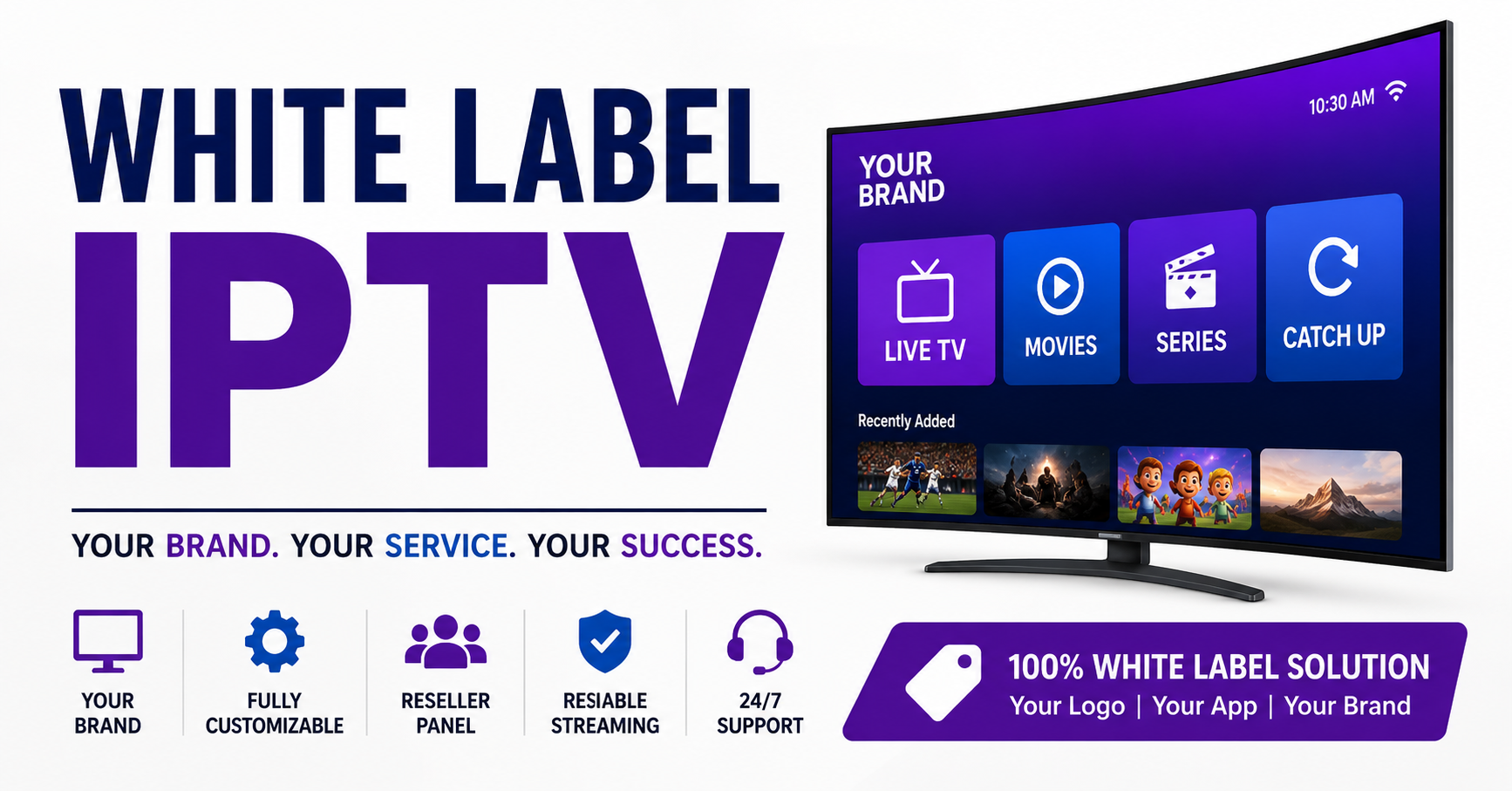
Let’s kill the confusion early. White label IPTV means a provider gives you access to their infrastructure, servers, channel lineup, EPG data, the works, and lets you resell it under your own brand. Your subscribers never see the upstream provider’s name. They see yours. Your logo. Your app name. Your domain.
But here’s where people get it twisted. You’re not buying a finished product. You’re buying raw operational capacity and layering your brand on top. That distinction matters because it determines who’s responsible when things break. Spoiler: in the eyes of your customer, it’s always you.
Pro Tip: Before you pick a white label IPTV provider, ask them one question: “What happens to my panel if your main server goes down?” If they can’t explain their failover process in plain language, walk away.
A proper white label IPTV setup includes panel access with full branding control, the ability to create and manage sub-reseller accounts, credit-based activation, and ideally, a custom APK or at minimum a brandable player interface. Anything less and you’re just reselling, not building a brand.
How the Credit Billing System Works
Most white label IPTV operations run on a credit-based model. You purchase credits in bulk from your provider. Each credit activates a subscription line, one month, three months, twelve months, whatever tiers you offer. Your profit margin lives in the gap between what you paid per credit and what you charge the end user.
Simple enough on paper. In practice, it demands financial discipline most newcomers don’t have.
Buy too many credits upfront and you’re sitting on dead stock if subscribers churn. Buy too few and you can’t onboard new customers fast enough during peak demand, major sporting events, holiday weekends, the start of a new football season. Timing matters.
Here’s what veteran operators know: credit pricing isn’t static. Providers adjust margins. It’s happened more than once across the industry. A provider might tighten margins because server costs jumped, or because they’re funding infrastructure upgrades. If your retail pricing has zero cushion, one upstream adjustment can gut your profitability overnight.
| Factor | Low-margin reseller | Smart-margin reseller |
|---|---|---|
| Credit buffer | Buys exact amount needed | Keeps 15-20% credit reserve |
| Pricing flexibility | Fixed retail price, no room to absorb cost changes | Tiered pricing with built-in adjustment room |
| Churn response | Panics, slashes prices | Analyses churn cause, adjusts onboarding |
| Provider negotiation | Accepts first rate offered | Negotiates volume discounts quarterly |
Pro Tip: Never set your white label IPTV retail price based on today’s credit cost alone. Build in a 12-18% margin buffer so upstream price adjustments don’t force you into a loss position.
Why Uptime Expectations Destroy Reseller Relationships
This is the single most destructive misunderstanding in the entire white label IPTV space. New British IPTV resellers, and their subscribers, expect 100% uptime. That expectation is not just unrealistic, it’s technically impossible in any IPTV environment.
Servers go down. Uplink sources experience interruptions. ISPs throttle traffic. DNS poisoning affects stream resolution. CDN nodes get overloaded during peak viewership. These aren’t failures of your provider. They’re the physics of delivering live video over the public internet.
The operators who survive learn to manage expectations before they become complaints. That means communicating proactively. When you know a server migration is happening Tuesday at 3 AM, you tell your resellers Monday evening. When a buffering spike hits during a premium sports stream, you push an alert through your Telegram group or WhatsApp broadcast before the first angry message lands.
- Set up a dedicated status channel (Telegram works best for speed)
- Send proactive alerts before scheduled maintenance windows
- During unplanned outages, communicate within 10 minutes, even if the update is “we’re investigating”
- After resolution, send a brief post-mortem so resellers can relay it to their own subscribers
Most white label IPTV providers worth partnering with already have backup uplink servers and failover systems. But your resellers don’t know that unless you tell them. Silence during an outage breeds panic. Panic breeds churn.
Branding Is Not a Logo, It’s an Entire Trust Architecture
A common trap in white label IPTV: a reseller slaps their logo on the panel login page and calls it “branding.” That’s not branding. That’s decoration.
Real branding in a white label IPTV context means your subscribers experience a cohesive identity at every touchpoint. The app they install has your name. The activation email comes from your domain. The support channel carries your brand voice. The pricing page on your website matches the tone and aesthetic of everything else.
This matters for retention more than acquisition. Anyone can run a Facebook ad and get trial sign-ups. The resellers who retain subscribers past 90 days are the ones whose operation feels legitimate, professional, and trustworthy. Branding does that heavy lifting silently.
Pro Tip: Register a dedicated domain for your white label IPTV brand and set up a professional email address on it. Subscribers are significantly more likely to trust, and stay with, a service that doesn’t communicate through Gmail or Hotmail.
Think about the subscriber’s mental model. They’re handing over money for a service that replaces or supplements their traditional television. If your branding looks amateur, their confidence drops every time something buffers. If your branding looks sharp and consistent, they give you the benefit of the doubt during minor disruptions.
The Support Load Nobody Warns You About
Here’s the truth that needs to be said louder: if you’re running a white label IPTV operation, you are a support desk. Whether you planned for it or not. Whether you want to be or not.
Your subscribers will message you at midnight asking why Channel X isn’t loading. They’ll send you screenshots of error codes they don’t understand. They’ll ask you how to install the APK on a device you’ve never touched. They’ll demand refunds for a two-hour outage during a match they could’ve watched on catch-up.
Support takes real time commitment. It’s not something you check once a day between other tasks. During peak hours, evenings, weekends, live sporting events, your support channel is the frontline of your entire business. Slow responses cost you subscribers. Bad responses cost you IPTV Panel resellers.
- Dedicate specific hours to live support, don’t promise 24/7 unless you can deliver it
- Build a FAQ document or video guide for common setup issues (APK installs, EPG refresh, VPN configuration)
- Use canned responses for the ten most common questions, but personalise them enough that they don’t feel robotic
- If you have sub-resellers under your white label IPTV brand, train them on basic troubleshooting so they handle tier-one support themselves
The resellers who treat support as overhead rather than a core function are the ones who churn hardest. The ones who treat it as their competitive advantage build loyal subscriber bases that stick around for years.
ISP Blocking and DNS Poisoning: The 2026 Landscape
The enforcement environment in 2026 is more aggressive than anything the white label IPTV space has seen before. AI-driven detection systems deployed by major broadcasters and ISPs can now identify streaming traffic patterns in near real-time and apply targeted blocks at the DNS level.
What this means practically: a subscriber calls you saying “everything was working fine yesterday and now nothing loads.” Nine times out of ten, their ISP has started poisoning DNS requests to your server addresses. The stream requests get silently redirected to nowhere.
The fix isn’t complicated, but it requires preparation. Every serious white label IPTV operator should be advising subscribers on DNS configuration from day one. Cloudflare (1.1.1.1), Google (8.8.8.8), or better yet, a private DNS resolver. Beyond that, VPN usage is shifting from optional to near-mandatory in several European markets.
Pro Tip: Bundle a DNS configuration guide with every new subscription activation. It takes five minutes to write and prevents roughly 40% of “it’s not working” support tickets.
On the infrastructure side, providers who maintain geographically distributed servers with rotating IPs have a significant edge. Load balancing across multiple CDN endpoints reduces the surface area for targeted blocking. If your white label IPTV provider is running everything through a single data centre, your exposure is dangerously concentrated.
Scaling a White Label IPTV Brand Without Breaking It
Growth creates its own problems. The infrastructure that handles 200 subscribers comfortably starts cracking at 800. The support workflow that one person managed becomes unmanageable at 1,500 active lines. Scaling isn’t just about selling more, it’s about upgrading every layer of your operation in sync.
HLS latency becomes a real issue at scale. When hundreds of concurrent viewers hit the same stream during a live event, buffering spikes unless your provider has proper load balancing in place. Ask about CDN distribution before you need it, not after your subscribers are already complaining.
| Scaling stage | Subscriber count | Key priority |
|---|---|---|
| Startup | 0-200 | Branding, basic support setup, pricing strategy |
| Growth | 200-800 | Automated onboarding, tiered pricing, Telegram/WhatsApp groups |
| Established | 800-2,000 | Sub-reseller recruitment, dedicated support hours, credit reserve management |
| Advanced | 2,000+ | Multi-server redundancy, private DNS, custom APK, panel analytics |
Your credit purchasing strategy also needs to evolve. At the startup stage, buying monthly makes sense. Once you’re moving 500+ lines, quarterly bulk purchasing with negotiated volume discounts becomes essential for protecting margins. The operators who scale profitably are the ones who treat credit management like inventory management, because that’s exactly what it is.
Sub-Reseller Management: Building a Layer Without Losing Control
One of the most powerful features of a white label IPTV panel is the ability to create sub-resellers underneath you. They buy credits from you, sell to their own subscribers, and you earn on the spread. It’s a multiplication engine.
But it’s also a risk engine if you don’t manage it. Sub-resellers who undercut your own retail pricing cannibalise your direct sales. Sub-resellers who provide terrible support damage your brand, because remember, the end subscriber often doesn’t know or care that they bought through a middleman. They just know the app has your name on it.
Set minimum retail pricing guidelines and enforce them
Provide sub-resellers with branded support materials so their communication looks consistent with your operation
Monitor activation patterns, a sudden spike in activations from one reseller might indicate bulk dumping at unsustainable prices
Offer tiered credit pricing that rewards consistency, not just volume
Pro Tip: The most sustainable white label IPTV sub-reseller networks aren’t the biggest, they’re the most disciplined. Five reliable sub-resellers who maintain pricing standards outperform fifty who race to the bottom.
Frequently Asked Questions
What exactly is white label IPTV?
White label IPTV is a business model where a provider supplies the streaming infrastructure, servers, channels, EPG, and you resell it under your own brand. Your subscribers see your name, your app, and your identity. The upstream provider remains invisible. It lets you run an IPTV business without building the technical backend yourself.
How does the credit system work in white label IPTV?
You purchase credits in bulk from your provider at wholesale rates. Each credit activates one subscription for a set duration, monthly, quarterly, or annual. Your profit comes from the difference between credit cost and your retail price. Managing credit inventory carefully is essential to avoid overstocking or running short during high-demand periods.
Can I run a white label IPTV business part-time?
Technically yes, but support demands make it difficult. Subscribers expect responsive help, especially during evenings and live events. If you can’t commit consistent hours to troubleshooting and communication, subscriber churn will eat into whatever sales you generate. Treating it as a serious time commitment from day one produces far better retention.
How do I handle ISP blocking affecting my white label IPTV subscribers?
Provide every subscriber with a DNS configuration guide at activation. Recommend reliable public DNS servers or a private resolver. In markets where blocking is aggressive, advise VPN usage. On the infrastructure side, ensure your provider uses geographically distributed servers with load balancing to reduce single-point-of-failure exposure.
Is white label IPTV legal?
Legality depends entirely on the content being distributed and the licensing arrangements in your jurisdiction. This guide covers the operational and technical aspects of running a white label IPTV business. Always consult local regulations and seek legal advice specific to your market before launching.
How many subscribers do I need before white label IPTV becomes profitable?
Profitability depends on your credit cost, retail pricing, and overhead. Most operators reach a sustainable baseline around 150-250 active subscribers, assuming reasonable margins and low fixed costs. The key variable isn’t subscriber count alone, it’s churn rate. Retaining subscribers is more profitable than constantly replacing them.
What should I look for in a white label IPTV provider?
Prioritise providers who offer backup uplink servers, transparent failover processes, flexible credit pricing, and full branding support including custom APK options. Ask about their server distribution, load balancing setup, and how they handle peak-hour traffic. A provider who can’t answer these questions clearly isn’t ready to support your growth.
How do I prevent sub-resellers from undercutting my white label IPTV pricing?
Set clear minimum retail pricing guidelines as a condition of their sub-reseller agreement. Monitor activation patterns for signs of bulk dumping. Structure your tiered credit pricing to reward consistent volume rather than one-off large purchases. The goal is a disciplined network, not just a large one.
White Label IPTV Reseller Success Checklist
- Verify your provider’s failover and backup uplink server setup before committing to any credit purchase.
- Set your retail pricing with a minimum 12-18% margin buffer above current credit costs.
- Register a dedicated domain and professional email for your brand, no Gmail, no free hosting.
- Build a subscriber onboarding pack: DNS guide, APK install instructions, channel list, and support contact details.
- Create a Telegram or WhatsApp broadcast channel for proactive outage alerts and maintenance windows.
- Establish minimum pricing guidelines before onboarding any sub-resellers.
- Block out dedicated support hours, minimum two hours during peak evening slots, every day.
- Monitor your credit inventory weekly; maintain a 15-20% reserve buffer at all times.
- Review your churn data monthly, if you’re losing more than 15% of subscribers per cycle, diagnose the cause before spending on acquisition.
- Build your white label IPTV brand with operational discipline from day one, start with the UK reseller panel setup guide at BritishSeller and scale from a foundation that’s built to last.