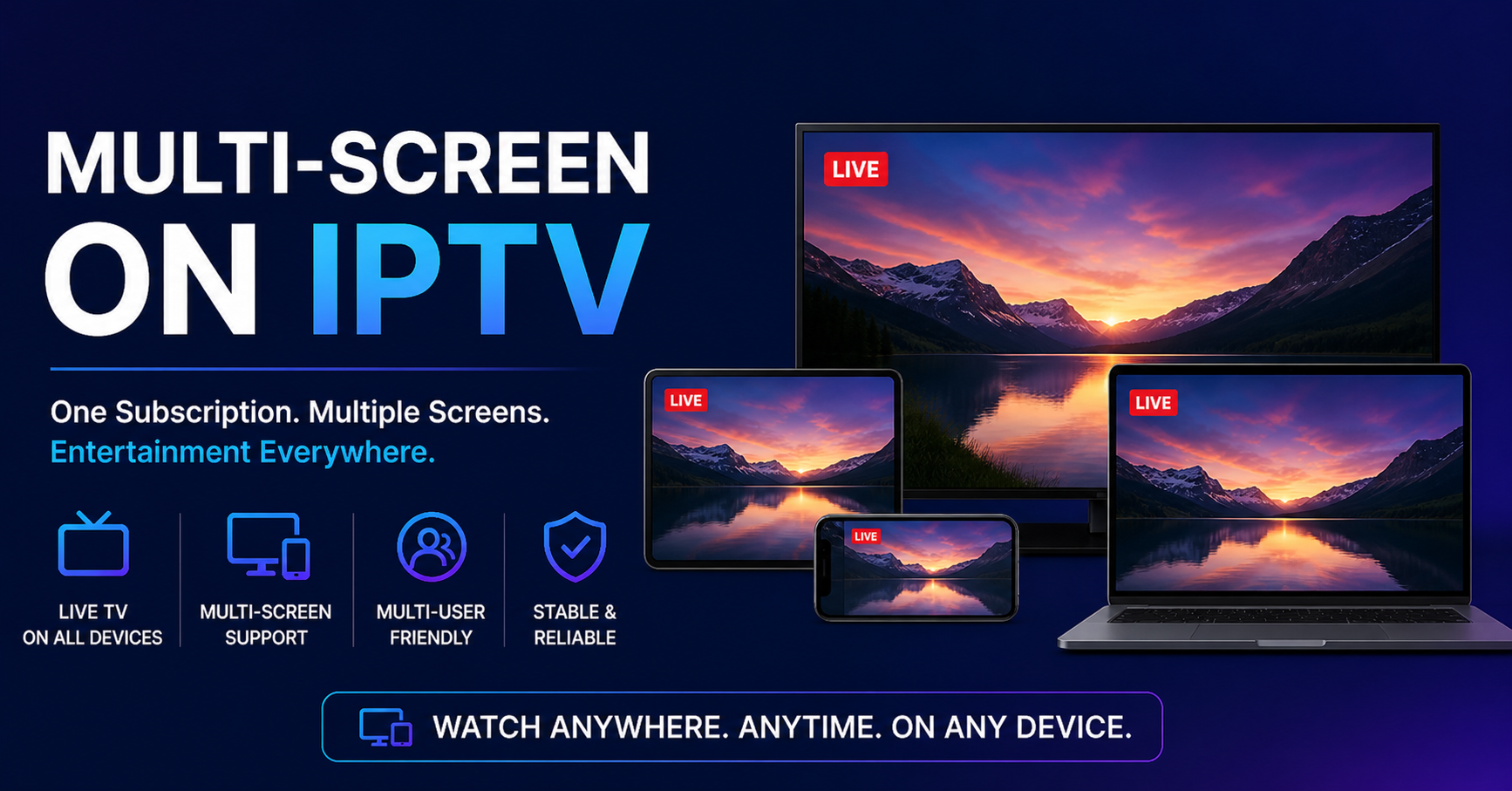
Most people think multi-screen on IPTV is just a checkbox feature. Tick the box, sell a 4-screen plan, collect the money. Then Tuesday night comes, a major sports fixture kicks off, and half your subscribers are staring at a buffering wheel.
That’s not a server issue. That’s a planning issue, and it’s one that quietly destroys reseller reputations every single season.
This guide isn’t about explaining what IPTV is. You already know. This is about how multi-screen on IPTV actually behaves under load, what breaks it at scale, and how experienced operators structure their setups to survive peak demand without hemorrhaging customers.
Why Multi-Screen on IPTV Strains Infrastructure Differently Than Single Streams
A single-stream subscriber pulls one HLS session from your panel. Manageable. Predictable. Easy to account for in bandwidth planning.
Multi-screen on IPTV multiplies that load per connection, not per subscriber account. A 4-connection household watching four different channels simultaneously generates four concurrent HLS requests, four separate authentication handshakes, and four independent buffer cycles. If even one of those streams hits a congested segment on the delivery chain, the entire household’s experience degrades.
This is why UK IPTV reseller who simply “upgrade” a plan to allow more connections without touching their infrastructure end up with disproportionate complaints from their multi-screen customers specifically.
The real problem isn’t bandwidth, it’s session concurrency management at the panel level. Most entry-level panels handle concurrent sessions sequentially rather than through true load-distributed architecture. When 60 households each running 3 to 4 streams all spike simultaneously during a premium sports fixture, the panel queues requests rather than routing them. That’s your buffering window right there.
Pro Tip: Before selling multi-screen on IPTV plans, test your panel’s concurrency ceiling at 1.5x your projected peak load. If it struggles at 80% capacity in testing, it will collapse in production during a high-demand event.
Why Panel Credits Aren’t the Same as Stream Capacity
Panel credits are not the same as stream capacity. This confusion costs resellers money constantly.
When you allocate credits to a multi-screen on IPTV customer, you’re defining the maximum simultaneous connection allowance on that account. But those connections still compete for the same upstream server bandwidth as every other active session on your panel, reseller or direct subscriber alike.
Here’s what that means in practice:
- Credit allocation controls who can connect
- Upstream bandwidth controls whether the stream actually plays cleanly
- Server load balancing determines which server node handles which request
If your upstream provider doesn’t offer genuine load balancing across multiple server nodes, not just a single failover, multi-screen on IPTV will always be your weakest product during peak hours.
Here’s how a budget panel setup compares to premium infrastructure:
| Feature | Budget panel setup | Premium infrastructure |
|---|---|---|
| Concurrent session handling | Sequential queue | Distributed load routing |
| Multi-screen stability | Drops under peak load | Sustained under 90%+ load |
| HLS latency during spikes | 8 to 15 second buffering | Sub-3 second recovery |
| Failover on server drop | Manual or absent | Automatic rerouting |
| DNS poisoning resistance | Minimal | Active mitigation layers |
Resellers operating on premium infrastructure can comfortably sell 4-screen plans because the backend can actually honour the promise. Resellers on budget panels are selling a theoretical product.
How ISP-Level Blocking in 2026 Specifically Targets Multi-Stream Behaviour
Single-stream IPTV traffic can sometimes pass through basic traffic analysis undetected, particularly on residential ISP connections where occasional streaming bursts are normal. Multi-screen on IPTV, however, generates a pattern that’s increasingly recognisable to AI-driven deep packet inspection systems.
Four simultaneous HLS streams to the same domain from one IP address, pulling M3U8 segments every 2 to 6 seconds, creates a fingerprint. Modern ISP enforcement tools in 2026 don’t just block known IPTV server IPs, they identify behavioural signatures. Multiple concurrent segment pulls from non-CDN endpoints is one of them.
This is why the better upstream providers have shifted toward:
- Rotating delivery subdomains per session
- CDN-masked endpoint distribution
- Per-stream randomised segment timing
As a reseller, you can’t control this infrastructure directly. But you can choose providers whose upstream architecture already accounts for it, and you can advise customers running multi-screen on IPTV to use different device types rather than the same app on multiple devices simultaneously (which amplifies the traffic fingerprint).
Pro Tip: Customers running multi-screen on IPTV on four identical Firestick devices using the same app version generate more detectable traffic than four different device/app combinations. It sounds counterintuitive, but diversity in client devices actually reduces fingerprint consistency.
Pricing Multi-Screen Plans Without Quietly Losing Money
Pricing multi-screen on IPTV correctly is a separate skill from setting it up technically. Most UK IPTV resellers undercharge because they price based on credit cost alone, ignoring the support overhead that multi-connection households generate.
Consider what a 4-screen household actually costs you versus a single-stream subscriber:
- 4x the potential support tickets: one screen dropping feels like “the service is broken”
- 4x the concurrent load during peak hours
- Higher churn risk: families have more opinions and more devices that can cause issues
- More frequent device troubleshooting: smart TVs, tablets, phones, and set-top boxes each have different behaviours
The correct pricing model for multi-screen on IPTV should factor a support multiplier into the monthly rate, not just the raw connection cost. Operators who’ve scaled past 500 active subscribers know that a £5 premium over single-screen isn’t enough when a 4-screen family generates 6x the support interaction of a solo subscriber.
Structure your plans around connection tiers with clear terms:
- 1 connection: entry tier
- 2 connections: household standard
- 4 connections: family/premium tier with explicit device guidance on setup
Each tier should come with documented device instructions, reducing inbound support volume before the customer even starts.
Back-Up Uplinks and Why Multi-Screen Customers Notice Outages First
Here’s something most resellers only learn after their first major outage: multi-screen on IPTV customers always notice downtime before single-stream users. Always.
The reason is mathematical. If a server node drops and takes 90 seconds to failover, a single-stream user experiences one disruption. A 4-screen household experiences four simultaneous disruptions, one per active stream, and at least one person in the household is watching something different to the others, meaning the complaint covers multiple channels. The support ticket reads as a wider outage than it actually is.
This is why back-up uplink servers aren’t optional infrastructure for resellers selling multi-screen on IPTV, they’re a customer retention mechanism.
Your upstream provider should offer:
- Primary server cluster: main delivery nodes
- Hot standby uplink: switches within seconds, not minutes
- Geographic redundancy: separate data centre, not the same rack
If your upstream offers only a single failover node hosted in the same facility as your primary, that’s not genuine redundancy. A facility-level issue takes both down simultaneously. For multi-screen on IPTV customers in particular, the difference between a 90-second failover and a 15-minute manual switch can represent 3 to 4 simultaneous complaints landing in your WhatsApp inbox at once.
Pro Tip: Run a controlled failover test quarterly, pull your primary server and time the switch. If your multi-screen on IPTV customers could detect that gap, your failover isn’t fast enough.
Customer Churn Psychology: Why Multi-Screen Subscribers Leave Faster
Single-screen subscribers who experience one buffering event per week often stay. They rationalise it, reboot the app, move on. Multi-screen on IPTV subscribers operate on a completely different psychological threshold.
When four streams are running in the same household, the probability of at least one person experiencing a disruption in any given hour is compounded. Even if the service quality is statistically identical to a single-stream connection, the household perceives it as worse, because more people are watching, more opinions are formed, and whoever controls the subscription feels accountable to the others.
What this means operationally:
- Multi-screen on IPTV customers need proactive communication during known maintenance windows
- They benefit from having clear device-specific troubleshooting guides ready before they ask
- A quick check-in message from your support channel after a confirmed outage, even a brief one, dramatically reduces churn among multi-screen subscribers
The resellers who retain multi-screen customers long-term aren’t always running the best infrastructure. They’re running adequate infrastructure with superior communication cadence. Expectation management is a retention tool.
What Changes When Sub-Resellers Start Selling This Too
Once you start sub-reselling, multi-screen on IPTV becomes a pricing and policy decision, not just a technical one. Your sub-resellers will want to sell it. Some will oversell it. And when their multi-screen customers complain, the ticket arrives at your panel anyway.
The controls you need in place before scaling multi-screen on IPTV through a reseller network:
- Credit allocation per sub-reseller: Set a cap on how many 4-connection accounts any single sub-reseller can activate relative to their total credit volume. An unlimited 4-screen plan with 50 sub-resellers and no volume ceiling is a guaranteed infrastructure collapse during peak events.
- Connection monitoring: Your panel should give you visibility into concurrent active sessions, not just active subscriptions. If a sub-reseller’s client base is regularly hitting 95%+ of their allocated connection ceiling simultaneously, that’s your early warning signal before the complaints come in.
- Tiered wholesale pricing: Multi-screen on IPTV costs more to deliver, price it that way at wholesale level too. Sub-resellers buying 4-connection credits at the same rate as 1-connection credits will always overpromise, because their margin calculation never accounted for the infrastructure reality.
For deeper guidance on structuring a sustainable sub-reseller operation, the team at britishseller.co.uk has put together operator-level resources that go considerably beyond generic setup guides.
Frequently Asked Questions
What is multi-screen on IPTV and how many connections do I actually need?
Multi-screen on IPTV means running more than one simultaneous stream under a single account, typically across different devices in the same household. Most families manage comfortably on 2 connections. If you have 3 to 4 regular viewers watching different channels at the same time, a 4-connection plan is appropriate. More connections than you actually use simultaneously just costs money without adding value.
Why does multi-screen on IPTV buffer more during sports events than standard viewing?
Premium sports streams draw the highest concurrent demand across any IPTV infrastructure. During live fixtures, thousands of subscribers hit the same channel clusters simultaneously. Multi-screen on IPTV households compound this, each connection adds load at exactly the moment upstream servers are already under peak strain. Providers with distributed server architecture handle this significantly better than single-node setups.
Can I run multi-screen on IPTV on different apps simultaneously on the same account?
Yes, in most cases, provided your panel allows it and the connection count matches your plan. However, running different app versions or different player types across devices can actually improve stability by reducing traffic pattern fingerprinting. Using the same app on four identical devices generates more detectable concurrent traffic than a mix of different clients.
Is multi-screen on IPTV more likely to trigger ISP blocking?
Multi-screen on IPTV generates a more recognisable traffic signature than a single stream, multiple concurrent HLS requests from one IP is atypical for standard streaming behaviour. AI-driven ISP enforcement tools in 2026 increasingly identify this pattern. Using a VPN at the router level, or connecting each device through a different network path where possible, reduces detection risk.
As a reseller, how do I price multi-screen on IPTV plans fairly?
Price multi-screen on IPTV with a support multiplier built in, not just the credit cost. A 4-connection household generates substantially more support overhead than a single-screen subscriber. Factor in the additional server load during peak hours, the higher churn sensitivity, and the need for device-specific setup guidance. A flat markup on credit cost alone will quietly erode your margins over time.
What should I do when a multi-screen customer reports all streams dropping simultaneously?
Simultaneous drops across all connections on a single account almost always indicate a server-side issue rather than a client or device problem. Check your panel’s server status immediately, confirm whether other customers on the same node are affected, and communicate proactively, don’t wait for the customer to ask again. If your upstream offers hot failover, verify it switched correctly. Document the incident time for pattern analysis.
How do back-up uplink servers specifically help multi-screen on IPTV customers?
Because multi-screen on IPTV customers run multiple concurrent streams, any server drop multiplies the disruption they experience. A fast-switching hot standby uplink, ideally failing over within 10 to 15 seconds, can resolve the issue before the customer even notices. Slow manual failovers, or providers with only one failover node in the same data centre as the primary, offer essentially no meaningful protection during a facility-level incident.
Can sub-resellers offer multi-screen on IPTV without causing problems for the main reseller?
Yes, but only with proper credit caps and connection monitoring in place. Sub-resellers who oversell multi-screen on IPTV plans without volume controls will eventually cause infrastructure stress that flows back to the parent IPTV panel. Set clear limits on 4-connection account activations per sub-reseller relative to their total credit allocation, and monitor simultaneous active sessions, not just subscription counts.
Reseller Success Checklist: Multi-Screen on IPTV
- Test your panel’s concurrency ceiling at 1.5x projected peak load before selling multi-screen plans
- Confirm your upstream offers genuine load balancing across geographically separate nodes, not a single failover
- Set credit allocation caps for sub-resellers on 4-connection accounts proportional to their total volume
- Build device-specific setup guides for multi-screen households before they ask, reduce inbound support
- Price multi-screen on IPTV with a support multiplier, not just credit cost markup
- Monitor active concurrent sessions per sub-reseller, not just total subscription counts
- Run a quarterly failover test, measure the gap in seconds, not assumptions
- Communicate proactively with multi-screen customers during confirmed outages before tickets arrive
- Advise customers to diversify device/app combinations rather than running identical setups on all screens
- Review your upstream provider’s DNS poisoning mitigation and CDN masking capability for 2026 enforcement patterns