2010 World Cup taught British IPTV operators a lesson nobody wanted: when England played Germany, half the cheap panels in the country froze at kickoff. Streams buffered, customers raged, and resellers who had spent months building trust watched it evaporate inside ninety minutes. That memory matters now, because the 2026 tournament is going to be bigger, longer, and more demanding than anything the industry has handled before.
Here is the short version for anyone who wants the answer.
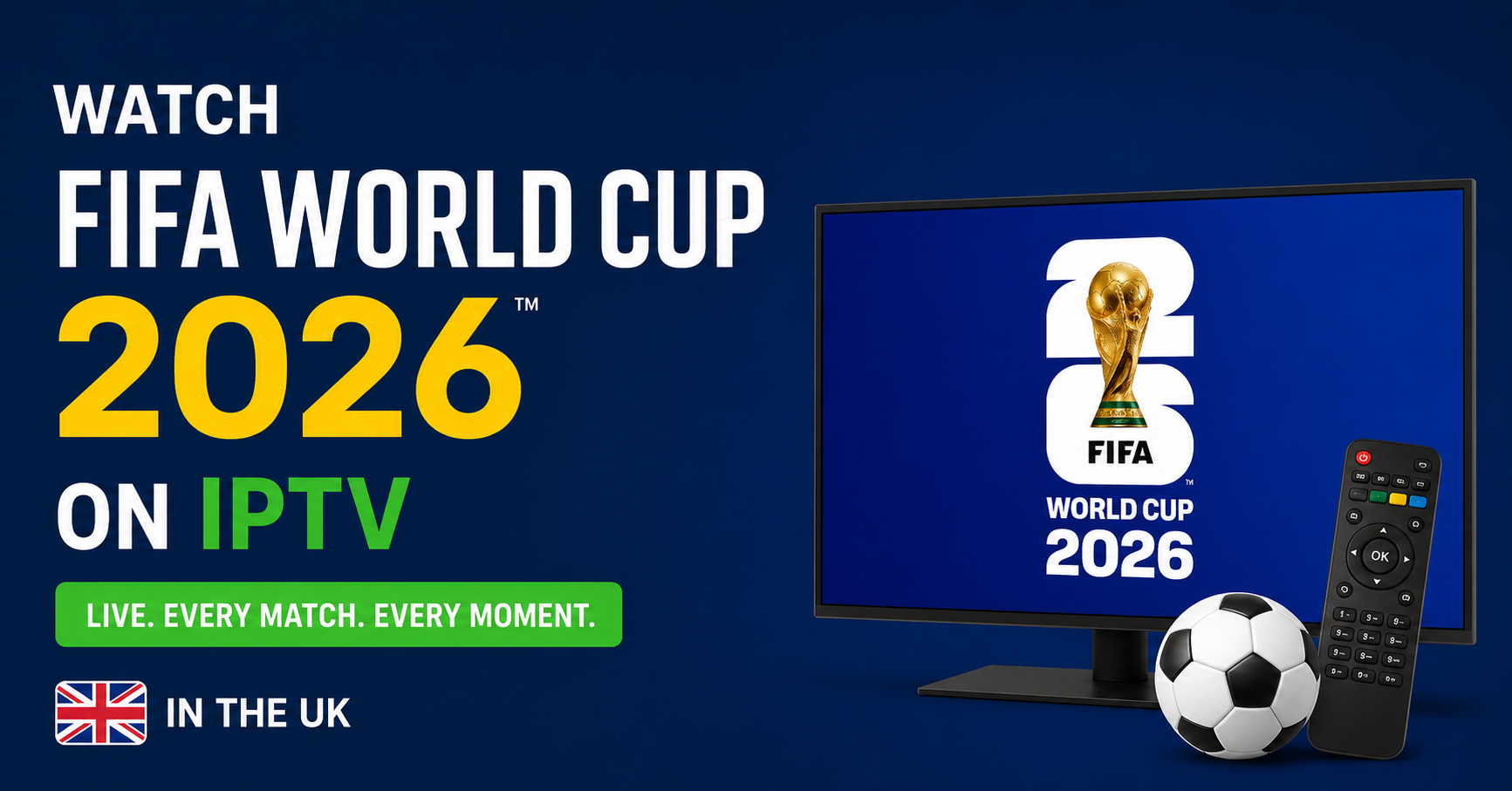
You can watch FIFA World Cup 2026 on IPTV in the UK by using a stable service connected to redundant servers, paired with a player like TiviMate or IPTV Smarters on a device with a wired connection, where possible. The single biggest factor isn’t the app or even the subscription price; it’s whether the infrastructure behind your stream can absorb the traffic spike when millions tune in simultaneously. Choose reliability over the cheapest tier, test your setup before the opening match, and have a backup playlist ready. That’s the whole game; the rest of this is the why.
Why 2026 Breaks the Old Playbook
This tournament is the first to feature 48 teams across 104 matches, hosted jointly by the United States, Canada, and Mexico. For UK viewers, that means kickoff times scattered across the evening and late night because of the time zone gap. The practical consequence is concentrated traffic. Instead of demand spreading evenly, you get sharp, predictable surges when the marquee fixtures land in the UK prime time window.
For anyone running a panel, this is the part worth internalising. A normal Saturday load is manageable. A World Cup knockout match where England, the United States, or a big European side is playing creates a spike that can be three or four times your usual peak. Infrastructure that coasts through a regular Premier League weekend can collapse under that weight if it was never built for it.
Pro Tip:
The danger window isn’t the match itself. It’s the ninety seconds around kickoff when nearly every customer opens their stream at once. If your servers are going to fail, they fail then. Stress test specifically for that simultaneous connection burst, not sustained load.
What Actually Determines Stream Quality
Most people blame the app when a stream stutters. The app is rarely the culprit. Quality during a major event comes down to a chain, and the chain breaks at its weakest link.
- Weak Setup, Resilient Setup
- Single source server, multiple load-balanced sources
- No failover, Automatic failover routing
- One uplink Backup uplinks ready
- WiFi only, wired connection where possible
- No pre-event testing. Tested 48 hours before kickoff
- Shared overloaded panel , Dedicated capacity headroom
Notice that four of those six rows have nothing to do with the customer’s device. They sit with the service and its infrastructure. This is why two people using the identical app on the identical Fire TV Stick can have wildly different experiences during the same match.
The Infrastructure Side, Explained Simply
You don’t need to be a network engineer to understand what keeps a stream alive during peak demand. A few concepts cover most of it.
Load balancing spreads viewers across several servers so no single machine drowns. Failover means if one server dies mid-match, traffic reroutes automatically instead of dumping everyone offline. Backup uplinks are spare internet connections that kick in when the primary route gets congested or throttled. And monitoring is simply someone watching the system in real time, ready to act before customers even notice.
Cheap services skip all of this. That’s how they stay cheap. During an ordinary week, you’d never know the difference. During a World Cup semi-final, the difference is everything.
Pro Tip:
Ask any provider one direct question before the tournament: “What happens to my stream if your main server fails during a live match?” If the answer is vague or they dodge it, you already have your answer about their failover setup.
A Real Pattern We See Every Major Tournament
After handling support through several big football events, the same story repeats. A UK IPTV reseller signs up dozens of new customers in the weeks before the tournament, excited by the growth. Then the opening weekend arrives, the infrastructure isn’t ready for the surge, and the complaints flood in faster than anyone can answer them. Within a fortnight, a chunk of those new subscribers have already churned.
The lesson nobody wants to hear: a tournament is the worst time to onboard customers onto fragile infrastructure. Growth that arrives faster than your capacity can carry is not growth; it’s a liability waiting for kickoff.
Choosing Your Setup as a Viewer
If you’re a subscriber rather than an operator, your decisions are simpler but still matter.
- Pick a player you trust. TiviMate and IPTV Smarters are the reliable defaults on Android devices and Fire TV Stick. Apple users lean toward apps suited to that ecosystem.
- Use a wired Ethernet connection for the matches that matter. WiFi is fine until the moment your household and your neighbours all stream at once.
- Test everything a couple of days before the opening match, not an hour before kickoff.
- Keep a second source or playlist as a backup. Redundancy isn’t paranoia during a tournament, it’s planning.
- Restart your device before a big match to clear memory and avoid mid-game slowdowns.
For Resellers: Surviving the Spike
This is where the tournament separates the prepared from the hopeful. If you operate a reseller panel, the World Cup is simultaneously your biggest revenue opportunity and your biggest reputational risk.
The resellers who come out ahead treat the weeks before the tournament as preparation, not just promotion. They confirm their upstream provider has genuine capacity headroom. They don’t oversell credits beyond what the infrastructure can carry. And they communicate honestly with customers about what to expect.
Pro Tip:
Don’t push your largest promotion right before the opening match. Run it three to four weeks earlier so new customers settle in during normal load. That way, their first experience of your service isn’t a chaotic World Cup weekend where even good infrastructure is under strain.
A reseller panel is only as strong as the network feeding it. A panel owner who understands this stops competing purely on price and starts competing on reliability, which is the only thing customers actually remember after a tournament ends. The credit reseller who undercuts everyone but can’t keep streams alive during England versus Brazil will lose more customers in one weekend than they gained all month.
Knockout Stage Reality Check
The group stage is a warm-up. The real test arrives in the knockouts, when single matches command enormous simultaneous audiences, and there’s no second fixture to spread the load. For both viewers and operators, the deeper the tournament goes, the less margin for error exists.
If your setup wobbled even slightly during the group stage, treat that as a warning, not a fluke. It will not improve on its own under a heavier load. Fix it before the round of 16, because the final is the single most-watched broadcast of the entire event, and nothing exposes weak infrastructure like a billion people watching at once.
Frequently Asked Questions
Is it legal to watch FIFA World Cup 2026 on IPTV in the UK?
Legality depends entirely on whether the service holds proper broadcasting rights for the content. Licensed IPTV providers operating within UK regulations are legitimate. Always verify a provider’s licensing status, since using unauthorised streams of rights-protected football carries legal and service reliability risks worth avoiding.
What is the best device to watch the FIFA World Cup 2026 on IPTV in the UK?
There’s no single best device, but a wired Android TV box or a Fire TV Stick with a strong connection covers most viewers well. The device matters less than the stability behind your stream. A premium device on weak infrastructure still freezes, while a modest box on solid servers performs reliably.
Why does my IPTV stream buffer during big matches?
Buffering during major matches almost always points to the service infrastructure rather than your device. When millions connect at kickoff, services without load balancing and failover get overwhelmed. Your home connection plays a part, too, so use Ethernet, but persistent buffering during peak matches signals a provider capacity problem.
How can resellers prepare their panel for the tournament?
Resellers should confirm their upstream capacity, avoid overselling panel credits beyond infrastructure limits, and run major promotions weeks before kickoff rather than during it. A reseller panel inherits the stability of the network feeding it, so the preparation that matters most happens upstream, well before the first whistle.
Do I need a VPN to watch the World Cup on IPTV?
A VPN can help with connection privacy and occasionally with ISP throttling during peak events. Still, it isn’t mandatory for a properly licensed service. Some viewers use one for stability when their ISP slows streaming traffic. Choose a fast VPN, as a slow one will add latency and make buffering worse.
Will streaming quality drop during the most popular matches?
Quality drops happen on services that lack capacity headroom for traffic spikes. A well-built service maintains quality even during the most-watched fixtures because it spreads the load and reroutes around problems. If your quality collapses specifically during the biggest matches, the infrastructure, not the match, is the issue.
How early should I test my setup before the opening match?
Test at least 48 hours before the opening match, ideally longer. This gives you time to swap players, fix connection issues, contact your provider, or arrange a backup source. Testing an hour before kickoff leaves no room to solve anything, which is exactly when problems tend to surface.
Success Checklists
For Subscribers
- Test your setup at least 48 hours before the opening match.
- Use a wired Ethernet connection for major fixtures.
- Keep a backup playlist or second source ready.
- Restart your device before big matches.
- Confirm your provider holds proper broadcasting rights.
For Resellers
- Verify upstream provider capacity headroom before the tournament
- Avoid overselling panel credits beyond infrastructure limits
- Run major promotions three to four weeks before kickoff
- Stress test specifically for simultaneous kickoff connection bursts
- Communicate realistic expectations to new customers
For Sub Resellers
- Confirm your parent panel owner’s infrastructure can handle the surge
- Don’t promise uptime you can’t personally verify
- Onboard new customers well ahead of the opening match
- Keep a direct support line open during peak fixtures
- Monitor your credit allocation against real capacity
The Bottom Line
Watching the FIFA World Cup 2026 on IPTV in the UK comes down to one principle that survives every tournament: infrastructure beats everything else. The app, the device, even the subscription price are secondary to whether the system behind your stream can hold its shape when demand spikes. Subscribers should prioritise stable, properly licensed services and test early. IPTV UK Resellers should build capacity before they chase growth, because a tournament punishes fragility without mercy. For a deeper look at building a dependable setup, the team at britishseller.co.uk covers the operational side in more detail.
The operators who thrive during the World Cup aren’t the ones with the flashiest marketing. They’re the quiet ones who tested their failover in May and slept through the final because nothing broke.