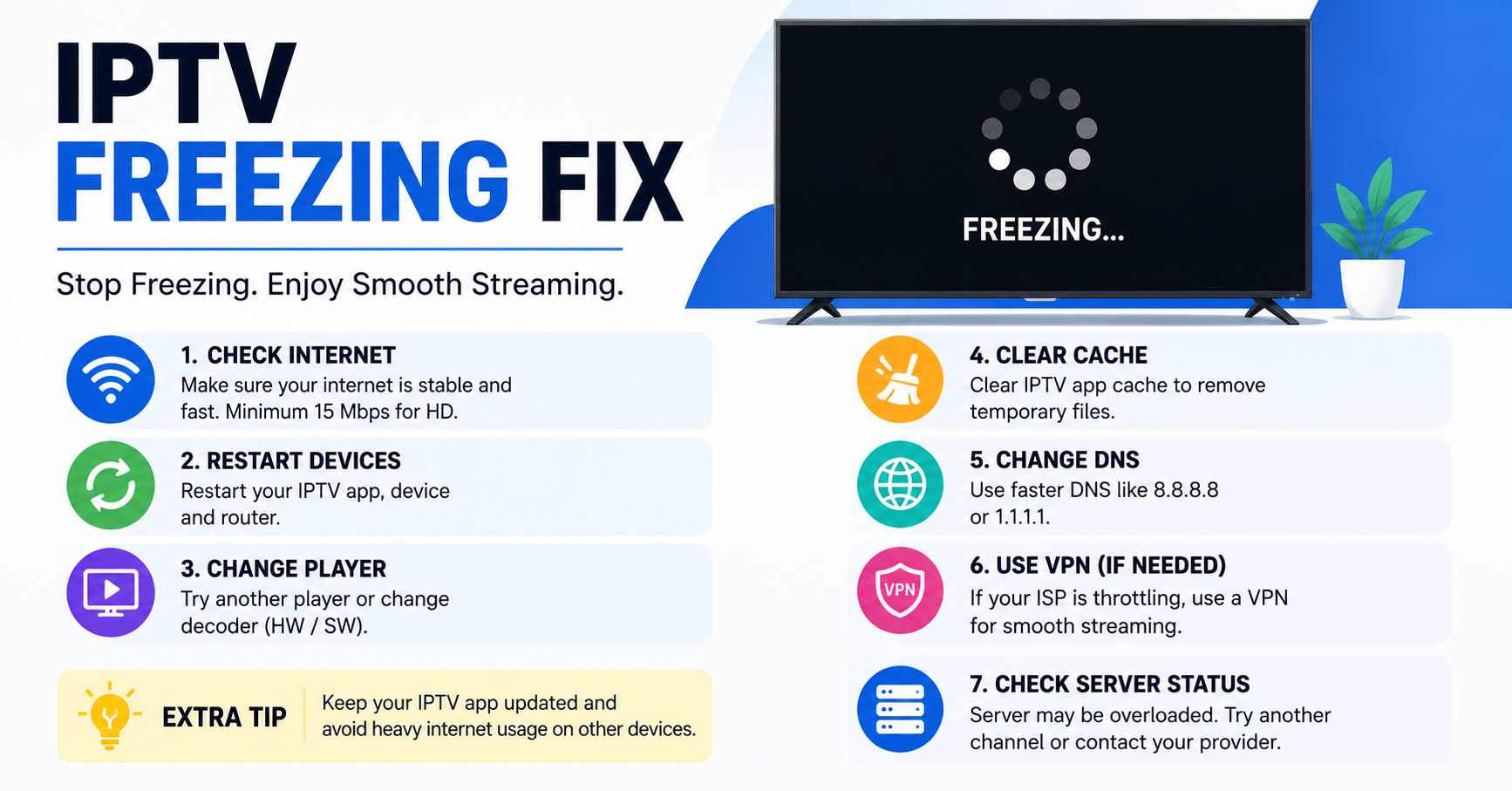
Most IPTV freezing isn’t a server problem. Roughly 70% of freezing complaints trace back to the subscriber’s own Wi-Fi setup, not the panel or the provider. The fastest fix is almost always confirming whether the customer is on Wi-Fi or Ethernet before touching anything else. If that checks out clean, the remaining causes split between server uplink issues, ISP throttling, and underpowered playback devices, in roughly that order of likelihood.
Somebody told me once that running an IPTV reseller operation is easy money. That person had never sat behind a panel on a Saturday night watching ticket after ticket roll in, every single one saying the same thing. Freezing. Buffering. Unwatchable. If you’ve landed here searching for a reliable IPTV freezing fix, you’re either a frustrated subscriber or a reseller who’s bleeding customers. Either way, this isn’t a recycled list of “restart your router” tips. This is what actually works, pulled from years of operating panels, switching uplinks under pressure, and learning that most IPTV freezing fix solutions start with a question nobody wants to hear: is your Wi-Fi actually strong enough?
Let’s get into it.
The 70% Truth About IPTV Freezing Nobody Publishes
Here’s something most IPTV freezing fix articles won’t say because it doesn’t sound dramatic enough: roughly 70% of freezing complaints trace back to the user’s own setup. Not the server. Not the panel. Not some shadowy ISP conspiracy. The customer’s side.
That ratio comes from handling real support tickets across multiple IPTV reseller storefronts over years of operation. When someone says their stream is freezing, the instinct is to blame infrastructure. But the pattern tells a different story.
The usual culprits on the user end:
- Wi-Fi signal dropping below usable thresholds during peak household usage
- Outdated streaming devices struggling with HLS decoding
- ISP-provided routers with weak 5GHz coverage in larger homes
- VPN configurations that add unnecessary latency hops
- Multiple devices saturating a connection that was barely sufficient to begin with
Pro Tip: Before you touch your panel or escalate to your provider, ask the customer one question: “Are you on Wi-Fi or Ethernet?” That single answer resolves more IPTV freezing fix tickets than any server-side adjustment ever will.
Understanding this split matters because it changes your entire troubleshooting approach. If you’re a reseller spending hours investigating server load when the subscriber is streaming over a 2.4GHz connection three walls away from the router, you’re wasting time and losing credibility.
Why Wi-Fi Is the Silent Killer of IPTV Streams
Most subscribers don’t realise their Wi-Fi signal is the weakest link. They see “connected” on their device and assume full speed. That’s not how it works. A connected device operating on two bars of signal in another room might pull 8 to 12 Mbps on a connection rated for 80. That’s not enough for a stable HD stream, and it’s nowhere near sufficient for 4K.
The IPTV freezing fix for this scenario is straightforward but requires the subscriber to act. Ethernet is always the first recommendation. A direct cable connection from router to device eliminates wireless instability entirely. When Ethernet isn’t practical, a powerline adapter or a mesh Wi-Fi system fills the gap.
Here’s where it gets interesting for resellers. You can actually reduce your churn rate by educating subscribers about this upfront. Include a short connection guide with every new subscription. A single PDF or a pinned FAQ that explains why Ethernet matters. Most resellers skip this, and then wonder why their refund rate climbs every month.
Here’s how connection type maps to real-world stream stability:
| Setup type | Typical speed to device | Stream stability | IPTV freezing risk |
|---|---|---|---|
| Ethernet (direct) | 90 to 100% of rated speed | Very stable | Low |
| 5GHz Wi-Fi (same room) | 60 to 80% of rated speed | Stable | Low to medium |
| 5GHz Wi-Fi (different room) | 30 to 50% of rated speed | Intermittent drops | Medium to high |
| 2.4GHz Wi-Fi (any distance) | 15 to 35% of rated speed | Frequent drops | High |
| Powerline adapter | 40 to 70% of rated speed | Generally stable | Medium |
That table alone explains why so many IPTV freezing fix searches exist. Half the internet is streaming on a connection type that can’t support it.
Why Speed Testing at the Router Isn’t Enough
When a freezing complaint comes in, the first move isn’t opening the panel. It’s asking the subscriber to run a speed test, and not just any test. You need to know their speed at the device, not at the router. Those are two very different numbers.
A subscriber might have a 100 Mbps package from their ISP. The router-level test confirms it. But the Firestick in the bedroom? It’s seeing 11 Mbps through two walls on a congested band. That’s where the IPTV freezing fix begins, at the actual point of playback.
For resellers, building this into your support workflow saves enormous time. A scripted first-response message that asks for a device-level speed test screenshot filters out the majority of tickets before they escalate.
Pro Tip: Tell subscribers to use a speed test app installed directly on their streaming device, not their phone, not their laptop. The device doing the streaming is the only measurement that matters for an accurate IPTV freezing fix diagnosis.
Minimum recommended speeds for stable IPTV playback:
- SD streams: 5 Mbps sustained
- HD streams: 15 Mbps sustained
- FHD (1080p): 25 Mbps sustained
- 4K streams: 40+ Mbps sustained
“Sustained” is the keyword. Burst speeds mean nothing if the connection dips every forty seconds. IPTV needs consistent throughput without jitter, and jitter is exactly what bad Wi-Fi produces.
When It’s Actually the Server: What a Real Operator Does
So you’ve confirmed the subscriber’s connection is solid. Ethernet, good speed, decent device. Still freezing. Now it’s on your side, and that remaining 30% is where your reputation as a reseller lives or dies.
The immediate IPTV freezing fix on the server side is switching the uplink. Not tomorrow. Not after “monitoring.” Right now. Every minute a subscriber watches a buffering wheel is a minute they’re considering someone else’s service. Uplink providers vary wildly in reliability, and the best reseller operations maintain at least two active uplink sources they can pivot between within minutes.
This isn’t optional infrastructure. It’s survival infrastructure. If your panel runs on a single uplink with no failover, you’re building on sand.
Pro Tip: Negotiate with your panel provider for access to at least two independent uplink sources. If they can’t offer it, that tells you everything about their infrastructure maturity. A proper IPTV freezing fix strategy starts at the provider level.
Load balancing also plays a role here. Panels that dump all users onto a single server cluster will choke during high-traffic windows. HLS latency spikes, streams fragment, and the freezing complaints flood in. Distributed load handling, where connections route through multiple nodes based on geographic region or current server load, is what separates resellers who survive peak nights from those who lose half their base after one bad weekend.
Pre-Scaling: The Event-Night IPTV Freezing Fix Nobody Teaches
Picture this. It’s a major football evening. Premium sports streams are about to go live across every timezone you serve. Your subscriber count has grown 40% since the last big match night. What happens next either builds your business or breaks it.
Most UK IPTV resellers react. The smart ones pre-scale.
Pre-scaling means anticipating load before it arrives. If you know a high-demand event is scheduled, you coordinate with your panel provider 24 to 48 hours in advance. You confirm uplink capacity. You verify server allocation. You test backup routes. You do all of this before a single subscriber hits play.
This is a learned-the-hard-way IPTV freezing fix. It doesn’t show up in troubleshooting guides because it’s not a fix at all, it’s prevention. But prevention is always cheaper than recovery. Losing 200 subscribers in one night because you didn’t prepare for a predictable traffic spike is an expensive education.
Tactical pre-scaling checklist for event nights:
- Confirm with your provider that uplink capacity is scaled for projected load
- Test your backup uplink route 12 hours before the event
- Monitor panel credit allocation to ensure no service interruptions mid-stream
- Prepare a pre-written customer message acknowledging high demand and setting expectations
- Have your support team ready 30 minutes before kick-off, not after complaints start
This approach flips the IPTV freezing fix conversation from reactive to proactive. Your subscribers notice. Your churn drops. Your reputation compounds.
ISP Throttling and DNS Poisoning: The 2026 Reality
The enforcement landscape in 2026 is materially different from even two years ago. ISPs now deploy AI-driven traffic analysis that identifies streaming patterns in real time. This goes beyond simple port blocking. Modern detection examines packet behaviour, connection duration, and protocol signatures to flag and throttle specific traffic types.
For subscribers, this means an IPTV freezing fix might not be about their device or your server, it could be their ISP actively degrading the connection. The telltale sign is a stream that works perfectly at 2 AM but freezes consistently during evening hours. That pattern points directly at traffic management policies kicking in during peak periods.
DNS poisoning has also evolved. Some ISPs redirect DNS queries for known streaming endpoints, causing resolution failures that present as freezing or infinite loading. The IPTV freezing fix here involves switching to encrypted DNS providers, DNS over HTTPS or DNS over TLS, which prevents the ISP from intercepting and manipulating resolution requests.
Here’s how to read the signs of throttling versus other causes:
| Throttling indicator | What it looks like | Likely IPTV freezing fix |
|---|---|---|
| Evening-only freezing | Works fine off-peak, buffers 6 to 10 PM | VPN or encrypted DNS |
| All channels affected equally | No single channel issue | ISP-level throttling, change DNS |
| Speed test normal, stream still freezes | Connection looks fine on paper | Deep packet inspection, use VPN |
| Specific content categories freeze | Sports or live content only | Protocol-level filtering, switch ports |
Pro Tip: Recommend that subscribers test with a reputable VPN on a nearby server. If the stream stabilises immediately, the ISP is the problem, not your service. This one test saves hours of back-and-forth troubleshooting on every IPTV freezing fix ticket.
Device-Side Failures That Mimic Server Problems
There’s a category of IPTV freezing that looks like a server issue but is actually hardware. Older Firestick models, underpowered Android boxes, and budget smart TV apps all share a common problem, they lack the processing headroom to decode modern HLS streams without stuttering.
The IPTV freezing fix in these cases isn’t about connectivity or infrastructure. It’s about the device itself. A first-generation Firestick trying to handle a 1080p stream with an EPG overlay and a recording function running simultaneously will freeze. Not because the stream is bad, but because the hardware is out of its depth.
Resellers rarely talk about this because it feels like blaming the customer. But it’s not blame, it’s diagnosis. A good reseller helps the subscriber understand what their device can actually handle.
Signs the device is the bottleneck:
- App crashes or force-closes during playback
- Menus and EPG load slowly even on fast connections
- Freezing occurs on one device but not another on the same network
- Audio continues while video freezes (decoder overload)
When subscribers report that audio keeps playing but the picture freezes, that’s almost always a device-side decoding failure. The stream is arriving fine. The device just can’t render it. The IPTV freezing fix is either lowering the stream quality setting in the player or upgrading to a device with better processing power.
The Freezing Cause That Has Nothing to Do With Streaming
Here’s one that catches newer resellers off guard. A subscriber’s service freezes, not because of any technical failure, but because their panel credits expired mid-session. The stream cuts, the app throws an error or simply buffers indefinitely, and the reseller gets a “my IPTV is freezing” ticket that has nothing to do with IPTV performance at all.
Credit allocation management is operational hygiene. Set reminders for bulk renewals. Monitor expiration dates across your subscriber base. If you’re managing 500+ lines, manual tracking isn’t viable, you need a systematic approach, whether that’s a spreadsheet with automated alerts or a panel that flags expiring credits.
Pro Tip: Configure your panel to send automatic notifications 48 hours before a subscriber’s credits expire. This eliminates a significant chunk of “freezing” complaints that are actually service lapses, and it makes your operation look professional. Every IPTV freezing fix strategy should include credit management as a foundational step.
This also ties into churn psychology. A subscriber whose service silently expires and then finds it “frozen” doesn’t think “my credits ran out.” They think “this service is unreliable.” That perception sticks, even after you reactivate them. The damage is reputational, and it’s entirely preventable.
Making Your Diagnostic Process Repeatable at Scale
If you’re handling IPTV freezing fix requests one at a time with no system, you’ll drown past 200 subscribers. Scaling support means building a repeatable diagnostic workflow that your team (or even your subscribers themselves) can follow before a ticket ever reaches you.
A proven first-response diagnostic sequence:
- Confirm connection type: Wi-Fi or Ethernet
- Request device-level speed test screenshot
- Ask which specific channels or content types are affected
- Check if the issue is present on a second device on the same network
- Verify panel credit status and subscription expiry date
- Test the subscriber’s line from your panel to confirm server-side stream health
If steps one through five come back clean, only then do you investigate server-side. This IPTV freezing fix workflow eliminates roughly 80% of tickets at the first-response stage. That’s not an estimate, it’s operational reality from running this across multiple storefronts.
For resellers managing teams, document this workflow and make it non-negotiable. Every support agent follows the same sequence. Consistency in diagnosis means consistency in resolution time, and resolution time is the single biggest factor in whether a subscriber stays or leaves after a freezing incident.
Frequently Asked Questions
What is the fastest IPTV freezing fix for live sports streams?
Switch from Wi-Fi to a wired Ethernet connection before kick-off. Live sports demand consistent throughput without micro-drops, and Wi-Fi introduces jitter that buffering algorithms can’t always compensate for. If Ethernet isn’t possible, use a 5GHz band with line-of-sight to the router and close competing devices.
Can a VPN actually stop IPTV freezing?
Yes, when the cause is ISP throttling or deep packet inspection. A VPN encrypts your traffic so your ISP can’t identify and selectively degrade streaming packets. Connect to a nearby server to keep latency low. If the freezing stops with a VPN active, your ISP’s traffic management was the issue.
Why does my IPTV freeze only during evening peak hours?
Peak-hour freezing usually points to either ISP-level congestion management or server overload on your provider’s side. ISPs apply heavier traffic shaping between 6 to 10 PM. Simultaneously, panel servers handle maximum concurrent users. Testing with a VPN isolates which side is causing the problem.
How many Mbps do I actually need for an IPTV freezing fix to hold?
For reliable HD playback, you need 15 Mbps sustained at the streaming device, not at the router. For 4K content, aim for 40 Mbps or higher. “Sustained” means the speed stays consistent without dipping, which is why Ethernet connections outperform Wi-Fi for IPTV stability.
Is IPTV freezing a sign my reseller panel is overloaded?
It can be, but only if freezing is reported across multiple subscribers on different networks simultaneously. If one user freezes while others on the same panel stream fine, the issue is user-side. Panel overload typically affects groups of users at once, especially during high-demand content windows.
What role does DNS play in IPTV freezing issues?
DNS poisoning or ISP-level DNS redirection can cause streams to fail at the resolution stage, which looks like freezing or infinite loading. Switching to encrypted DNS (DoH or DoT) from a trusted provider prevents interception and is an often-overlooked IPTV freezing fix that takes under two minutes to configure.
Should resellers offer connection guides to reduce IPTV freezing fix tickets?
Absolutely. A simple one-page guide covering Ethernet setup, recommended speed thresholds, and device compatibility cuts first-contact support tickets significantly. Most freezing complaints stem from preventable user-side issues, and proactive education reduces churn more effectively than reactive troubleshooting.
How do I know if my streaming device is causing the freezing?
If audio continues playing while video stutters or freezes, the device’s processor is struggling with stream decoding. Other signs include slow EPG loading, app crashes, and freezing that only occurs on one device while a second device on the same network plays fine. Upgrading the device or lowering stream quality resolves this.
Your IPTV Freezing Fix Execution Checklist
This isn’t theory. Run through this list and implement each step this week.
Build a first-response support template that asks for connection type and device-level speed test before anything else. Secure access to at least two independent uplink sources through your panel provider, test failover switching today, not during a crisis. Create a subscriber onboarding guide covering Ethernet setup, minimum speed requirements, and recommended devices, attach it to every new activation.
Set up automated credit expiration alerts at 48 hours before lapse to eliminate false “freezing” tickets caused by service gaps. Before every major broadcast event, contact your provider to confirm capacity and test your backup uplink route, pre-scaling is cheaper than losing subscribers. Document your full diagnostic workflow and train every support agent on the same sequence, consistency in process means consistency in retention.
Monitor ISP throttling patterns in your key markets and maintain an updated recommendation for encrypted DNS and VPN usage. Audit your subscriber base quarterly for outdated devices and proactively recommend upgrades to reduce device-side freezing complaints
For panel infrastructure, uplink options, and UK IPTV Panel reseller credit packages built for operations that take stability seriously, check out British Seller, it’s where the operational side of this guide connects to real service.