Last September, a customer messaged me twenty minutes before a Monday Night Football kickoff. His ESPN IPTV feed had frozen on the pregame show. Nothing wrong with his app, his Firestick, or his subscription. The problem was three thousand miles away, on a single overloaded server that forty thousand people were hitting at the exact same second. That moment explains almost everything you need to know about ESPN IPTV, and why some setups crumble while others don’t.
Here’s the short answer most guides bury: ESPN IPTV works fine on a technical level, but reliability during live sports depends almost entirely on the infrastructure behind your service, not the app on your screen. If your ESPN IPTV stream buffers during a marquee game, the cause is usually server load or ISP throttling, not your internet speed. The fix is rarely “restart the app.” It’s choosing a provider with real redundancy, and configuring your end correctly.
The rest of this is the explanation behind that answer.
What ESPN IPTV Actually Is (And Isn’t)
Table of Contents
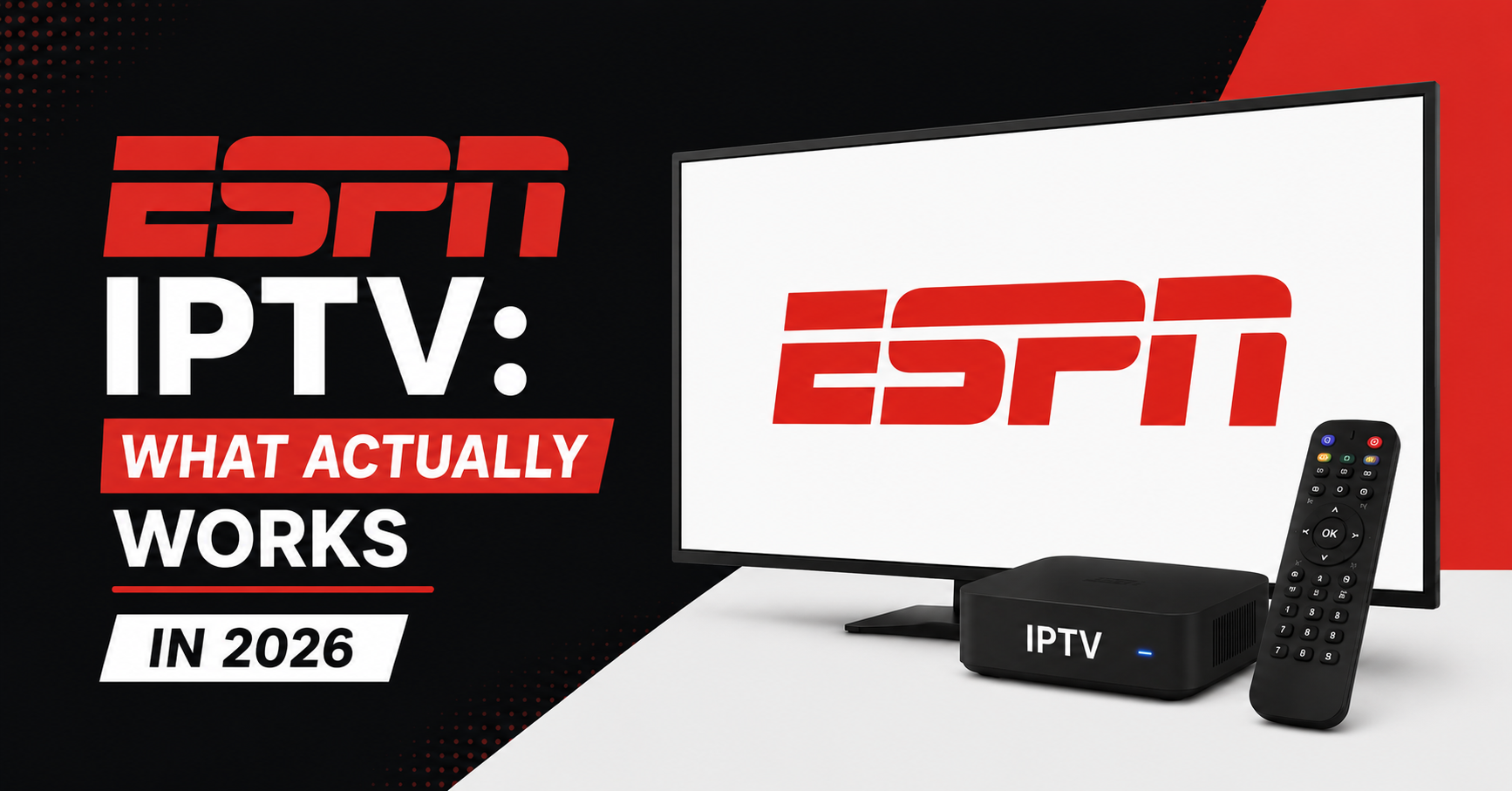
ToggleESPN IPTV refers to accessing ESPN’s family of sports channels, ESPN, ESPN2, ESPN+, ESPNU, SEC Network, through an IPTV service rather than a traditional cable box or the official ESPN app. The streams are delivered over the internet using HLS (HTTP Live Streaming), the same underlying protocol the official apps use.
What it isn’t: a magic feed pulled directly from ESPN’s own servers. An ESPN IPTV channel is a restreamed source, which means there’s an extra hop between the original broadcast and your screen. Every hop adds latency and a potential failure point. Understanding this single fact changes how you troubleshoot everything else.
Pro Tip: If your ESPN IPTV stream is consistently 30-45 seconds behind your neighbor’s cable broadcast, that’s normal HLS latency stacking across restream hops, not a fault. If it’s minutes behind or stuttering, that’s a server problem worth reporting.
Why the Buffering Always Hits at the Worst Moment
The cruel irony of sports streaming: everything works perfectly on a Tuesday afternoon and falls apart during the College Football Playoff. This isn’t bad luck. It’s math.
When a major game starts, every viewer on a given source connects within the same narrow window. A server provisioned for 5,000 concurrent streams suddenly faces 15,000. The result is buffering, frozen frames, or a dead channel. After reviewing hundreds of support tickets across multiple seasons, I can tell you the complaints cluster around exactly four windows: NFL Sunday afternoons, Saturday college football, NBA primetime, and the opening minutes of any heavyweight UFC card.
The providers who survive these spikes do something the cheap ones don’t, they spread load across multiple uplinks and reroute traffic automatically when one source saturates.
| Symptom | Likely cause | Who can fix it |
|---|---|---|
| Buffers only during big games | Server overload at source | Provider (load balancing) |
| Buffers at random times | ISP throttling | You (VPN/router tweak) |
| Audio/video out of sync | Player or device decoding | You (switch player) |
| Channel dead, others fine | Single-source failure | Provider (failover) |
| Everything slow | Local bandwidth | You (check network) |
The ISP Problem Nobody Warns You About
There’s a second culprit, and it’s gotten worse in 2026. Internet providers increasingly use traffic fingerprinting to identify and throttle streaming patterns that look like restreamed sports. We started noticing unusual behaviour two seasons ago: identical ESPN IPTV streams ran flawlessly on one ISP and stuttered constantly on another in the same city.
This is deep packet inspection at work. Your ISP isn’t blocking the content outright, it’s quietly shaping the bandwidth, which feels exactly like a provider problem but isn’t.
The practical signal: if your stream buffers across multiple providers but only on one network, the ISP is your bottleneck.
Pro Tip: Test the same ESPN IPTV stream on mobile data versus home Wi-Fi during a live game. If mobile is smooth and home stutters, your home ISP is throttling. A reputable VPN often resolves this, but only if the VPN server itself isn’t congested.
How Player Choice Quietly Changes Your Experience
People assume the app is interchangeable. It isn’t. The same ESPN IPTV source can look dramatically different depending on the player handling it.
TiviMate has the best buffer management, ideal for unstable connections, but is Android-based devices only. IPTV Smarters Pro offers broad compatibility with weaker buffering under load. OTT Navigator is excellent for advanced users who tweak cache settings. GSE Smart IPTV is reliable on iOS/Apple TV where TiviMate isn’t available.
A mistake we repeatedly see: someone blames their provider for buffering when their player’s buffer cache is set to default. Raising the buffer to 3-5 seconds in TiviMate eliminates most micro-stutters during high-traffic games. It trades a slightly longer load time for stability, a trade worth making during a final.
For the Reseller Side: Why Sports Channels Make or Break Your Panel
If you’re an UK IPTV reseller, ESPN and the broader sports lineup are simultaneously your strongest selling point and your biggest liability. Customers churn faster over a frozen NFL game than over almost anything else. One reseller I worked with lost roughly a third of his subscriber base in a single month, not because his prices were wrong, but because his reseller panel ran on a single oversubscribed source that died every Sunday.
The lesson for any IPTV reseller or panel owner: your retention is decided during three hours on Sunday, not in your marketing.
Mini case study: a sub-reseller running about 200 customers switched from a cheap reseller panel to one with documented failover. His support tickets during sports events dropped by an estimated 70%, and his renewal rate climbed noticeably the following quarter. He didn’t change his pricing or his ESPN IPTV lineup, only the infrastructure underneath it. For resellers comparing where to source a stable IPTV reseller panel, providers like britishiptvreseller.com publish their redundancy setup rather than hiding it.
Every IPTV operator eventually learns the same thing: panel credits are cheap, but a reputation for dropping the big game is expensive. A credit reseller who undercuts on price while ignoring uplink redundancy is building churn into the business model.
Pro Tip: If you’re a panel owner evaluating a new source, don’t test it on a quiet weekday. Buy a small batch of panel credits and stress-test ESPN IPTV during an actual NFL Sunday. That single test tells you more than any sales pitch.
Spotting a Serious Provider Versus a Disposable One
The infrastructure gap between a cheap Iptv service and a professional one is invisible until the moment it matters.
| Cheap infrastructure | Professional infrastructure |
|---|---|
| Single source | Multiple geo-distributed sources |
| No failover | Automatic failover routing |
| No redundancy | Backup uplinks during spikes |
| Frequent peak downtime | Stable under concurrent load |
| Limited monitoring | Active 24/7 monitoring |
| Vanishes after a bad weekend | Communicates during outages |
A serious operation has redundancy planning and reroutes traffic when one uplink saturates. A disposable one has a single point of failure and a customer base that learns this the hard way during the playoffs.
Setting Up ESPN IPTV the Right Way
A clean setup process prevents most self-inflicted problems.
Choose a player matched to your device, TiviMate for Android/Firestick, GSE for Apple. Load your provider’s playlist or Xtream Codes login, and never paste credentials into untrusted apps. Set buffer cache to 3-5 seconds before any major event. Wire your streaming device via Ethernet if possible, since Wi-Fi adds an avoidable failure layer. Test ESPN IPTV 24 hours before a game you care about, not during it. Keep a backup player installed so a single app glitch doesn’t cost you the match.
Frequently Asked Questions
Is ESPN IPTV legal to use?
The legality of ESPN IPTV depends entirely on the source and your country’s laws. Officially licensed streaming through ESPN’s own app or authorized distributors is legal. Unlicensed restreams exist in a legal grey area that varies by jurisdiction. Always verify your provider’s licensing status and understand the regulations where you live before subscribing.
Why does my ESPN IPTV stream buffer only during live games?
Because thousands of viewers connect to the same source simultaneously when a major game starts, overloading servers provisioned for normal traffic. This is the single most common ESPN IPTV complaint. The fix isn’t on your end, it requires a provider with load balancing and failover that spreads demand across multiple uplinks during traffic spikes.
What internet speed do I need for ESPN IPTV?
For a single HD ESPN IPTV stream, 15-25 Mbps of stable bandwidth is plenty. 4K needs around 40 Mbps. Speed is rarely the real problem, though, consistency matters more than raw numbers. A stable 20 Mbps outperforms an erratic 100 Mbps connection that drops during peak hours.
Can a VPN fix ESPN IPTV buffering?
Sometimes. If your ISP is throttling streaming traffic through fingerprinting, a VPN can bypass the shaping and restore smooth playback. But if the buffering comes from an overloaded provider source, a VPN won’t help and may even add latency. Diagnose the cause first by testing on a different network.
As a reseller, how do I stop customers churning over sports outages?
Source your UK IPTV reseller panel from a provider with proven failover and stress-test it during real sports events before committing. Most IPTV Panel reseller churn happens in the hours around major games. A stable IPTV reseller panel with redundancy retains customers far better than aggressive pricing on a fragile single-source setup.
Which player is best for ESPN IPTV on a Firestick?
TiviMate is widely considered the strongest choice for Firestick and Android TV, mainly for its buffer management during high-traffic games. IPTV Smarters Pro is a solid alternative with broader compatibility. For Apple TV or iOS, GSE Smart IPTV is the more reliable option since TiviMate isn’t available there.
Does ESPN+ work the same way through IPTV?
ESPN+ content is sometimes bundled into ESPN IPTV channel lists, but its availability varies by provider and source. Live ESPN+ events behave like any other restream, subject to the same server load and latency. Don’t assume a provider carries ESPN+ exclusives without confirming first.
Action Checklist
For Subscribers:
- Test ESPN IPTV the day before a game you care about
- Set player buffer cache to 3-5 seconds before kickoff
- Use Ethernet over Wi-Fi where possible
- Keep a second player app installed as backup
- Test on mobile data to rule out ISP throttling
The single lesson worth keeping: with ESPN IPTV, the app on your screen almost never decides whether you see the game, the infrastructure behind it does. Test before the whistle, not after, and judge any provider by how it performs at 1 PM on an NFL Sunday rather than how it looks in a sales pitch.