Last spring, a friend of mine called with a question that sounded simple. Dave runs a small plumbing firm in Leeds, and a bloke at his football club had offered him a reseller account. He wanted to know whether becoming an IPTV reseller UK households would genuinely pay for was a sensible side income or a fast route to trouble. I told him the answer was both, depending entirely on who stood behind the product.
Plenty of ordinary people are weighing up the same move, and I understand why. The market is noisy, crowded and full of promises that collapse by the second month. So here’s an honest guide to building something that lasts, written for any would-be IPTV reseller UK hopeful who’d rather be careful than quick.
I’ve spent years watching this corner of the telecoms world, from the glossy sales pages to the support inboxes behind them. Some of what I’ve seen is impressive. Plenty of it is not. Along the way I’ve learned which questions separate a solid business from a short-lived one.
The Legal Line You Can’t Afford to Cross
Before any talk of margins, you need to know where the law sits. Under the Copyright, Designs and Patents Act 1988 and the Fraud Act 2006, supplying a service that streams protected channels without a licence can lead to criminal charges. It makes no difference whether you built the platform or simply sold access to it. Bodies such as FACT, the Federation Against Copyright Theft, and the Premier League have pursued sellers as well as server operators.
Courts in England and Wales have handed out custodial sentences to people who sold illicit streaming subscriptions, so this isn’t a theoretical risk. The safer route is to resell only services built on properly licensed content, backed by a written agreement you’d be comfortable showing a solicitor. Ask any supplier for proof of rights before you send a single pound. Any IPTV reseller UK newcomer who skips this check is gambling with their savings.
That might sound like a buzzkill, but it’s actually your biggest advantage. Customers have been burned by services that vanish on a busy weekend, and a seller who can speak confidently about licensing stands out at once. Trust is the scarcest thing in this trade. I’d rather build a small, defensible business than a big, fragile one.
Written terms protect both sides. A one-page document covering what’s included, how renewals work, what counts as acceptable use and how complaints are handled will prevent most arguments. Pair it with clear receipts for every payment. If a dispute ever does arise, paperwork beats memory every time.
What an IPTV Reseller UK Business Actually Sells
Strip away the jargon and a reseller sells access, support and peace of mind. You buy credits or bulk subscriptions from a wholesale supplier, then pass them on to your own customers at a higher price. The supplier owns the infrastructure, and you own the relationship. When something breaks at nine on a Saturday night, it’s your phone that rings.
People often picture passive income, but that’s a stretch. A healthy IPTV reseller UK operation looks more like running a tiny shop than collecting rent. You’ll answer questions, fix login problems and chase renewals. The money is real, though, if you treat it as a service business.
Who buys from resellers in the first place? Mostly households that want a simple monthly arrangement, expats who miss familiar channels, and people tired of juggling several subscriptions. They rarely care about the technology. They care about whether it works on the lounge television tonight.
Broadly, there are three models, and each suits a different personality.
- Credit-based resale: you buy credits from a supplier’s panel and activate customer lines yourself.
- White-label resale: the supplier hosts everything while you sell under your own brand.
- Referral resale: you send customers to a supplier for a commission and handle nothing technical.
Most newcomers to the IPTV reseller UK scene start with credits because the entry cost is low and the control is high. White-label tends to suit people who already have a customer base and want a brand of their own. Referral deals are the gentlest introduction, though the earnings are modest.
How an IPTV Panel Works Behind the Scenes
An IPTV panel is the dashboard your supplier gives you to manage customer lines. You log in, create a subscription, set its length and send the credentials to your customer. Good panels also show connection counts, expiry dates and basic usage. Weak ones feel like they were built over a weekend.
I once tested a panel that logged me out every ten minutes and showed expiry dates in the wrong time zone. That sort of sloppiness tells you plenty about the people behind it. If the tooling is careless, the support will be too.
Look for a few specifics before committing. Can you reset a line without raising a ticket? Does the panel offer sub-reseller accounts if you grow? Is there an activity log so you can settle disputes with evidence?
Uptime matters just as much as the interface. Ask what happens during peak events, such as a major live sports weekend or a big series finale, because that’s when weak infrastructure shows itself. A decent supplier will talk openly about server capacity, failover and how outages get communicated. Evasive answers are a warning sign.
Security deserves a quick mention too. Your panel holds customer details, so check that it uses HTTPS, supports strong passwords and doesn’t share logins between staff. The ICO, the UK’s data protection regulator, expects anyone holding personal data to protect it properly, even if you’re a one-person operation.
Choosing an IPTV Provider You Can Stand Behind
Your IPTV provider is the foundation of everything, so this is where I’d spend most of my research time. A flashy website and a cheap price tell you almost nothing. Trading history, transparent terms and reachable humans tell you far more.
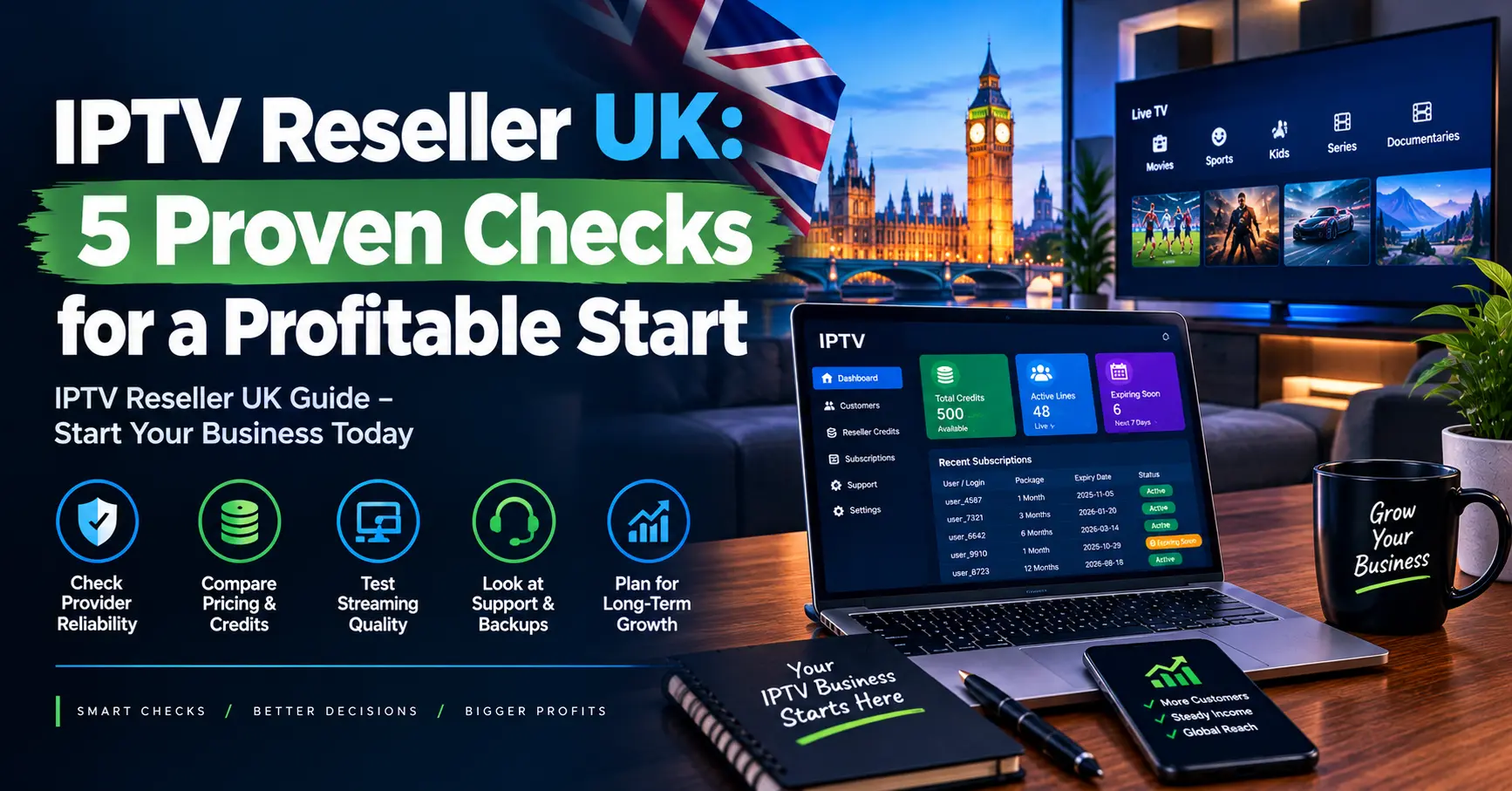
Treat the following as the five checks I’d run before trusting anyone with my customers:
- Company details: a registered business name, ideally traceable through Companies House.
- Written licensing: documents showing the rights to distribute the content on offer.
- Trial access: a short test period, even a paid one, so you can judge buffering and channel stability.
- Support response: send a question at eight in the evening and time the reply.
- Payment options: traceable methods that come with receipts, not only gift cards or cryptocurrency.
Notice what’s missing from that list: the biggest channel count. Resellers love quoting big numbers, but customers care whether the three channels they actually watch work properly. Quality beats quantity every time, and a good IPTV reseller UK business learns that quickly.
Consumer groups such as Which? have long advised people to check refund policies and contract terms before signing up to any subscription. The same advice applies to you as a buyer. If a supplier’s terms are vague about outages, credits or cancellations, expect vague behaviour when something goes wrong.
Switching suppliers is painful, so plan for it from the beginning. Keep your own customer records, outside the panel, in a simple spreadsheet. If your provider disappears tomorrow, you’ll still know who paid, when they renewed and what they were promised. That small habit has saved more than one reseller I know.
Signs of a Premium IPTV Service Worth Reselling
The phrase premium IPTV service gets thrown around far too casually. Every seller claims it, yet very few define it. To me, premium means stable streams, sensible buffering, accurate programme guides and a team that replies like adults.
Programme guide accuracy is a good test. If the guide shows the wrong show at the wrong time, your customers will notice within a week and blame you, not the supplier. Picture quality matters too, particularly for customers with large 4K televisions who spot compression artefacts quickly.
Run your own checks over a fortnight before judging any service. Watch the same channels in the morning, at lunchtime and at peak evening hours, and write down every stall or freeze. Compare results across wired and wireless connections, and try at least two devices. Patterns appear quickly when you record them.
Then there’s device compatibility. A premium IPTV service should work smoothly on Amazon Firestick, Android boxes, Smart TVs and mobile apps without strange workarounds. Your IPTV reseller UK customers will ask about setup constantly, so clear instructions help enormously. For that reason I point newcomers towards Install IPTV on Firestick: The Honest UK Guide to Stable Streaming before they send out a single credential.
There’s a trade-off here, and I won’t pretend otherwise. A genuinely premium service costs more at wholesale, which squeezes your margin or forces you to charge more. Our breakdown of [Internal Link: what to expect from a premium IPTV service → /premium-iptv-service-checklist/] covers that balance in more detail. Some customers will always pick the cheapest option and leave after two months, and chasing them rarely ends well.
Pricing, Credits and Margins in Plain Numbers
Numbers make this real, so here’s a simplified example. Prices vary between suppliers, and I’m using round figures purely for illustration. Your own costs will differ.
| Scenario | Wholesale cost per line (12 months) | Your retail price | Gross margin per line |
|---|---|---|---|
| Starter, 10 lines | £20 | £35 | £15 |
| Growing, 50 lines | £17 | £35 | £18 |
| Established, 150 lines | £14 | £33 | £19 |
At 50 lines, that’s roughly £900 a year in gross margin before costs. Subtract payment fees, advertising and the hours you spend on support, and the figure looks more modest. Ten lines barely covers a takeaway each month, whereas 150 lines can become a proper side income. Even so, any IPTV reseller UK income plan should assume slow growth.
Setting your own price takes some thought. Undercutting everyone attracts bargain hunters who leave first and complain loudest, while charging too much invites scrutiny you may not be ready for. Many resellers settle slightly below the big household-name subscriptions, because customers compare mentally. Test a price for a month, then adjust.
Remember that HMRC treats this as trading income. Once your gross trading income passes the £1,000 trading allowance in a tax year, you’ll need to register for Self Assessment. Keep business payments in a separate account from day one, because untangling a mixed bank statement in January is miserable. A good IPTV reseller UK plan includes tax from the start.
Your First 30 Days as an IPTV Reseller UK Newcomer
Week one is about learning, not selling. Open your panel, create a handful of test lines and use them yourself on a few devices. I’d also write down every question that crosses your mind, because your customers will ask the same ones.
- Days 1 to 7: Test streams on at least three devices at different times of day, including busy evenings.
- Days 8 to 14: Write simple setup instructions and a short terms page covering renewals, refunds and acceptable use.
- Days 15 to 21: Offer trial lines or a discounted first month to five people you know, and ask for blunt feedback.
- Days 22 to 30: Fix what they complained about, then open up to a wider audience through a simple website and a few honest testimonials.
This pace may feel slow, but it protects your reputation. An IPTV reseller UK customer who has a bad first week rarely offers a second chance, and word travels fast in local communities. Starting small also lets you spot supplier problems while the stakes are low.
Marketing can stay refreshingly simple at first. Local community groups, word of mouth and a tidy website with an honest FAQ will outperform expensive adverts when you only have a handful of lines. Avoid exaggerated claims, because they invite complaints and, in some cases, attention from the Advertising Standards Authority. Let satisfied early customers do the talking.
Support Is the Product Nobody Advertises
Something I learned the hard way: customers rarely leave because of price. They leave because nobody answered. A reseller who replies within an hour, even with a holding message, builds loyalty that discounts can’t buy. Think about the last time a broadband company ignored you, and you’ll remember it more vividly than the monthly fee.
Haven’t you ever left a company purely because nobody called back? Your customers feel exactly the same way. Set clear support hours, publish them and stick to them. A shared inbox and a few template replies for buffering, login failures and expired lines will save hours every week.
Picture a Sunday evening in November. A customer’s stream freezes ten minutes before a film he’s been waiting all week to watch, and he messages you in a panic. If you’ve already published a quick fix guide and replied warmly, he’ll thank you and renew in spring. If you’re silent until Monday, he’ll tell three neighbours.
Buffering complaints deserve a patient approach. Often the culprit is Wi-Fi, an overloaded router or an outdated app rather than the stream itself. Ofcom’s broadband research has repeatedly shown that real-world home speeds can fall short of advertised ones, so asking for a wired test is perfectly reasonable.
Every good IPTV reseller UK operator also knows when to say no. Refunds for genuine faults are fair, but you needn’t accept abuse or endless demands. Write your boundaries into your terms and apply them kindly.
Four Mistakes I Keep Seeing
After watching dozens of newcomers start out, I can tell you the same errors appear again and again.
- Buying too many credits upfront before testing the supplier properly.
- Promising “no buffering ever”, which no honest seller can guarantee.
- Skipping written terms and relying on chat messages.
- Mixing personal and business payments, which makes tax time painful.
None of these is fatal on its own, but they stack up quickly. Fixing them early costs almost nothing, whereas fixing them after a hundred customers have signed up can cost you the business.
Where I’d Start If It Were My Money
If this were my own money, I’d begin with ten customers, one dependable IPTV provider and a promise I knew I could keep. Skip the fantasy of overnight income. Build slowly, document everything and treat every customer as someone who might recommend you at the pub. Do that for six months and you’ll own something far more valuable than a long channel list.
So here’s my challenge. Write down the three questions you’d ask a supplier tomorrow, then actually ask them. The answers will tell you more than any sales page ever could. Becoming an IPTV reseller UK customers recommend is entirely possible, but it starts with doing the boring things properly.
Frequently Asked Questions
Is reselling IPTV legal in the UK?
Reselling is lawful only when the content is properly licensed for distribution to your customers. Selling access to channels streamed without rights can breach the Copyright, Designs and Patents Act 1988 and the Fraud Act 2006. Always ask a supplier for written proof of licensing, and consider a short consultation with a solicitor before you launch. This isn’t legal advice, so treat it as a starting point.
How much can an IPTV reseller UK beginner realistically earn?
Earnings depend on volume, pricing and how much time you spend on support. With fifty customers paying £35 a year and a wholesale cost of £17, gross margin sits around £900 before fees and tax. Ten customers will earn pocket money rather than a salary. Most people need six to twelve months to reach a figure worth talking about.
What is an IPTV panel, and do I need one?
Think of a panel as the control room for your customer lines. It lets you create, extend, suspend and reset subscriptions without emailing your supplier each time. Almost every wholesale arrangement includes one, though quality varies enormously. Test it properly before you commit to a bulk credit purchase.
Is a premium IPTV service worth the higher wholesale cost?
For many people it is, particularly if they want fewer complaints and longer customer lifespans. A stable IPTV provider costs more per line, but it reduces refunds and the hours you’d otherwise spend firefighting. Cheap services tend to look attractive for about six weeks. After that, the support tickets arrive.
Do I need a registered company to run an IPTV reseller UK business?
Not necessarily at the start, since many people trade as sole traders. Once your income grows or you want liability protection, a limited company can make sense. You’ll need to register with HMRC either way if you pass the trading allowance. An accountant will give you a far more reliable answer than any blog post.