Last winter, a friend of mine ran a small streaming side business from his spare room in Leeds. On the Saturday of a huge football weekend, his supplier’s dashboard simply stopped loading. Within the hour, forty customers had messaged him, and he had nobody to call.
That weekend taught him something I’ve repeated to every new reseller since. Your choice of iptv reseller panel provider isn’t one decision among many. It’s the foundation, and everything else, from branding to pricing, sits on top of it.
So I’ve written the guide I wish he’d had. We’ll look at what a panel really does, how to judge a supplier, and what to ask before you buy premium iptv credits or commit to a monthly deal. I’ll also cover what makes the best iptv subscription from your customer’s side, because that’s the side that decides whether they renew.
What an IPTV Panel Actually Does Behind the Scenes
Think of an iptv panel as the control room of a small broadcaster. It’s the web dashboard where you create customer accounts, set expiry dates, manage connections and see who’s watching. Your viewers never see it, but you’ll live inside it every day.
Behind that dashboard sits the real engineering. Streams are collected, sorted into bouquets and delivered to apps on Fire TV Sticks, Android boxes and smart TVs. A well-built panel handles all of it without asking you to become a network engineer.
Most resellers use about a third of what their panel offers. They create lines, renew lines and answer messages. That’s fine at the start. Still, features like usage logs, sub-reseller tiers and automatic expiry reminders are what turn a messy side project into a tidy business.
Here’s the catch, though. A panel is only software, and software can’t answer your phone at 8pm on a match night. That’s why choosing an iptv reseller panel provider carefully matters more than any feature list.
I’ve also learned that panels differ in how forgiving they are. Some let you undo a mistaken renewal in one click. Others make you open a ticket and wait. Small details like that decide how stressful your Mondays feel.
Why Your IPTV Reseller Panel Provider Matters More Than Your Price List
Customers don’t care which iptv reseller panel provider sits behind your brand. They care whether the match loads, whether the picture holds, and whether you reply when it doesn’t.
You carry the reputation, though, while your supplier carries the infrastructure. It’s an uneasy split. That’s why I’d happily pay a little more to a steady iptv reseller panel provider than chase the cheapest credits on a forum.
Picture the worst timing. It’s 7:55 on a Saturday evening, kick-off is five minutes away, and your channels start to buffer. What do your customers do next? Most won’t wait for an apology. They’ll message another seller before the first whistle.
Reliability is dull to talk about, yet it’s the one feature that keeps people renewing. Flashy dashboards and enormous channel counts don’t come close. In my experience, a provider who answers tickets inside an hour is worth more than ten extra bouquets.
There’s a second reason this choice matters. Your supplier’s mistakes become your refunds, and your supplier’s silence becomes your reputation problem. I’ve watched a reseller’s online reviews slide in a fortnight because of an upstream outage they couldn’t control.
It works the other way too. A dependable provider makes you look brilliant. Your customers will never know about the quiet fixes happening behind your brand, and that’s precisely the point.
Seven Checks to Run on Any IPTV Reseller Panel Provider
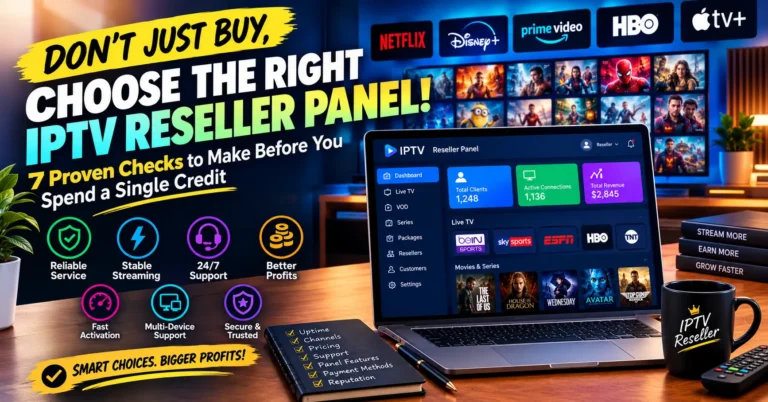
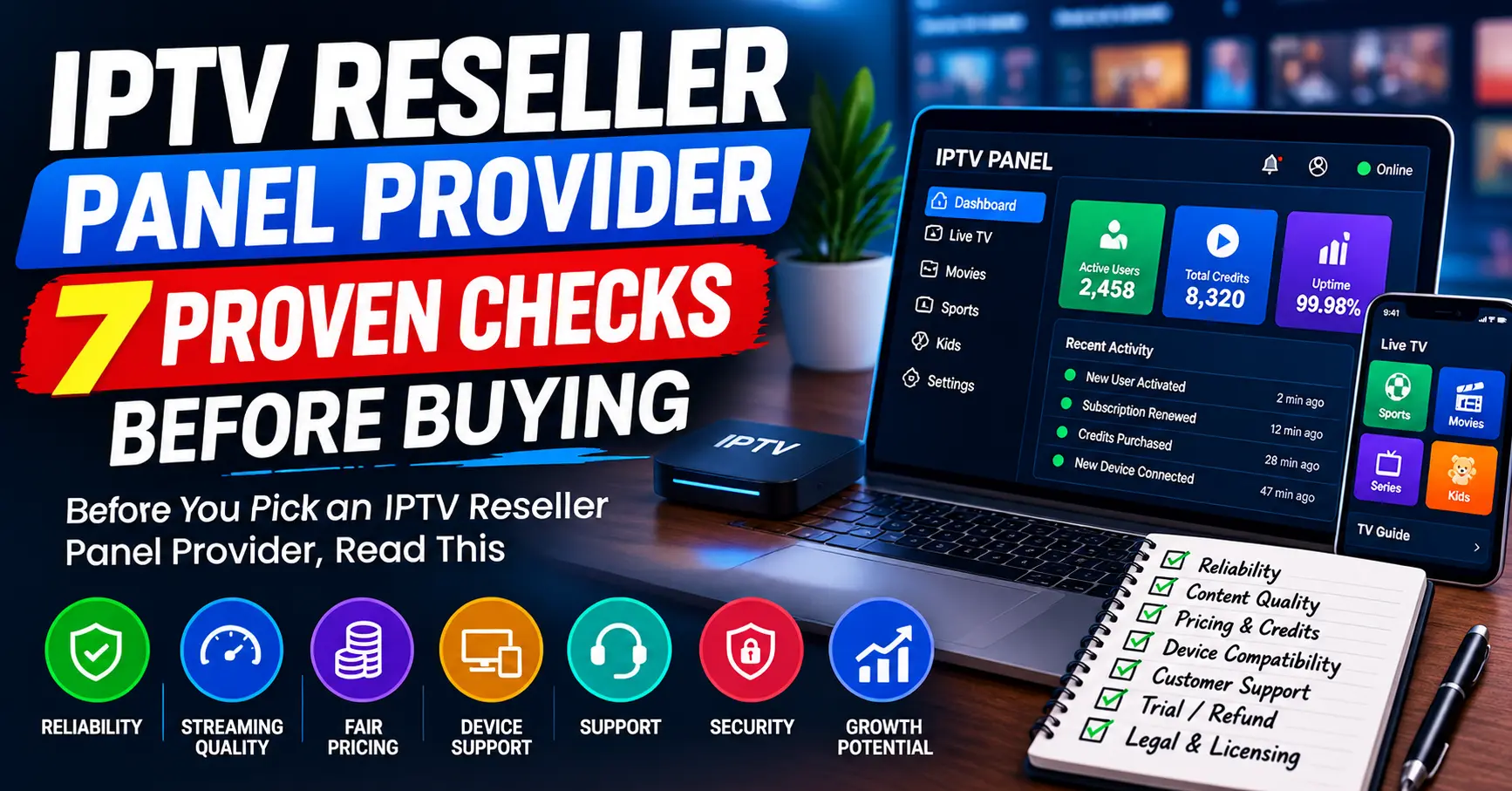
Before you send a single payment to an iptv reseller panel provider, run through these seven checks. I use them myself, and they’ve saved me from at least three bad deals. If you’d like a wider comparison framework, my guide on how to compare IPTV suppliers goes deeper.
- Company details. If a supplier claims to be UK registered, look them up on Companies House. A real company name, number and registered address take two minutes to confirm.
- Licensing answers. Ask in writing how the content is sourced and licensed. A clear answer is encouraging, while a vague one is a warning.
- Uptime record. Ask for a status page or a recent outage history. Then test the service across a full week, including a weekend evening.
- Support speed. Send a question at an awkward hour and time the reply. Slow answers now mean slower answers during a crisis.
- Panel features. Look for bulk line creation, sub-reseller tiers, expiry alerts and usage logs. Ask for a demo login before paying.
- Payment options. Prefer card or bank payments that offer some buyer protection. Be careful with suppliers who accept only crypto or gift cards.
- Trial credits. A confident supplier will let you test with a small purchase before you commit to a bulk pack.
None of these checks is complicated. Together, though, they filter out most careless operators within a week. Skip even one and you’re gambling with your customers’ goodwill, not just your own money.
Some of you will say that’s a lot of effort for a side business. Fair point. Yet a bad supplier costs far more than a week of testing ever will.
Licensing: The Conversation Most Resellers Avoid
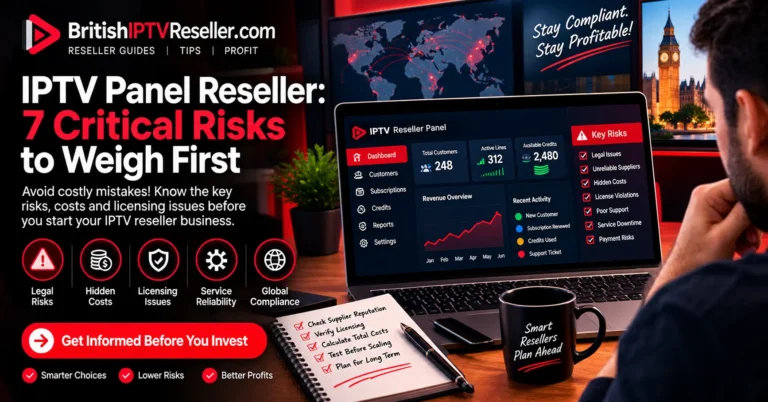
Nobody enjoys talking about licensing, but it’s where this trade lives or dies. The Federation Against Copyright Theft, known as FACT, has repeatedly warned UK consumers and sellers about unlicensed streaming. Whether you’re a one-person reseller or a larger outfit, your name sits on whatever you sell.
Choose an iptv reseller panel provider who is UK registered and can explain plainly how their content is licensed. Ask for that explanation by email so you’ve got a record. If the reply is a shrug emoji, that’s an answer too.
Ofcom’s Media Nations research has tracked for years how British households keep drifting from scheduled broadcast towards streaming. That tells you demand isn’t going anywhere, which is good news for legitimate sellers. It also means rights holders and regulators are watching the sector more closely.
Honestly, I’d walk away from any deal I couldn’t explain to a customer’s face. It isn’t the most exciting rule in this guide. It is, however, the one that has kept me out of trouble.
Panel Types Compared at a Glance
Different sellers need different tools, so here’s a quick comparison of the three setups I see most often.
| Panel type | Best for | Control level | Main trade-off |
|---|---|---|---|
| Shared basic panel | Newcomers with under 50 customers | Low | Fewer features and less branding freedom |
| Managed reseller panel | Growing sellers who want support included | Medium | Higher credit cost per line |
| White-label panel with API | Established sellers with hundreds of lines | High | More setup work and more responsibility |
Tables like this can’t capture every detail, but they do show a pattern. The more control an iptv panel gives you, the more responsibility lands on your desk. A managed option suits most beginners, while a white-label setup suits sellers who already know their customers well.
Ask your iptv reseller panel provider how upgrades work. Moving from a basic setup to a managed one shouldn’t mean rebuilding your customer list from scratch. I’ve seen that go badly, and it isn’t fun.
How to Buy Premium IPTV for Your Customers Without Regret
Buying credits feels like the easy part, and that’s exactly why people rush it. When you buy premium iptv for resale, you’re really paying for a promise that it’ll keep working next month. Treat the purchase like a hiring decision rather than a shopping trip.
Start Small, Then Scale
Pick the smallest pack the supplier offers. Use it on your own devices first, then give a few lines to friends who’ll tell you the truth. Two weeks of honest feedback beats any sales page.
Credits often expire or tie to set durations, so read the terms before you stock up. A big discount on a huge bundle looks tempting. It’s a poor deal if quality dips after month two.
Test Like a Customer
Load the service on the cheapest device your customers are likely to own, often an older Fire TV Stick. If it struggles there, they’ll struggle too. Check the guide, the channel switching speed and how the picture behaves in fast action.
Then try the awkward hours. Sunday afternoons, bank holiday evenings and big match nights are when weak servers show their cracks. Keep notes, because you’ll want evidence if you need to raise a complaint.
Maintenance windows deserve a question too. A provider who patches things at 3am is far kinder to your customers than one who updates during the Saturday evening rush. Support that covers evenings and weekends matters more than any discount, because that’s when people actually watch.
Finally, ask yourself a plain question. Would you pay for this service with your own money every month? If the answer is a hesitant maybe, keep looking.
Setting Up Your First Week With a New Panel
The first week sets the tone for everything after it. Spend the opening days exploring rather than selling. Create test accounts, break things on purpose and see how the dashboard responds.
On day one, create three test lines with different expiry dates and connection limits. Watch how the iptv panel reports them. If the numbers disagree with what you see on your own TV, raise it immediately.
By midweek, try the boring admin tasks: renewals, line deletions, password resets and package changes. These are what you’ll do hundreds of times. A dashboard that makes them slow will cost you hours every month, and a good iptv reseller panel provider will welcome this kind of testing.
Come the weekend, hand two or three lines to trusted friends and ask them to watch properly, not politely. Real viewing habits expose problems that lab testing never will. Ask them to note every buffering moment and the time it happened.
After that, write down what you found. A simple page with scores for stability, support, features and value makes the final decision far easier. Memory plays tricks, especially after a stressful match night.
What the Best IPTV Subscription Looks Like From Your Customer’s Chair
Your customers won’t read a specification sheet. They’ll judge the best iptv subscription by how it feels on an ordinary Tuesday night, so you need to see it through their eyes.
- Stable streams with minimal buffering at peak times
- A tidy guide that loads quickly and has sensible categories
- Reliable picture quality on both older and newer devices
- Fast fixes when something breaks, ideally within hours
- Clear pricing with no surprise charges at renewal
Notice that none of those points mention channel numbers. Big numbers sell the first month, but good behaviour sells the twelfth. I’d rather offer a smaller lineup that works than a giant one that wobbles.
Needs vary, of course. A family that watches mostly children’s programmes wants different things from a sports fan chasing six matches on a Saturday afternoon. Ask your customers what they actually watch, then match the package to that. A thoughtful iptv reseller panel provider will help you build those packages without fuss.
Warning Signs That Should Make You Walk Away
Red flags come in two kinds. Loud ones are easy to spot. The polite ones are easy to miss, so I’ll name the ones that have cost people real money.
Pressure comes first. If a supplier insists you must buy today for a special price, that’s a sales tactic, not proof of quality. Good providers don’t need to rush you.
Another warning is a total lack of paper trail. No company name, no terms of service, no refund policy and no named contact usually means nobody is accountable. I once lost a month of income to a supplier who simply vanished from Telegram, and I’ve never skipped the checks since.
Watch for providers who promise zero downtime, too. Every honest operator has bad days. What matters is how openly they tell you and how fast they fix it. Is a promise of perfection really believable?
Beware any iptv reseller panel provider who refuses a small test purchase. A genuine business wants you to be happy before you scale. A reluctant one is hiding something, even if it’s only poor quality.
Three Beginner Mistakes I Keep Seeing
Mistake one is choosing an iptv reseller panel provider on price alone. The cheapest credits are cheap for a reason, and the reason usually shows up as buffering or vanished support. Spend your savings on testing instead.
Second comes the habit of skipping records. Keep every invoice, chat log and copy of the terms in one folder. When a dispute arises, the reseller with evidence wins refunds, and the one without simply loses money.
Third, and perhaps most common, is overselling. New resellers promise perfection to land customers, then spend months apologising. Honest promises such as “reliable and quick to fix” hold up far better.
I made all three myself in my first year. It stung, but it also taught me more than any article could. If you avoid even one of them, this guide has done its job.
When Things Go Wrong at 8pm on a Saturday
Even the best supplier has an off night, so plan for it. Your customers will forgive an outage far faster than they’ll forgive silence. A short message saying you’re aware and working on it buys you hours of patience.
Set up a simple broadcast channel, perhaps on WhatsApp or Telegram, where you post status updates. Keep the tone calm and honest. Avoid blaming your supplier by name, because customers only care that you’re fixing it.
Offer a small gesture when an outage is long, such as an extra day added to the subscription. It costs you almost nothing and keeps people loyal. I’ve seen a single free day save dozens of renewals.
The Maths of Credits and Margin
Say you pay £4 per credit, and each credit covers one month for one customer. You sell that month for £8. It looks like £4 of profit, but payment fees, support time and the odd free replacement month shave it down. This is only an example, so swap in your own numbers.
Support time is the cost people forget. Spend twenty minutes helping one customer install an app, and your hourly rate collapses. Good panels cut that time with clear setup guides you can pass straight on.
Margins also hide in renewals. A customer who stays a year is worth more than five who leave after a month. That’s why stable service pays you back long after a cheap bundle has run out, and why you should compare every iptv reseller panel provider on real costs, not headline credit prices. The same logic applies when you buy premium iptv credits in bulk.
If you’d like a fuller walk-through of pricing tiers and onboarding, my longer guide covers it: From Credits to Customers: A Practical IPTV Panel Reseller Playbook
Keep a simple spreadsheet from day one. Track credits bought, credits sold, refunds and the hours you spend on support. After three months, you’ll know your real margin, and it may surprise you.
Where I’d Start If This Were My Business
Personally, I’d shortlist three suppliers, check their company details, and send each the same list of questions. Then I’d buy one small pack from the best two and test both for a month. It’s slow. It also works.
Meanwhile, I’d write a simple setup guide for customers, with screenshots for the most popular devices. It’s the cheapest way to cut support messages. Customers love a reseller who makes life easy.
Treat your iptv reseller panel provider as a long-term partner rather than a vending machine. Ask hard questions early, pay fairly and keep your own customers informed when things go wrong. Do that, and the best iptv subscription for your customers stops being a lucky find and becomes something you’ve built on purpose.
Go and make that shortlist today. Your future Saturday evenings will thank you.
Frequently Asked Questions
Q1: What should I look for in an iptv reseller panel provider?
A1: Start with the basics: a verifiable UK company, written licensing answers and a quick support reply. After that, check the panel’s features and test the service across a full week. A good provider will welcome these questions. A poor one will dodge them.
Q2: How do I buy premium iptv safely for resale?
A2: Buy a small pack first and treat it as a trial. Pay using a method with some buyer protection, and keep every invoice and message. Ask how the content is licensed before you pay, not after. Only then think about bigger bundles.
Q3: What makes the best iptv subscription for my customers?
A3: Stability beats size every time. The best iptv subscription gives customers steady streams at peak hours, a quick guide and fast fixes. It should also work on older devices without fuss. Price matters, but it comes after reliability.
Q4: Is an iptv panel hard to learn for a beginner?
A4: Rarely. Most panels use simple menus for creating lines, renewing accounts and viewing usage. Expect a week or two before it feels natural. A supplier who offers setup guides or a demo login makes that learning curve much shorter.
Q5: How many credits should I order from a new iptv reseller panel provider?
A5: Order the smallest pack on offer, usually enough for ten to twenty test lines. Use those for two to four weeks, watching quality and support speed. If both hold up, scale gradually. Never spend your whole budget on day one.