Most people buying an IPTV subscription for Smart TV do it backwards. They find the cheapest panel, load it up during a live match, and then spend the next 45 minutes watching a pixelated freeze frame while the group chat erupts. Sound familiar?
The problem is almost never the TV. It is the infrastructure sitting behind the subscription, the uplink servers, the load balancing, the connection handling. Smart TVs are passive devices. They will play whatever stream you point them at, cleanly or catastrophically. The difference comes entirely from what you are buying and who you are buying it from.
This guide breaks down how to choose an IPTV subscription for Smart TV correctly, what resellers need to understand before onboarding household clients, and why 2026 has changed the rules around ISP enforcement in ways most sellers are still ignoring.
Whether you are setting this up for a family living room or managing an UK IPTV reseller panel with hundreds of active connections, the decisions you make at the start determine everything downstream.
Why Smart TV Compatibility Is More Complicated Than It Looks
A Smart TV is not one thing. It is a category containing dozens of operating systems, Tizen, webOS, Android TV, Google TV, Vidaa, and proprietary systems from manufacturers who update their firmware unpredictably. An IPTV subscription for Smart TV that runs flawlessly on one model can throw an authentication error on the next, not because the stream is broken, but because the app layer is.
Most resellers do not explain this to their customers. They hand over a username and password and assume the client will figure out the rest. That assumption is where churn begins.
The three most common Smart TV compatibility failure points:
- App version mismatch: older Smart TV firmware often cannot support current M3U parsing standards
- Portal URL conflicts: some Smart TV IPTV apps cache portal entries and reject updates without a full reset
- EPG timing errors: Electronic Programme Guide data loaded from an incompatible timezone offset causes guide data to shift by hours, which customers consistently misread as a content or stream fault
Pro Tip: Always ask a new subscriber what Smart TV brand and model year they are using before issuing credentials. A 2019 Samsung Tizen device and a 2024 Google TV device will behave completely differently with the same IPTV subscription for Smart TV. Document your compatibility matrix and stop treating all Smart TVs as identical.
The Part of the Chain Your Provider Never Mentions
Here is what most IPTV subscription for Smart TV marketing material never mentions: the server your stream originates from is only one part of the chain. Between that origin server and your television sit CDN nodes, load balancers, DNS resolution layers, and the last-mile connection of your ISP, any one of which can create the buffering or dropout your customer blames on the subscription.
Premium IPTV infrastructure in 2026 runs on multi-CDN architecture with automatic failover. If a primary node goes down, the system re-routes connections to a backup uplink server within seconds. Cheaper panels, the ones flooding reseller markets at rock-bottom credit prices, run on single-server setups. When that server hiccups during peak viewing hours, every connected device goes down simultaneously.
Here’s how the infrastructure tiers actually compare:
| Infrastructure type | Load handling | Failover | Typical uptime | Best for |
|---|---|---|---|---|
| Single-server panel | Poor above 500 concurrent | None | 85 to 92% | Solo testing only |
| Multi-server standard | Moderate | Manual | 94 to 97% | Small resellers |
| Multi-CDN with auto-failover | Excellent | Automatic | 99%+ | Scaling operations |
| Dedicated uplink + backup | Highest | Sub-10 second | 99.5%+ | Enterprise resellers |
If your IPTV subscription for Smart TV provider cannot tell you how many uplink servers they have and what their failover process looks like, that is your answer.
How ISPs in 2026 Are Targeting IPTV Traffic Differently
This is the section most reseller guides skip entirely, and it is the one that will save or end your operation.
ISP-level blocking of IPTV streams has moved far beyond simple IP blacklisting. In 2026, deep packet inspection combined with AI-driven traffic analysis allows major ISPs to identify and throttle HLS stream patterns in near real-time. They are not blocking individual channels, they are identifying the signature of the stream itself.
What this means practically:
- A stream that worked flawlessly for six months can degrade overnight following an ISP policy update
- Customers on fibre broadband from certain providers will experience consistent dropout even with premium infrastructure
- DNS poisoning has become a common enforcement mechanism, redirecting portal URLs to dead endpoints without ever blocking the connection outright
An IPTV subscription for Smart TV delivered over unencrypted HTTP is significantly more vulnerable to this than one routed through a provider using adaptive encryption or rotating CDN endpoints. Ask your wholesaler which method they use. If they do not understand the question, that tells you everything.
Pro Tip: Advise household customers on fibre connections who report intermittent drops to test the same stream on mobile data. If the stream is stable on 5G but drops on fibre, the fault is ISP-level, not infrastructure. This single diagnostic step eliminates the majority of false support tickets that blame the subscription.
Picking a Panel That Survives Saturday Night
Saturday at kick-off. Sunday evening drama slot. New year’s eve at midnight. These are the moments that expose every weakness in a cheap IPTV subscription for Smart TV panel.
Concurrent connection handling is the stat that matters most and the one most resellers never check before committing. A panel offering 10,000 credits at a suspiciously low price is irrelevant if the server infrastructure behind it can only handle 2,000 simultaneous connections before degrading.
Questions every reseller must ask before signing a panel agreement:
- What is the maximum concurrent connection capacity?
- Is there a separate server cluster for sports versus VOD content?
- What is the average HLS latency during peak hours?
- Is there a dedicated support escalation channel during live events?
- Are backup uplink servers active or only switched in manually after an outage?
The resellers who retain customers for 12+ months are not always offering the cheapest credits. They are offering reliability that makes the subscription invisible, the customer watches their content, forgets the subscription exists, and renews automatically. That invisibility is built entirely in the panel selection phase.
Setting Up an IPTV Subscription for Smart TV Without the Support Nightmare
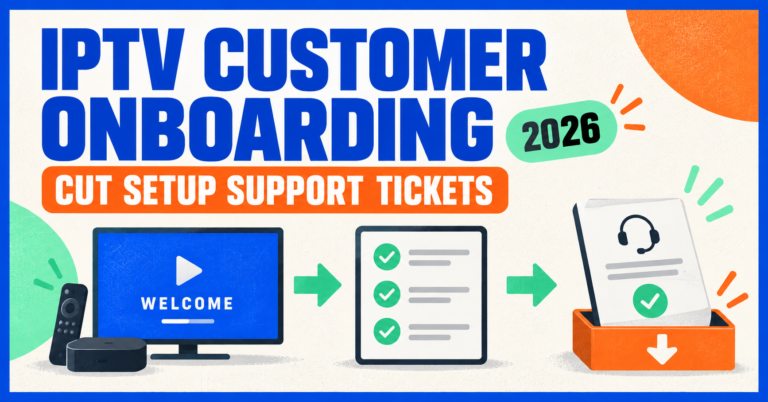
Most of the support tickets a reseller receives in their first month are avoidable. They come from customers who were handed credentials with no setup context and who hit one of three predictable friction points.
The three setup failures that generate 80% of support volume:
- Wrong app selection: the customer installs whichever IPTV app appears first in their Smart TV store rather than the one optimised for their device
- Portal vs M3U confusion: customers attempting to load M3U playlists into apps that only accept Xtream Codes portal format
- EPG not loading: typically caused by the customer not waiting the 12 to 24 hours required for guide data to populate after initial activation
A reseller who sends a one-page setup guide specific to the three or four most common Smart TV brands their customer base uses will cut their support load dramatically within 30 days. This is not a customer service luxury. It is an operational necessity for any IPTV subscription for Smart TV reseller handling more than 50 active lines.
Pro Tip: Build a separate setup guide for customers on Samsung Tizen versus those on Android TV. The portal entry process differs enough between the two that a single generic guide creates more confusion than it resolves. Two minutes of documentation saves 20 minutes of WhatsApp back-and-forth.
Getting Credits and Pricing Right as You Grow
The economics of reselling an IPTV subscription for Smart TV are straightforward in principle and brutal in practice. You buy credits at wholesale. You sell connections at retail. The margin lives between those two numbers, and it erodes faster than most new UK IPTV Panel resellers expect.
The erosion happens in four places:
- Refund requests from customers who had a genuine outage during an event
- Credits spent on test lines that never convert to paying customers
- Accounts left active after a customer churns without telling you
- Wholesale price increases from your panel provider timed to renewals
Resellers who build sustainable operations treat credit management like inventory management. They track active lines, set automated renewal reminders, and audit inactive accounts monthly. The ones who fail are treating their panel dashboard like a passive income machine that runs itself.
Here’s how different pricing models compare on stability and risk:
| Pricing model | Margin stability | Churn risk | Scalability |
|---|---|---|---|
| Monthly rolling | Low | High | Moderate |
| Quarterly bundles | Moderate | Moderate | Good |
| Annual with discount | High | Low | Excellent |
| Tiered (HD / 4K / Multi-screen) | Highest | Variable | Best |
An IPTV subscription for Smart TV sold as an annual package with a multi-screen option converts at a lower rate but retains at a significantly higher one. For a reseller building a stable income rather than chasing volume, the maths strongly favours annual pricing structures.
What Household Buyers Should Actually Look For
From the subscriber side, an IPTV subscription for Smart TV purchase comes down to three practical questions that most provider pages never answer directly.
Will it work on my specific TV without a separate device?
Native Smart TV support requires either a dedicated app in your TV’s store or Xtream Codes portal compatibility. Not every IPTV subscription for Smart TV includes both. Confirm before purchasing, not after.
What happens during a live event if it drops?
A provider without a clear answer to this question, whether that is an active backup stream, a credit compensation policy, or a support channel available during peak hours, is a provider whose infrastructure is single-point. That is the risk you are accepting.
Is there a trial period I can test under real conditions?
A 24-hour test line on a Tuesday afternoon is not representative of Saturday evening performance. Any provider confident in their infrastructure will either offer an extended trial or be transparent about their peak-hour performance metrics.
Pro Tip: If you are a household subscriber evaluating an IPTV subscription for Smart TV, run your trial specifically during the type of content you watch most. Sports streams during a live match are a completely different infrastructure load than VOD at off-peak hours. Test the conditions that matter to you, not the conditions that are convenient for the provider.
Frequently Asked Questions
What is the best way to install an IPTV subscription for Smart TV without extra hardware?
The cleanest method is using a native IPTV app available directly in your Smart TV’s application store, such as Smart IPTV, TiviMate where supported, or the manufacturer’s own IPTV portal interface. You enter your Xtream Codes credentials or M3U URL directly into the app. No Fire Stick, no Android box required. Compatibility varies by TV brand and firmware version, so confirm app availability for your specific model before purchasing.
How many simultaneous connections does a typical IPTV subscription for Smart TV include?
Most standard subscriptions include one connection per line. Households with multiple televisions need a multi-connection package, typically sold as 2, 3, or 5 simultaneous connections. Running two devices on a single-connection line will usually result in one stream dropping when the second activates. Always clarify connection limits with your reseller before setup, especially for family households with children’s rooms and a main living room running concurrently.
Why does my IPTV subscription for Smart TV buffer on fibre but not on mobile data?
This is almost always ISP-level traffic management rather than a subscription fault. Some fibre providers use deep packet inspection to identify and throttle IPTV stream patterns, particularly during peak hours. Mobile 5G connections often bypass this entirely. If your stream is stable on mobile data but drops repeatedly on your home fibre connection, the issue sits with your ISP, not your IPTV subscription for Smart TV provider.
Can I use one IPTV subscription for Smart TV across different brands, Samsung, LG, and Sony in the same house?
Yes, provided the subscription includes enough simultaneous connections for your household. The apps used may differ between TV brands, Samsung Tizen uses different IPTV clients than LG webOS or Sony Google TV, but the same Xtream Codes credentials work across all of them. The setup process varies per device, so request brand-specific setup instructions from your reseller rather than relying on a single generic guide.
Is it worth buying a 12-month IPTV subscription for Smart TV upfront?
For households with stable viewing habits, annual plans offer meaningful savings, typically 30 to 40% over equivalent monthly billing. The risk is committing to a provider whose infrastructure or content quality changes mid-year. Mitigate this by running a proper trial during peak viewing conditions before committing annually. Resellers benefit even more from annual customer agreements, retention rates are significantly higher and support volume per customer drops considerably.
What should a reseller check before buying IPTV panel credits to serve Smart TV customers?
Verify the panel’s concurrent connection capacity, confirm whether backup uplink servers exist and are active or only switched in manually, test stream stability during a live sports event rather than off-peak hours, and ask specifically about EPG data accuracy for Smart TV clients. EPG errors are the most common complaint from Smart TV users and are almost always a panel configuration issue rather than a customer error.
How do I know if an IPTV subscription for Smart TV provider has reliable infrastructure?
Ask directly: how many CDN nodes do they operate, is failover automatic or manual, and what is their guaranteed uptime during peak hours. Providers with genuine multi-CDN architecture can answer these questions specifically. Those running single-server operations will give vague or evasive answers. Also check whether they have a status page or incident history, transparency about past outages is actually a positive signal, not a warning sign.
What causes EPG data to show the wrong times on a Smart TV IPTV app?
EPG timing errors are almost always caused by a timezone offset mismatch between the provider’s EPG data feed and the app’s local settings. Smart TV IPTV apps often default to UTC, which shifts guide data by one hour in winter and two hours in summer for UK viewers. Manually setting the timezone offset in your IPTV app’s EPG settings, typically a +1 or +2 correction, resolves this in most cases. If the problem persists, the fault is in the provider’s EPG source configuration.
Reseller Success Checklist
- Confirm your panel provider’s concurrent connection ceiling before purchasing credits, not after your first peak-hour complaint
- Build separate setup guides for Samsung Tizen, LG webOS, and Android TV/Google TV customers
- Test every new panel during a live sports event, not at 2am on a Tuesday
- Ask your wholesaler directly about backup uplink server configuration and failover response time
- Audit inactive lines monthly, dead accounts are dead margin
- Migrate high-volume customers to annual billing where possible
- Document ISP-related drop complaints separately from infrastructure complaints, they require different resolutions
- Set up a dedicated support channel (WhatsApp or Telegram) specifically for peak-hour incident reporting
- Never issue a new IPTV subscription for Smart TV without confirming the customer’s TV brand, model year, and app preference first
- For trusted reseller-tier options and UK-focused panel infrastructure, visit British Reseller for IPTV Panel reseller plans.