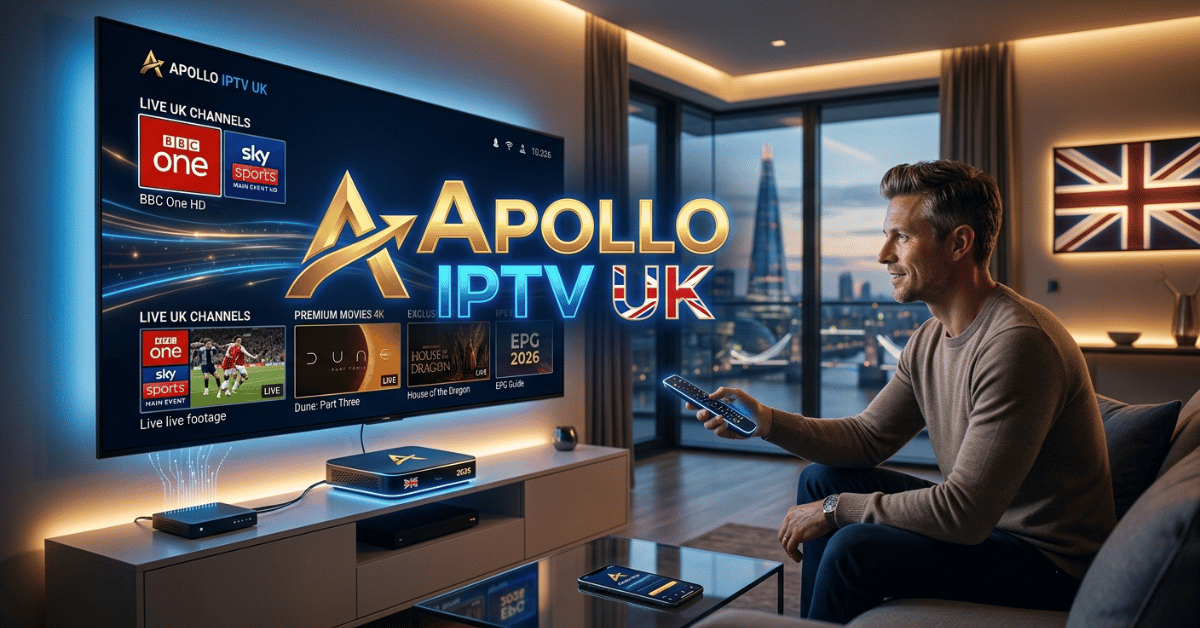
Walk into any UK IPTV reseller forum right now and Apollo IPTV comes up within the first five minutes. It’s recommended, criticised, defended, and dissected all in the same thread. So what’s actually going on? I’ve spent enough time managing IPTV reseller panel to know that popularity and reliability are two very different things, and Apollo IPTV has become a textbook case of that gap.
The moment that crystallised this for me was a Saturday at 4:45PM. Three minutes before kick-off on a premium sports stream, I had 60+ active subscribers on lines sourced from an Apollo IPTV-affiliated panel. What followed wasn’t buffering, it was a complete blackout. No stream, no fallback, no acknowledgement from the provider for 22 minutes. By the time channels recovered, the damage was done: eight refund requests, two chargebacks, and a WhatsApp group in full meltdown.
That’s the reality of Apollo IPTV that nobody puts in the headline. And it’s precisely why I want to break this down properly, not to bury it, but to give UK resellers an honest framework for evaluating whether Apollo IPTV belongs in your stack or not.
Apollo IPTV operates across multiple reseller tiers, offering M3U and Xtream Codes access, VOD libraries, and multi-device support. On paper, that sounds comprehensive. In practice, the infrastructure behind Apollo IPTV varies wildly depending on which upstream supplier is actually running the servers.
What Apollo IPTV Actually Delivers at the Infrastructure Level
Here’s the thing that most Apollo IPTV reviews skip entirely: the service is not a monolithic operation. When you buy credits or reseller access under the Apollo IPTV brand, you’re often tapping into a network of servers, some UK-based, some routed through European nodes, that may or may not be built for high-concurrency UK traffic.
Peak-time performance is the real stress test, and Apollo IPTV has a mixed record. During standard weekday hours, streams are generally stable. But the moment you hit a Saturday 3PM Premier League window or a major boxing night, the weaknesses surface fast.
The core problem is uplink capacity. Premium sports streams in 4K HEVC demand significant bandwidth per connection. If the Apollo IPTV infrastructure isn’t running UK-based 10Gbps+ uplinks with load-balanced delivery nodes, you’re going to see HLS latency climb, buffer-bloat kick in, and connections drop in sequence, exactly when your subscribers are most engaged and most likely to demand refunds.
Pro Tip: Before committing volume to any Apollo IPTV reseller arrangement, run a concurrent connection test during a live sports event, not a quiet Tuesday evening. That’s the only honest infrastructure benchmark that matters.
Another layer that Apollo IPTV resellers often overlook is DNS poisoning exposure. UK ISPs have become increasingly aggressive in 2025-2026 with DNS-level blocking of IPTV streams. If Apollo IPTV doesn’t provide dynamic DNS failover or IP rotation as part of its infrastructure, your reseller lines become vulnerable overnight, without any warning.
Read More: IPTV Panels Pricing
The Credit Model Behind Apollo IPTV, and Where It Gets Complicated
Apollo IPTV, like most panel-based systems, runs on a credit structure. You purchase credits upfront, convert them into subscriber lines, and manage renewals through a reseller dashboard. That’s standard. But the credit economics of Apollo IPTV are where resellers often miscalculate their margins.
Here’s the formula I use to sanity-check any panel-based arrangement including Apollo IPTV:
Net Reseller Margin = [(Retail Price − Credit Cost Per Line) × Active Lines] ÷ Total Credit Spend × 100
If you’re operating on Apollo IPTV credits at, say, £2.50 per line per month and retailing at £8, your gross looks attractive. But factor in churn (typically 15-25% monthly for IPTV resellers), refunds tied to downtime, and the cost of topping up credits urgently when lines expire without warning, and that margin compresses fast.
| Factor | Apollo IPTV Reseller Reality | Managed Panel (e.g. British IPTV Reseller UK) |
|---|---|---|
| Credit Flexibility | Fixed bundles, limited top-up options | Scalable credits, no minimum lock-in |
| Uptime Transparency | No public SLA | Infrastructure accountability |
| UK Server Priority | Varies by supplier chain | UK-optimised routing |
| Support Response | Community-dependent | Dedicated reseller support |
| DNS Failover | Not guaranteed | Built-in redundancy |
The comparison isn’t designed to be unfair to Apollo IPTV, it’s designed to show what managed infrastructure actually looks like versus a brand name with inconsistent backend arrangements.
Why Apollo IPTV Resellers Bleed Subscribers After the First Month
Customer churn is the silent killer in IPTV reselling, and Apollo IPTV’s ecosystem has structural factors that accelerate it. The first month is usually fine, subscribers are new, streams are working, everything feels solid. Month two is where the cracks appear.
The primary churn triggers I’ve observed with Apollo IPTV resellers are predictable:
Inconsistent EPG data: Electronic Programme Guides that don’t update properly, leaving subscribers confused about scheduling
VOD library gaps: Apollo IPTV’s VOD content varies significantly depending on the upstream package, and subscribers notice when titles go missing
App compatibility friction: Subscribers using Firestick or Smart TV apps often encounter configuration issues that Apollo IPTV support can’t resolve at speed
No trial-to-subscriber conversion process: Apollo IPTV doesn’t have a formalised free trial structure, making acquisition harder for resellers trying to build confidence with new customers
The psychology of Apollo IPTV churn is this: subscribers don’t leave because of one bad stream. They leave because of accumulated small failures that erode trust. Apollo IPTV’s reseller community lacks the tooling to proactively manage that trust, no automated renewal reminders, no usage analytics, no churn prediction.
Pro Tip: If you’re running Apollo IPTV lines, build your own retention layer externally, a Telegram bot for renewal reminders, a simple Google Sheet tracking subscriber activity, and a clear communication template when downtime hits. Apollo IPTV won’t do this for you.
ISP Blocking in 2026: How It’s Targeting Apollo IPTV Streams
The UK’s approach to IPTV enforcement has matured significantly. It’s no longer about blocking static IP ranges and calling it done. In 2026, ISP-level blocking uses a combination of deep packet inspection, AI-driven traffic pattern recognition, and coordinated DNS poisoning that adapts in near real-time.
Apollo IPTV streams are identifiable by their delivery patterns. When a large volume of HLS segment requests originate from the same infrastructure, ISP filtering systems flag and throttle or block those requests, often within hours of a major live event starting. This is why Apollo IPTV subscribers in urban UK areas (particularly those on FTTP connections without VPN) experience the sharpest drop-offs during premium sports windows.
The technical mitigation for this is server-side: Apollo IPTV would need to rotate stream delivery IPs dynamically, implement SNI masking, and route through content delivery nodes that don’t present identifiable traffic signatures. Whether the specific Apollo IPTV supplier you’re dealing with has implemented any of this is a question you should ask directly, and if you can’t get a straight answer, that tells you something important.
How to Evaluate Any Apollo IPTV Supplier Before Committing Credits
Not all Apollo IPTV arrangements are equal. Before you put real money into credits, here’s the evaluation framework I use:
Stress test timing: run your trial exclusively during a live sports event, not off-peak
Ask for server location specifics: UK-based servers should be the non-negotiable baseline
Test DNS failover manually: pull your M3U URL, block the primary IP at router level, and see if the stream reroutes
Check panel responsiveness: how long does it take to activate a new line at 9PM on a Friday?
Request uptime data: any serious IPTV supplier should have uptime logs, if they won’t share them, walk away
Resellers who skip this process are the ones filling forums with complaints three weeks later. Apollo IPTV has enough brand recognition to attract customers, but brand recognition doesn’t stream 4K content reliably during peak load.
If you’re at the point where Apollo IPTV inconsistency is costing you subscribers and you want a panel built for UK IPTV reseller volume, British IPTV Reseller UK offers the infrastructure accountability and credit flexibility that Apollo IPTV’s fragmented model simply doesn’t.
The Apollo IPTV Reseller Success Checklist
- Never evaluate Apollo IPTV on off-peak performance, test during a live Saturday sports window before committing credits.
- Calculate your real margin using the formula above, factoring in churn and refund rates, not just headline credit prices.
- Build your own subscriber retention layer, since Apollo IPTV won’t do this for you, and churn will quietly destroy your revenue.
- Confirm DNS failover and IP rotation with your specific Apollo IPTV supplier before any volume commitment.
- Have a backup panel ready, since running Apollo IPTV as your only source during a major UK sports event without a failover is an operational risk you can’t afford.