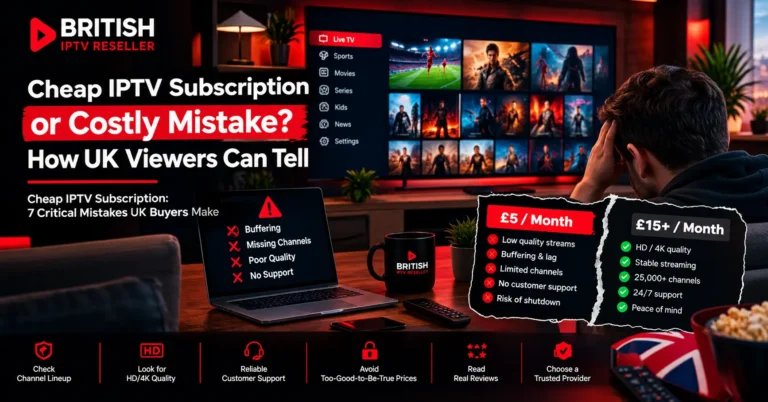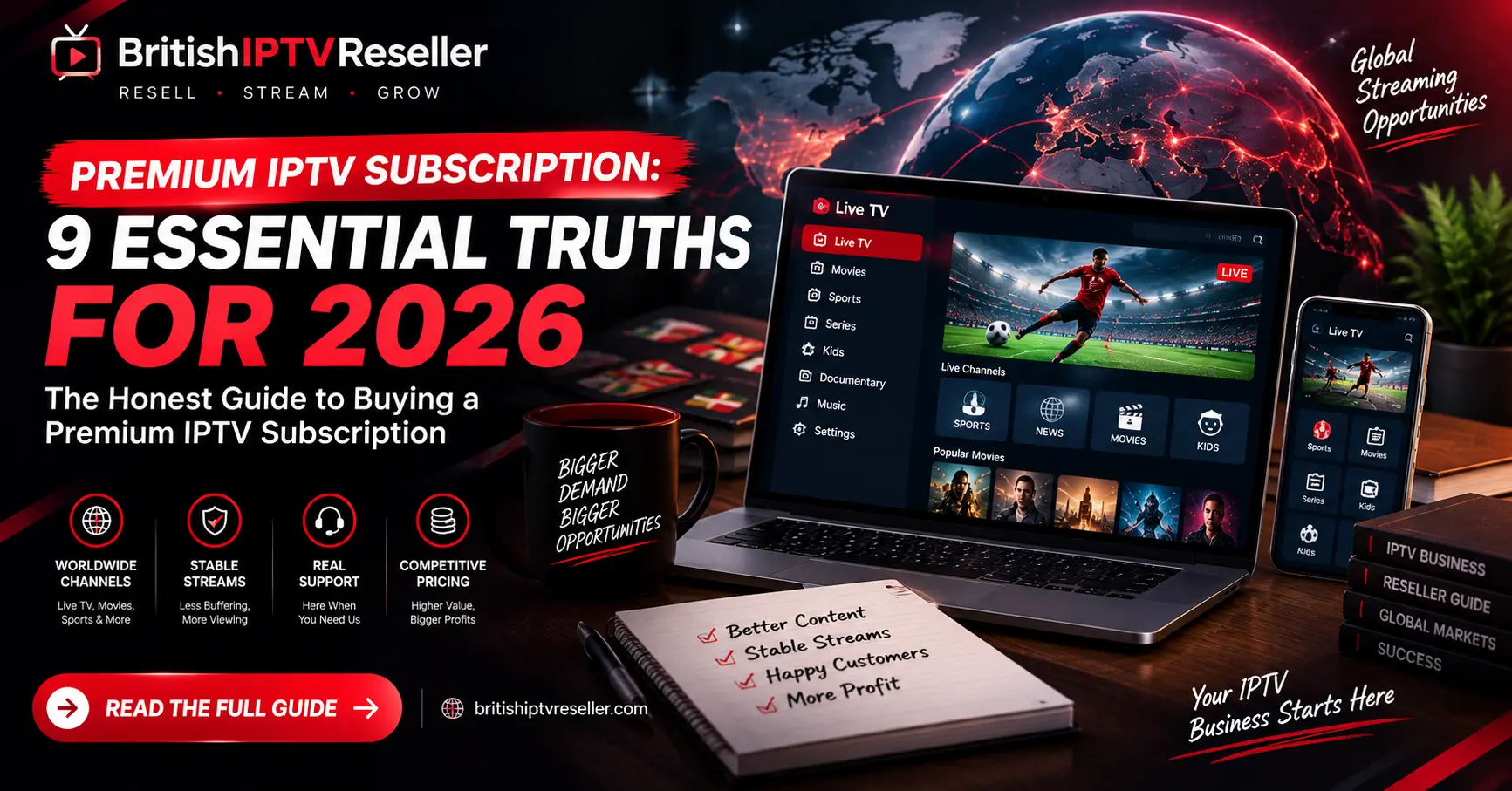
Last winter I spent an evening in a friend’s front room in Coventry watching him argue with a spinning loading circle. He’d paid twelve months up front for what the seller had confidently called a premium IPTV subscription. The picture held for about four minutes at a stretch, then stalled. By half nine he’d given up and put the radio on instead.
That evening is roughly why I keep writing about this subject. A premium IPTV subscription isn’t a price bracket and it certainly isn’t a marketing badge stuck on a checkout page. It describes the infrastructure sitting quietly behind the service, and buyers almost never get shown that part before they hand over their card details.
What a premium IPTV subscription actually buys you
Here’s the uncomfortable bit. Two services can offer identical stream counts, identical apps and identical pricing, and one will be watchable on a Saturday night while the other falls apart. The difference almost never appears in the sales copy.
What you’re really purchasing is headroom. Server capacity that isn’t already running at ninety percent before peak hours arrive, redundant routes so a single failure doesn’t take your evening with it, and a human being who answers messages when something breaks at eleven at night.
Capacity beats catalogue size every time
Sellers love enormous numbers. Thirty thousand of this, sixty thousand of that. I’ve lost count of how many storefronts lead with a figure that no household could work through in a decade.
Ask instead how many concurrent viewers sit on the server handling your region. That single question separates a genuine premium IPTV subscription from a thin resale of someone else’s overloaded capacity. Most sellers won’t have an answer ready, and how they handle the question tells you plenty.
The ninety-minute test
My own test is embarrassingly simple. Start something long and watch it properly, ideally during peak hours on a Friday or Saturday, and don’t touch the remote.
Anything can look flawless for five minutes. Sustained delivery across ninety minutes at peak load is the only honest measurement, and it’s the one a trial period exists to let you run. If a provider refuses any form of trial, you’ve learned something useful for free.
The infrastructure question nobody asks their iptv service provider
Video already dominates consumer internet traffic. Sandvine’s Global Internet Phenomena reports have tracked that shift for years, and the direction has never reversed. Every provider is fighting for the same congested evening window, which is exactly when you want to watch.
A serious iptv service provider spreads that load across multiple edge locations rather than pushing everyone through one box in one data centre. They also maintain a transcoding ladder, meaning a stream can drop to a lower bitrate gracefully instead of freezing while your device sulks.
Why the middle of the chain matters most
Picture the path your stream takes. Source, ingest, transcode, distribution, edge server, your ISP, your router, your telly. Any weak link ruins everything downstream, and the weak link is usually in the middle where nobody is looking.
When a customer tells me their service “went bad last month”, the cause is frequently invisible to them. The iptv service provider quietly migrated servers, oversold capacity after a marketing push, or lost a peering route. None of that shows up as an error message. It just shows up as buffering.
Ofcom’s connected nations reporting is worth a glance here too, because plenty of British households genuinely don’t have the upstream conditions they assume they have. Before blaming any provider, it’s worth knowing what your line actually delivers at eight in the evening rather than at eleven in the morning.
Reading an iptv abonnement offer like a sceptic
Travel across Europe and the vocabulary shifts. In France, Belgium and the Netherlands you’ll see the phrase iptv abonnement used constantly, and it simply means subscription. Same product category, different language, frequently the same underlying servers being relabelled by a dozen different storefronts.
That relabelling is the reason price alone tells you nothing. I’ve seen an iptv abonnement sold at four different price points on four different sites in the same week, all pointing at identical infrastructure. One of those sites offered support. Three did not.
So what separates a genuine offer from a repackaged one? Usually the detail in the answers rather than the polish of the website.
| Signal | Thin reseller offer | Genuine premium service |
|---|---|---|
| Trial | None, or “trust us” | Short trial, no drama |
| Support | Email only, slow replies | Direct channel, named person, sensible hours |
| Payment terms | Long prepaid term pushed hard | Monthly available without penalty |
| Technical answers | Vague, deflects to “server issue” | Explains load, region, device settings |
| Pricing | Undercuts everyone, no explanation | Competitive but justified |
| Uptime talk | Promises 99.9 percent, no evidence | Honest about maintenance windows |
That last row is my favourite tell. Anyone promising perfection is either inexperienced or hoping you are.
Where iptv credits fit, and why resellers think in them
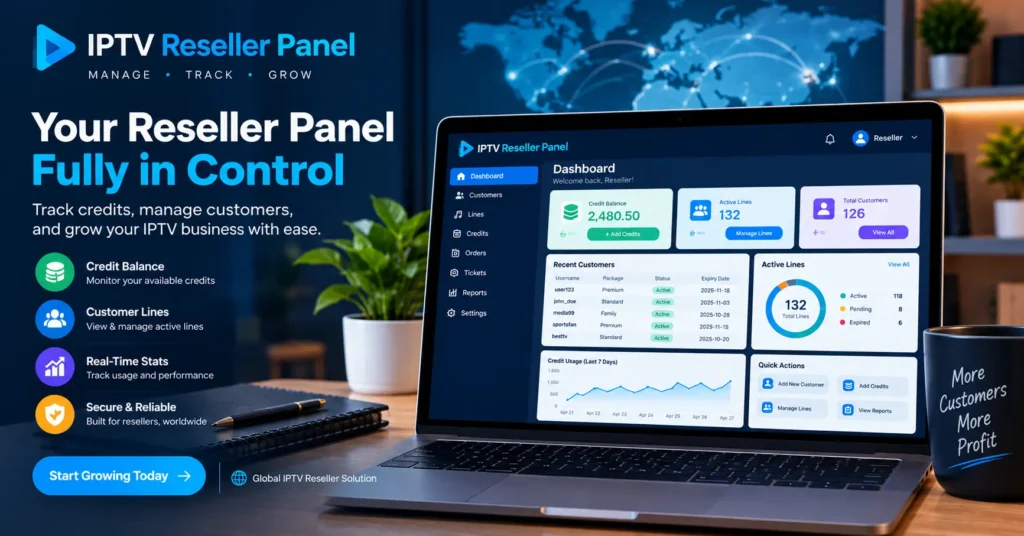
Now flip the perspective entirely, because half the people reading this are buying to resell rather than to watch. The unit of currency on that side is iptv credits, and understanding the model makes the retail market far easier to read.
One credit typically equals one month of one line. Buy a block of iptv credits at wholesale, spend them as customers arrive, and your cost per subscriber falls as your volume rises. It’s a simple structure, which is precisely why it gets abused by people who buy cheap blocks with no intention of supporting anyone.
The maths nobody puts in the sales pitch
Let’s say you buy 100 iptv credits at a discounted rate. Your instinct is to price aggressively and fill your panel quickly, because volume feels like progress.
Then reality arrives. Every customer you onboarded at a rock-bottom rate expects a response when a stream stutters, and support time doesn’t scale the way credit blocks do. I’ve watched resellers burn out within a quarter because they priced for acquisition and forgot the human cost of retention entirely.
The operators who last treat iptv credits as inventory with a service obligation attached, not as a lottery ticket. They price with margin for support, refuse to compete purely on being cheapest, and grow slowly enough that quality holds.
How To Become a British IPTV Reseller in 2026 (The Honest Guide) → / become iptv reseller
A five-minute audit before you pay anyone
You don’t need technical expertise to filter out most poor operators. You need five minutes and a willingness to ask slightly awkward questions.
- Ask which region your line will be served from. A confident answer suggests real infrastructure behind the offer.
- Request a trial and use it at peak time, not at lunchtime when everything looks perfect.
- Send a support message before buying and time the reply. That response speed is the one you’ll live with.
- Check whether monthly billing exists at all. Providers pushing only annual prepayment are managing their own risk, not yours.
- Ask what happens during maintenance. A premium IPTV subscription comes with an honest answer about downtime rather than a blanket denial.
- Confirm how many devices can stream simultaneously, and what happens when you exceed that.
Any provider irritated by those six questions has told you exactly how they’ll behave once your money has cleared.
When a premium IPTV subscription is the wrong purchase
I’d rather lose a reader’s business than sell them something that doesn’t suit them, so let’s be straight about the cases where this isn’t the right call.
If you watch two hours a week, you’re overbuying. If your home network runs on a decade-old router pushed through three walls, no provider on earth will fix that for you. And if you primarily want curated on-demand libraries with recommendation engines, mainstream streaming platforms already do that job better.
The part most articles skip
There’s also a legitimacy question that deserves plain language rather than a wink. Rights and licensing vary enormously by territory, and the responsibility for understanding what a service is licensed to distribute in your country sits with both the seller and the buyer.
A reputable operator will tell you what they’re actually providing. If a seller becomes evasive when you ask about the legal basis of their offering, that evasiveness is the answer. A premium IPTV subscription should never require you to accept vagueness as a condition of purchase.
The boring technical details that decide your picture quality
Roughly two thirds of the “the service is broken” complaints I’ve seen turned out to be conditions inside the customer’s own home. That’s not a defence of bad providers. It’s just what the data keeps showing.
Wire it if you possibly can. A five pound ethernet cable outperforms almost any wifi improvement you can buy, and it removes the single most common variable in the entire chain.
If wired genuinely isn’t possible, get the device onto the 5GHz band and move the router away from the microwave, the fish tank and the stack of paperbacks it’s currently buried under. Small changes, disproportionate results.
Device and app choices that actually matter
Older streaming sticks struggle with modern high-bitrate streams because their decoders were designed for a different era. A current-generation Android box or a recent Fire device handles the load far more comfortably, and the difference is immediately visible.
App choice matters nearly as much. Players differ enormously in how they handle buffer size and reconnection behaviour, and a provider worth paying attention to will recommend specific players rather than shrugging. Getting the most from a premium IPTV subscription often comes down to matching the right player to the right hardware, which takes about ten minutes to sort out properly.
Pro tips from the support desk
A handful of things I find myself repeating weekly, in no particular order of importance.
- Restart the router, not just the app. The app is rarely the problem.
- Test at 8pm on a Saturday before committing to anything long term.
- Keep a second payment method separate from your main account for any new vendor.
- Screenshot the terms at the moment of purchase, because storefronts get quietly rewritten.
- If support goes silent for more than 48 hours during your trial, walk away. That’s the honeymoon period.
None of this is clever. It’s just the accumulated result of watching the same avoidable problems happen to different people for years.
A final thought before you spend anything
The market rewards patience in a way that surprises people. The buyers who end up genuinely happy are almost never the ones who found the cheapest twelve-month deal on a forum at midnight. They’re the ones who trialled three options, asked uncomfortable questions and paid slightly more for someone who answers the phone.
Spend one evening testing properly and you’ll save yourself a year of irritation. That’s the whole argument, and I’d make it again tomorrow.
Frequently Asked Questions
How much should a premium IPTV subscription cost in 2026?
Pricing varies widely by region and term length, but suspiciously cheap offers usually signal oversold capacity rather than clever efficiency. A sustainable premium IPTV subscription needs to fund server headroom, bandwidth and support time, and those costs don’t disappear because a seller wants to undercut a competitor. Treat anything dramatically below the market average as a question rather than a bargain. The cheapest option in year one frequently becomes the most expensive once you factor in switching twice.
Is an iptv abonnement the same thing as an IPTV subscription?
Yes, functionally identical. The term iptv abonnement is simply the French, Dutch and Belgian phrasing for the same product, and you’ll see it across European storefronts constantly. The vocabulary changes but the underlying infrastructure questions don’t. Judge an iptv abonnement by exactly the same criteria you’d apply to any English-language offer.
What should I ask an iptv service provider before signing up?
Start with region of service, concurrent connection limits, trial availability and support response times. A capable iptv service provider will answer all four without hesitation because those answers reflect the infrastructure they’ve built. Vagueness on any of them is meaningful information. I’d also ask what happens during planned maintenance, since honesty about downtime is one of the strongest signals of a well run operation.
Do I need a fast internet connection for a premium IPTV subscription?
Less than most people assume, though stability matters far more than raw speed. A steady 25 to 50 Mbps connection handles high-quality streams comfortably for a typical household. The usual culprit behind poor performance is wifi interference or an ageing router rather than the broadband package itself. Wiring the device directly to the router resolves a remarkable proportion of complaints within minutes.
Can I resell a subscription I bought for personal use?
Not effectively, no. Retail lines and reseller panels are structured differently, and reselling properly means working with iptv credits through a panel designed for managing multiple customers. You also inherit a support obligation the moment someone pays you, which catches out a lot of newcomers. If reselling genuinely interests you, start by understanding the credit model and pricing structure before buying anything.