The first time I watched a stream collapse mid match was during a Champions League quarter final years ago. Forty resellers had pointed their customers at one source, that source had no backup uplink, and when a goal went in the whole thing froze on a frame of a corner flag. Nobody saw the goal. The support tickets started before the player had finished celebrating.
I bring that up because England vs Ghana live on IPTV 2026 is exactly the kind of fixture that exposes weak setups. So before the field notes, here is the short answer.
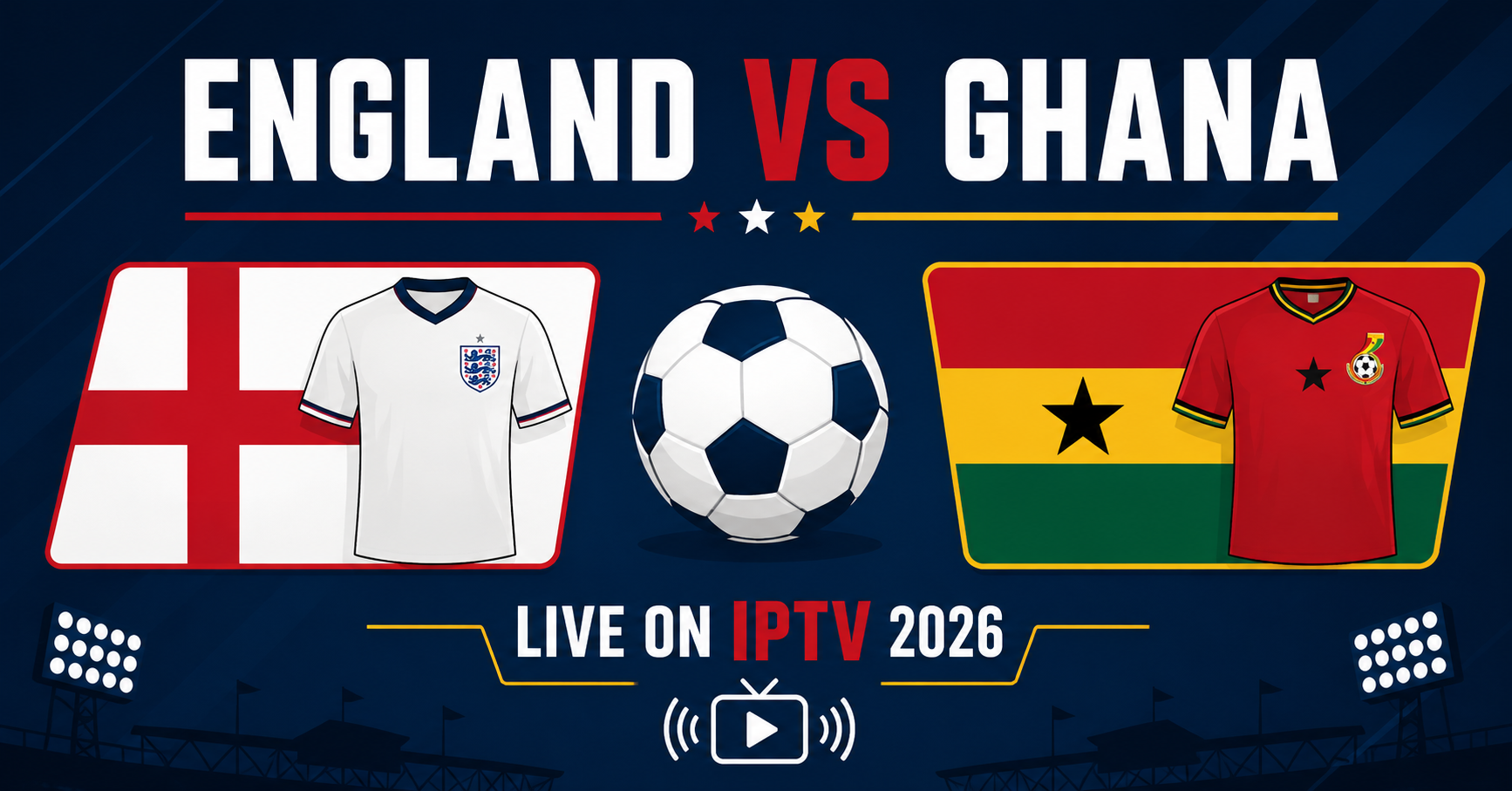
England play Ghana on Tuesday 23 June 2026 at Gillette Stadium in Foxborough, with a 9pm BST kick off (4pm ET). In the UK the match airs free on the BBC. In the United States the English language broadcaster is FOX, in Canada it is CTV and TSN through Bell Media, and in Australia it is SBS, free to air.
If you want this game live, the cleanest path is the official broadcaster in your country. If you are watching through an IPTV service or running one as a UK IPTV reseller, the single thing that decides your night is whether the infrastructure behind your stream has redundancy. Most buffering during a match like this is not your internet. It is a single overloaded source with no failover.
That is the whole answer. The rest of this explains why it happens and what separates a stream that holds from one that dies at kick off.
Where the match is actually being shown, country by country
Let me get the boring but important part out of the way, because half the people searching for this fixture just want to know which channel to open.
In the UK, England v Ghana will be shown live on the BBC, with coverage shared across the tournament between the BBC and ITV. Both are free, both have iPlayer and ITVX behind them. In the US, FOX Sports holds the English language rights and is committed to airing every match across FOX and FS1, with streaming through the FOX app. Spanish language coverage sits with Telemundo and Universo. Canadian viewers get CTV over the air plus TSN and RDS. Australia carries the tournament free on SBS, SBS Viceland and SBS On Demand.
Pro Tip:
If you only care about this one match and nothing else, the free to air option in your country will almost always be more stable than any paid stream, because national broadcasters provision their delivery for the whole nation watching at once. Resellers forget this. Your customer comparing your feed to BBC iPlayer is comparing you to a network built for tens of millions of simultaneous viewers.
Why this specific fixture punishes weak infrastructure
Group stage games involving England pull enormous concurrent traffic across every English speaking market at the same moment. That synchronisation is the problem. A normal evening spreads load across hours. A 9pm BST kick off collapses thousands of connection requests into the same sixty seconds.
Here is what we have watched happen, repeatedly, during exactly these spikes:
- Streams that ran perfectly for weeks suddenly stutter the instant kick off lands, because the source was never tested under genuine peak concurrency.
- Customers blame their own broadband, restart routers, and still complain, when the bottleneck was upstream the entire time.
- One unprepared IPTV reseller sees a month of churn arrive in a single evening, all of it traceable to ninety frozen minutes.
The fixture does not care how cheap your panel credits were. It tests the weakest link, and it tests it in front of everyone at once.
The single source trap, and what professional delivery looks like instead
Most stability complaints come down to one architectural decision. A cheap setup runs everything through one origin with no escape route. A serious setup assumes that origin will fail and builds around that assumption.
| Cheap setup | Professional setup |
|---|---|
| One origin source | Multiple origins across providers |
| No failover at kick off | Automatic failover within seconds |
| Single uplink | Backup uplinks ready to absorb load |
| Buffering when traffic peaks | Stays up through the spike |
| Nobody watching the system | Active monitoring during the match |
The difference is not the stream quality on a quiet Tuesday afternoon. Both look identical then. The difference only appears when ten thousand people connect inside the same minute, which is precisely what a marquee England game does.
Pro Tip:
Do a dry run forty eight hours before the match, not on the day. Point a real load at your source during an unrelated live event and watch the behaviour. If it wobbles under moderate traffic, it will fall over under England v Ghana. Discovering this on match night is the most expensive way to learn it.
What ISP behaviour looks like during big tournament nights
Something resellers underestimate in 2026 is how active ISP level interference has become around large live sports. During a major sports event we have repeatedly noticed unusual routing behaviour, sudden latency on specific upstream paths that were clean an hour earlier. This is not always deliberate throttling. Sometimes it is congestion. Sometimes it is automated traffic shaping that has gotten far more sophisticated, fingerprinting patterns rather than just blocking known addresses.
The practical effect is the same either way. A path that delivered a clean England vs Ghana live on IPTV 2026 feed at 8pm can degrade by kick off as the whole region floods the same routes.
What actually helps:
- Geo aware routing that does not funnel every customer down one path.
- More than one uplink so a degraded route can be abandoned mid stream.
- Monitoring that tells you a path is failing before your customers do.
The operators who survive these nights are not the ones with the cheapest source. They are the ones who assumed the network would misbehave and planned an alternative before it did.
A short field story about churn
A few seasons back I reviewed the support log of a struggling IPTV operator after a tournament weekend. The pattern was brutal and clear. Almost every cancellation request that month landed within twelve hours of two high profile matches. Not spread out. Clustered. The customers were not unhappy with the service in general. They were unhappy about the two nights it mattered most and failed.
That is the lesson hiding inside this whole topic. People forgive a glitchy Wednesday afternoon. They do not forgive a frozen screen during England at the World Cup. A reseller panel that holds during these two or three nights a year retains customers through everything else.
What subscribers can actually do on their end
Not everything is the provider’s fault, and a subscriber is not helpless. If you are watching the match through any IPTV service, a few practical moves genuinely reduce your chances of a frozen screen.
Pro Tip:
Open your stream ten minutes before kick off, not at 9pm exactly. Half the buffering people experience is everyone connecting at the same second. Connecting early means your session is already established before the stampede. It is the cheapest fix nobody uses.
Beyond that, a wired connection beats Wi Fi for a live event, closing background devices frees up bandwidth, and having the official free to air broadcaster open in another tab is a sensible safety net for a match you do not want to miss.
For resellers: the panel side of a big match night
If you run a IPTV reseller panel, your job on a night like this is not selling, it is staying up. Trial conversions and pricing strategy mean nothing if the service embarrasses you during the one fixture your customers genuinely care about.
A few things that separate a calm IPTV reseller from a panicking one:
- Confirm your source has tested failover before the match, not theoretical failover on a spec sheet.
- Have a backup origin ready to switch to, and know how to switch it fast.
- Watch your panel actively during the match window rather than checking it after the tickets arrive.
- Communicate proactively. A sub reseller who hears from you before things wobble stays loyal. One who only hears silence churns.
The IPTV business owners who treat these tournament nights as the real test of their infrastructure, rather than a normal evening, are the ones still operating two seasons later. For panel owners and credit resellers, reliability during peak events is the entire reputation.
Frequently Asked Questions
What time is England vs Ghana live on IPTV 2026?
Kick off is 9pm BST on Tuesday 23 June 2026, which is 4pm ET in the United States. The match is at Gillette Stadium in Foxborough. Open your stream around ten minutes early to avoid the connection rush that causes most buffering at the exact kick off moment.
Where can I watch England vs Ghana legally?
In the UK it is free on the BBC. In the US the English language broadcaster is FOX. Canada has CTV and TSN, and Australia carries it free on SBS. These official broadcasters are the most reliable route and a sensible backup even if you also use IPTV.
Why does my IPTV stream buffer during big matches?
Usually it is not your internet. A synchronised kick off floods a single source with thousands of simultaneous connections. If that source has no backup uplink or failover, it stutters. Streams that look fine on quiet days fail under genuine peak concurrency.
How do resellers keep England vs Ghana live on IPTV 2026 stable?
A prepared IPTV reseller tests failover before the match, keeps a backup origin ready, and monitors the panel actively during the kick off window. The reseller panels that survive tournament nights are built on redundancy, not on the cheapest available source.
Is a wired connection better than Wi Fi for the match?
Yes. A wired connection is more stable during high demand events and removes one common point of failure. Combined with closing background devices, it meaningfully lowers your chance of a frozen screen during the game.
Can a single bad night really cause customer churn?
It can. After reviewing support logs across several operators, cancellations cluster heavily in the hours after a high profile match that failed. People forgive ordinary glitches. They rarely forgive a frozen England game.
Will ISPs interfere with the stream on match night?
Sometimes routes degrade during major sports events, whether from congestion or automated traffic shaping. Geo aware routing and more than one uplink give a stream somewhere to go when a path fails, which is why redundancy matters most on the busiest nights.
Quick execution checklists
For subscribers:
- Confirm your local official broadcaster as a backup (BBC, FOX, CTV, SBS depending on country).
- Open your stream ten minutes before the 9pm BST kick off.
- Use a wired connection where possible.
- Close background devices eating bandwidth.
For resellers:
- Run a load test on your source forty eight hours before the match.
- Confirm failover works in practice, not just on paper.
- Keep a backup origin you can switch to within seconds.
- Monitor the panel live during the kick off window.
- Message your customers proactively before any wobble, not after.
For sub resellers:
- Confirm with your panel owner that the source is tested for this fixture.
- Have your own customer support reply ready for the match window.
- Know who to contact upstream the moment a feed degrades.
- Do not oversell capacity you have not verified holds under peak load.
If you want a deeper breakdown of stable reseller infrastructure, the team behind britishreseller.com has written extensively on building IPTV Reseller panels that survive exactly these traffic spikes.
England vs Ghana live on IPTV 2026 is not really a question about which channel to open. It is a stress test. Quiet nights tell you nothing. The night ten thousand people connect at the same second tells you everything about whether your setup, or your iptv provider, was built for the moment that actually matters.
One last thing worth remembering: the streams that fail at kick off almost never failed because of bandwidth. They failed because someone decided redundancy was an expense rather than the whole point. Build for the spike, not the average, and the marquee nights stop being the ones you dread.